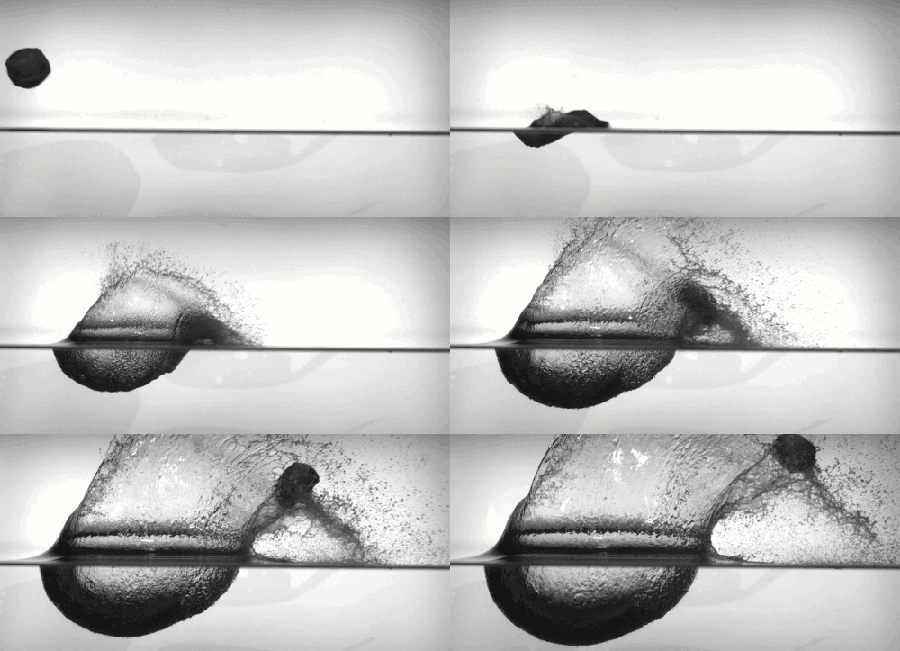
With the right shot, it’s possible to skip a bullet off water, as shown in this video from the Slow Mo Guys. The angle of the bullet relative to the water needs to be quite shallow, as this sets the bullet up for the hydrodynamic lift needed to skip. Physically, the mechanism for skipping a bullet is similar to rock-skipping. The bullet’s impact creates a cavity that the bullet rides. With the right conditions, the cavity orients the bullet upward, creating the lift needed to skip. (Video and image credit: The Slow Mo Guys)
Tag: skipping

The Skipping Dambusters
During World War II, the Allies developed “dambuster” bombs that skipped repeatedly off the surface of the water before striking their target. The goal was to cleverly bypass their enemies’ defenses both above and below the surface. Although the original dambusters used spinning spheres, the ricochet physics works for many other configurations as well; essentially, the physics are identical to rock-skipping. Conventional bullets can also skip off the water, though the required angle for skipping depends strongly on the shape of the bullet. If the geometry of the bullet impact doesn’t generate enough hydrodynamic lift, there will be no skip. (Image credit: Barnes Wallis Foundation, source; research credit: V. Murali and S. Naik, pdf; submitted by Marc A.)

Stone Skipping Physics
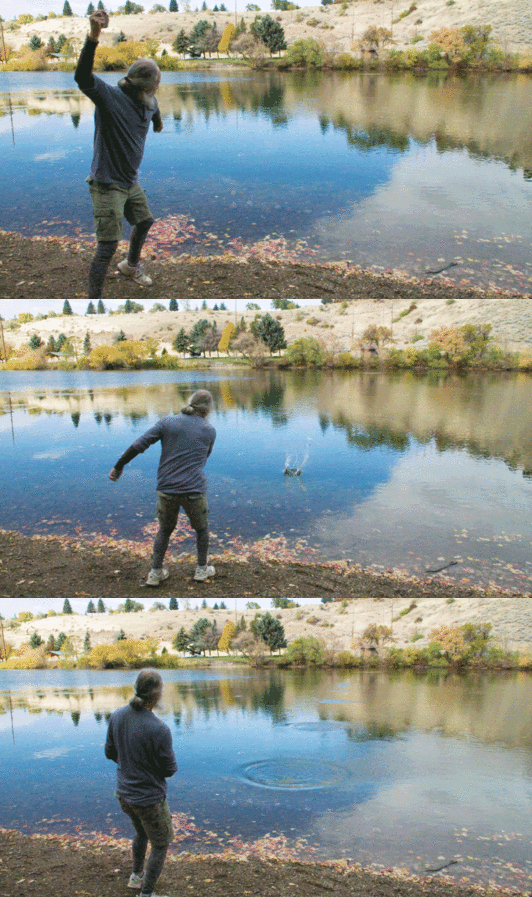
The current record for stone-skipping is about 88 skips. For most of us, that’s an unimaginably high number, but according to physicists, human throwers may top out around 300 or 350 skips. In the video above and the accompanying article, Wired reporter Robbie Gonzalez explores both the technique of a world-record-holding skip and the physics that enable it.
The perfect skip requires many ingredients: a large, flat rock with good edges; a strong throw to spin the rock and hold it steady at the right angle of attack; and a good first contact with the right entry angle and force to set up the skips’ trajectory. The video is long, but it’s well worth a full watch. It gives you an inside look both at a master skipper and at the experts of skipping science. (Video and image credit: Wired; see also: Splash Lab, C. Clanet et al.; submitted by Kam-Yung Soh)
ETA: Wired’s embed code is acting up, so if you can’t see the stone skipping video here, just go to the article directly.
Heads up for those going to the APS DFD meeting! You can catch my talk Monday, Nov. 19th at 5:10PM in Room B206. I’ll be talking about how to use narrative devices to tell scientific stories. I’ll be around for the whole meeting, so feel free to come say hi!

Skipping Squishy Spheres

Skipping a stone on water requires a flat, disk-like stone thrown at a shallow angle, but elastic spheres are remarkable skippers, too, even at higher impact angles. Researchers at the Splash Lab have just published their work on why these balls skip so well. As seen in the top animation, the elastic spheres deform on impact, flattening to a more disk-like shape that rides at an angle of attack relative to the air-water interface. Both features are important to the spheres’ enhanced skipping. By flattening, the sphere comes into greater contact with the water and by orienting at a larger angle of attack, the sphere increases the vertical component of force the water generates on the sphere. It’s this vertical force that lifts the sphere up and lets it keep bouncing.
Because the ball is soft, it keeps deforming after its impact and bounce (see top animation). For some skips, the timescale of the sphere’s elastic waves is smaller than the length of time the sphere is in contact with the water. When this is the case, the sphere’s elastic waves will affect the impact cavity in the water, forming what the researchers call a
matryoshka cavity, after the Russian nesting dolls. An example is shown in the second animation. For more, check out the USU press release, the original paper, or the award-winning video they made a few years ago. (Image credits: J. Belden et al./The Splash Lab)
If you enjoy FYFD and want to help support it, please consider becoming a patron!