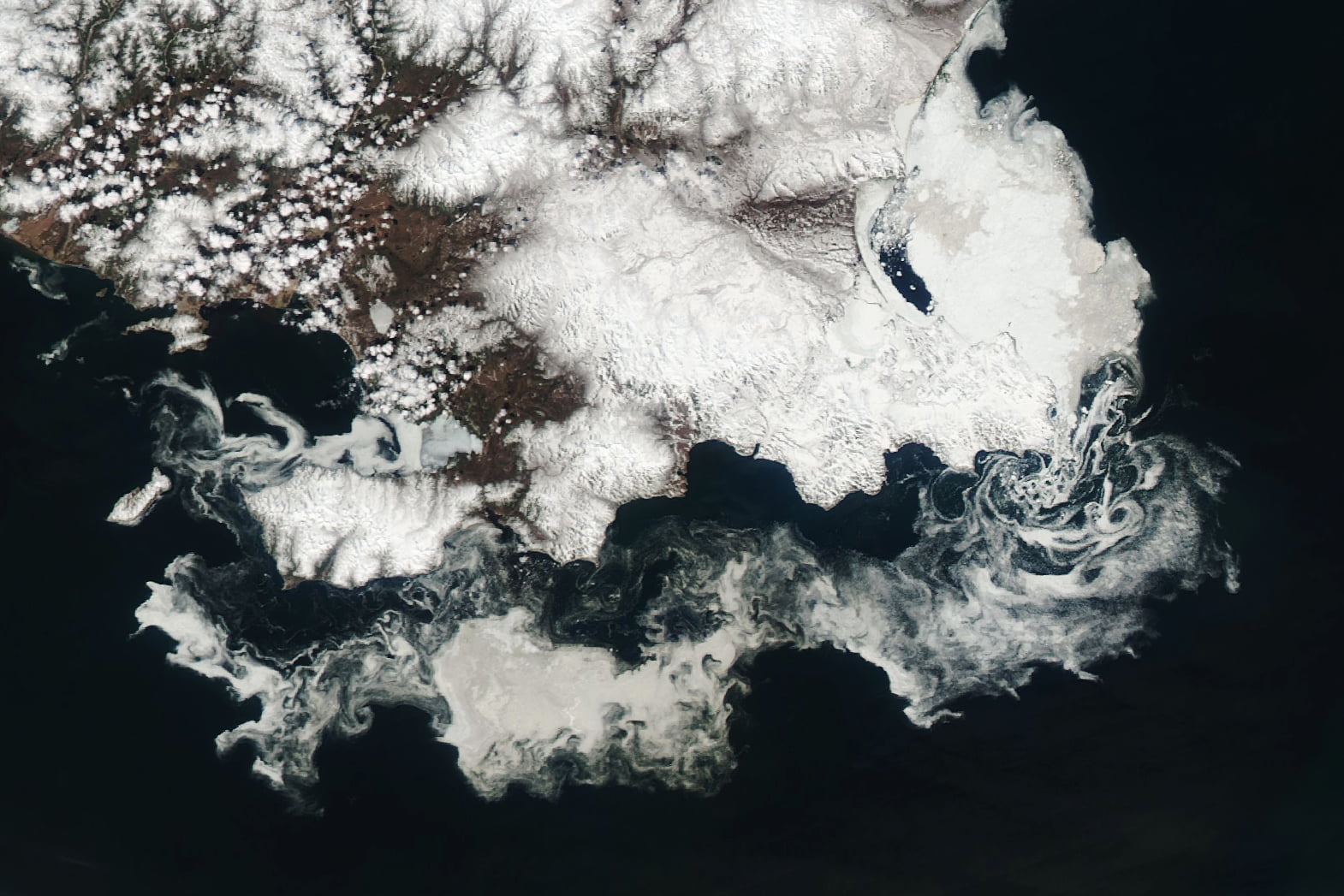
The Sea of Okhotsk is the northern hemisphere’s southernmost sea that seasonally freezes. Caught between the Siberian coast and the Kamchatka Peninsula, cold air from Siberia helps freeze water kept at lower salinity due to freshwater run-off. This image, taken in May 2023, shows free-floating sea ice forming spirals driven by wind and waves. Small islands off the eastern coast (right side in image) are likely responsible for the swirling eddies seen there. Like phytoplankton blooms and sediment swirls in warmer seasons, the sea ice acts as a tracer to reveal flow. (Image credit: W. Liang; via NASA Earth Observatory)
Tag: sea ice

Mushy Layers
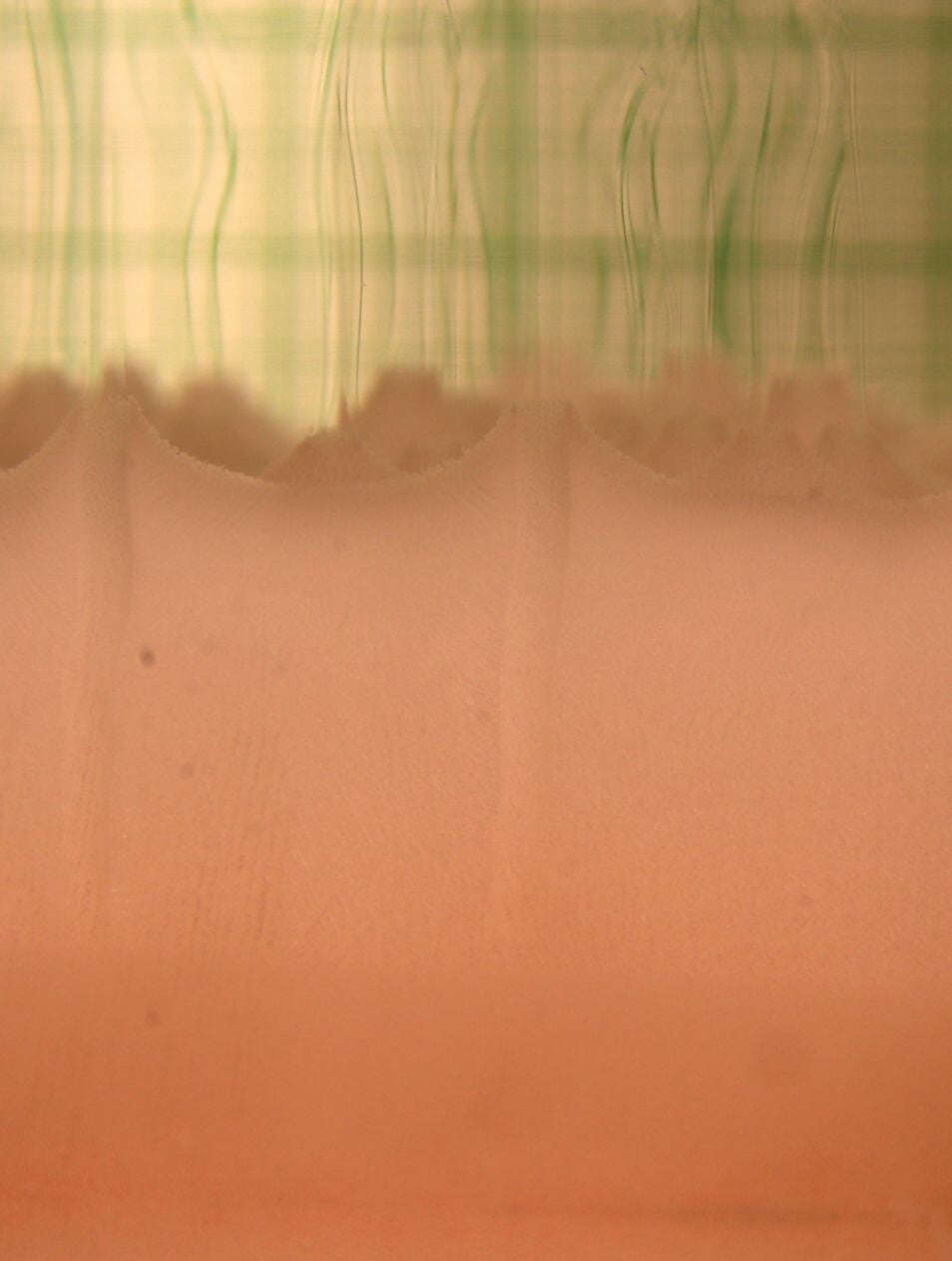
In many geophysical and metallurgical processes, there is a stage with a porous layer of liquid-infused solid known as a mushy layer. Such layers form in sea ice, in cooling metals, and even in the depths of our mantle. Within the mushy layer, temperature, density, and concentration can vary dramatically from one location to another.
The image above shows a mushy layer made from a mixture of water and ammonium chloride. Above the mushy layer, green plumes drift upward, carrying lighter fluid. Look closely within the mushy layer and you’ll see narrow channels feeding up to the surface. These are known as chimneys. In sea ice, chimneys like these carry salty brine out of the ice and into the seawater, increasing its salinity. See this Physics Today article for more details on the dynamics of mushy layers. (Image credit: J. Kyselica; via Physics Today)

Streaks of Sea Ice
As summer approaches in the Southern Ocean, sea ice melts, but the process is not purely one-way. Temperatures in some locations are cold enough for some limited new freezing. The result is a mix of ice conditions like those seen here. The oldest, thickest ice is part of the ice shelf in the image’s lower right. Normally, younger sea ice would nestle against this shelf, but strong winds have blown that ice north-eastward.
In the open waters between, delicate frazil ice — tiny needle-like crystals — forms. The wind, coupled with the wave motion, drives the frazil ice together to form streaks of nilas, which eventually accumulate into a layer along the older, broken, windswept ice. (Image credit: J. Stevens/USGS; via NASA Earth Observatory)

Icy Swirls
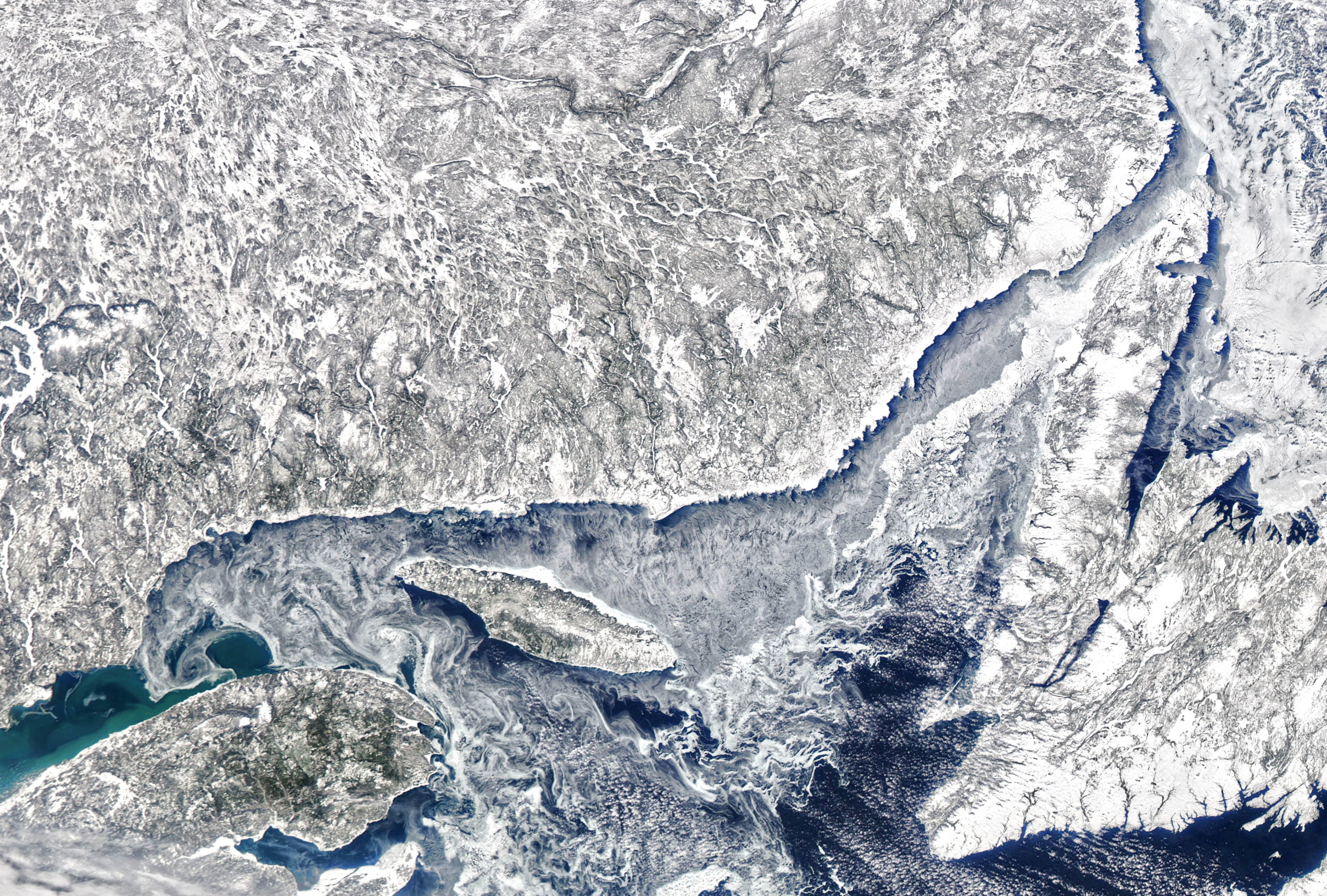
Rafts of sea ice follow swirling eddies in this satellite image of the Gulf of St. Lawrence. Just as with phytoplankton blooms and sediment, this thin sea ice can be moved by wind and currents to reveal hidden flow patterns. Experimentalists use many similar diagnostics that introduce bubbles, particles, smoke, and other tracers into flows to visualize motion that’s otherwise invisible. (Image credit: J. Stevens/NOAA/NASA; via NASA Earth Observatory)

Pancake Ice in the Sea
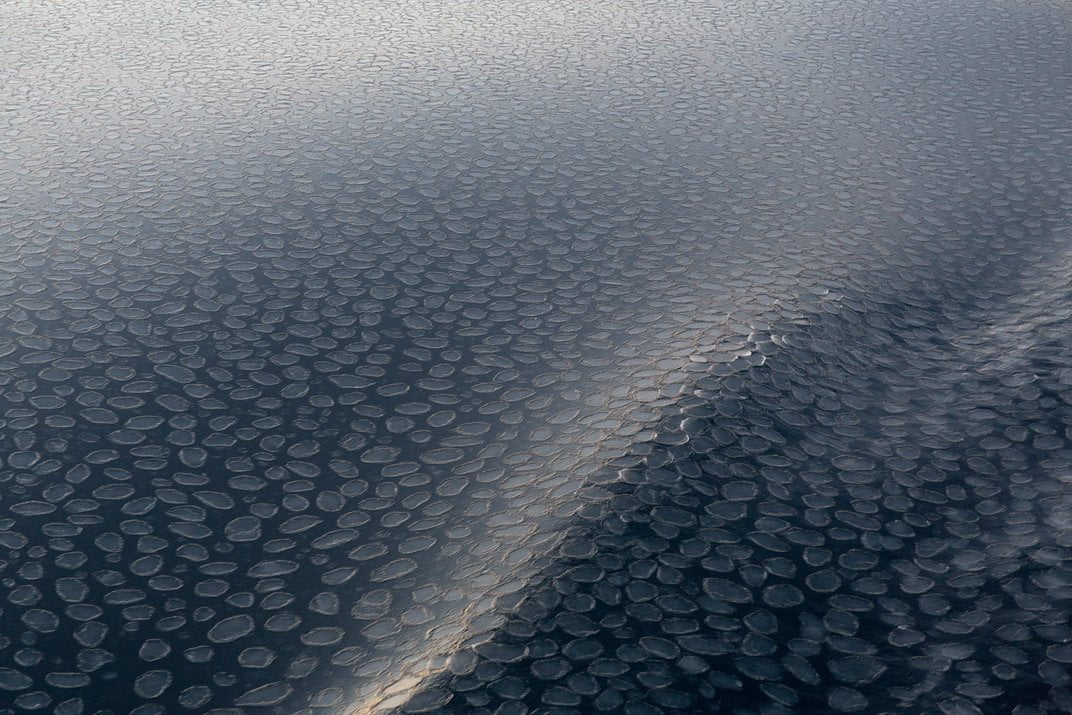
Sea ice forms in patterns that depend on local ocean conditions. Pancake ice, like that shown in the above photo from the Antarctic Ross Sea, is formed in rough ocean conditions. Each individual pancake has a raised ridge along its edge, due to wave-induced collisions with other pieces of ice. Over time the smaller pieces of ice will merge together, forming large sheets. Evidence of its turbulent formation will persist, however, in the rough surface of the ice’s underside. For more, check out the National Snow and Ice Data Center. (Image credit: S. Edmonds; via Flow Visualization)
Do you enjoy FYFD and want to help support it? Then please consider becoming a patron!
Reminder: If you’re at the University of Illinois at Urbana-Champaign, I’m giving a seminar this afternoon. Not in Illinois? I’ve got other events coming up, too!