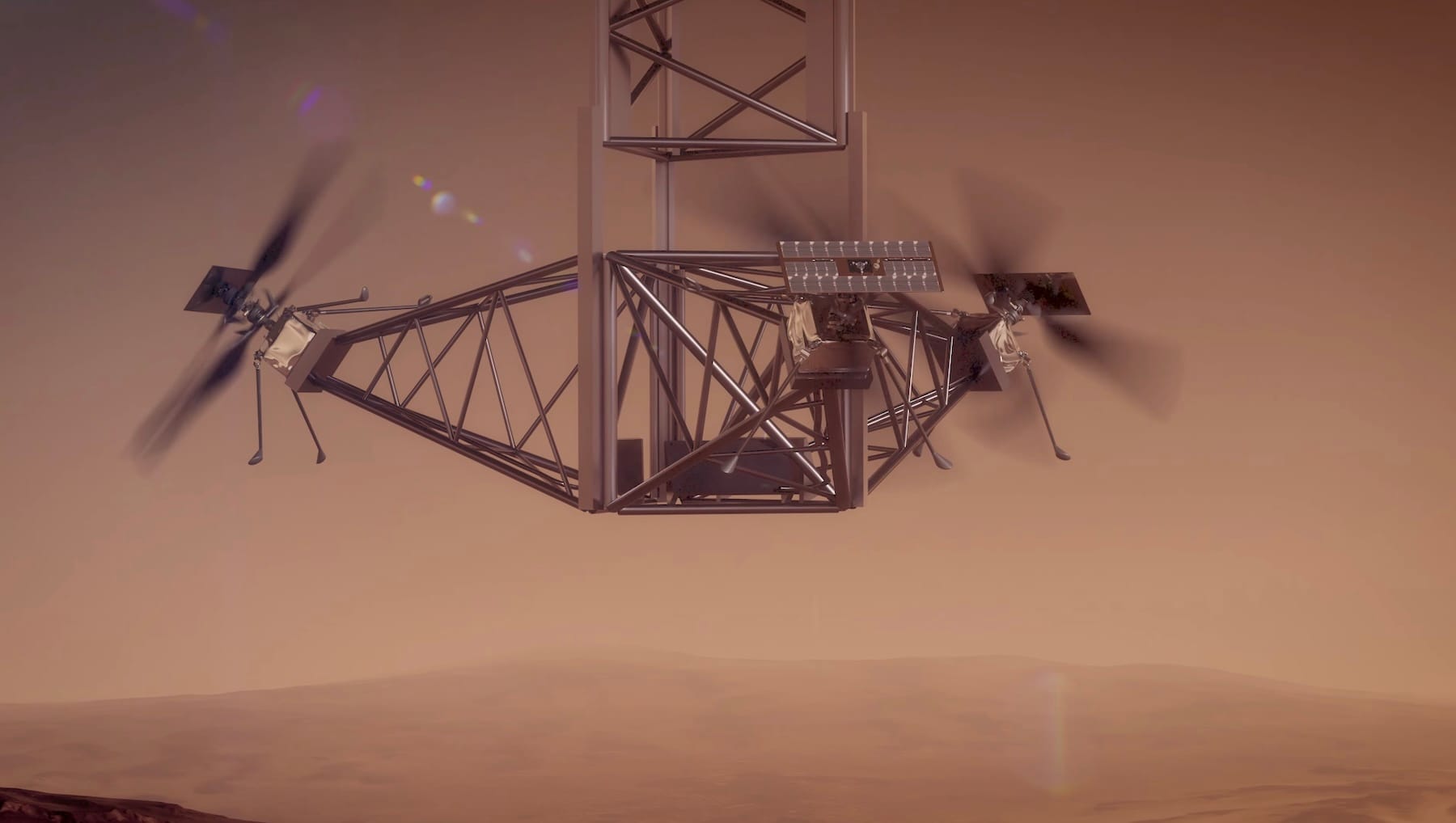
Tag: rotorcraft

  • Using Turbulence in Flight

    Using Turbulence in Flight

    When small, heavy particles are in a turbulent flow, they settle faster than in a quiescent one. Their interactions with turbulent eddies sweep them along, extracting energy that lengthens their overall path but reduces the time necessary for them to fall. Using the same principles, researchers are finding ways for rotorcraft and other vehicles to extract energy from turbulence for more efficient flight.

    The technique forces a vehicle to behave like a heavy particle by sensing turbulent gusts from its own accelerations and adding forcing to those accelerations when they are in the desired direction of flight. In essence, the vehicle uses the turbulence of its surroundings to find helpful tailwinds. (Image credit: A. Soggetti; research and submission credit: S. Bollt and G. Bewley)

  • Titan’s Dragonfly

    Titan’s Dragonfly

    Last week, NASA announced its next New Frontiers mission: a nuclear-powered drone named Dragonfly heading to Titan. This astrobiology mission is set to search our solar system’s second largest moon for signs of life. It’s exciting aerodynamically, as well, since Titan’s thick atmosphere makes it uniquely suited for heavier-than-air flight. Therefore, rather than using wheeled rovers like we have on Mars, Dragonfly is a rotorcraft. It will be capable of traveling up to 8km per flight, which will quickly surpass the fewer than 21km the Curiosity Rover has managed on Mars! 

    Like Earth, Titan has rainfall and open liquid bodies on its surface. I, for one, can’t wait to see the alien vistas Dragonfly sends back as it cruises over methane lakes. (Image and video credit: NASA)