Tag: Richard Feynman

  • Feynman’s Sprinkler Solved

    Feynman’s Sprinkler Solved

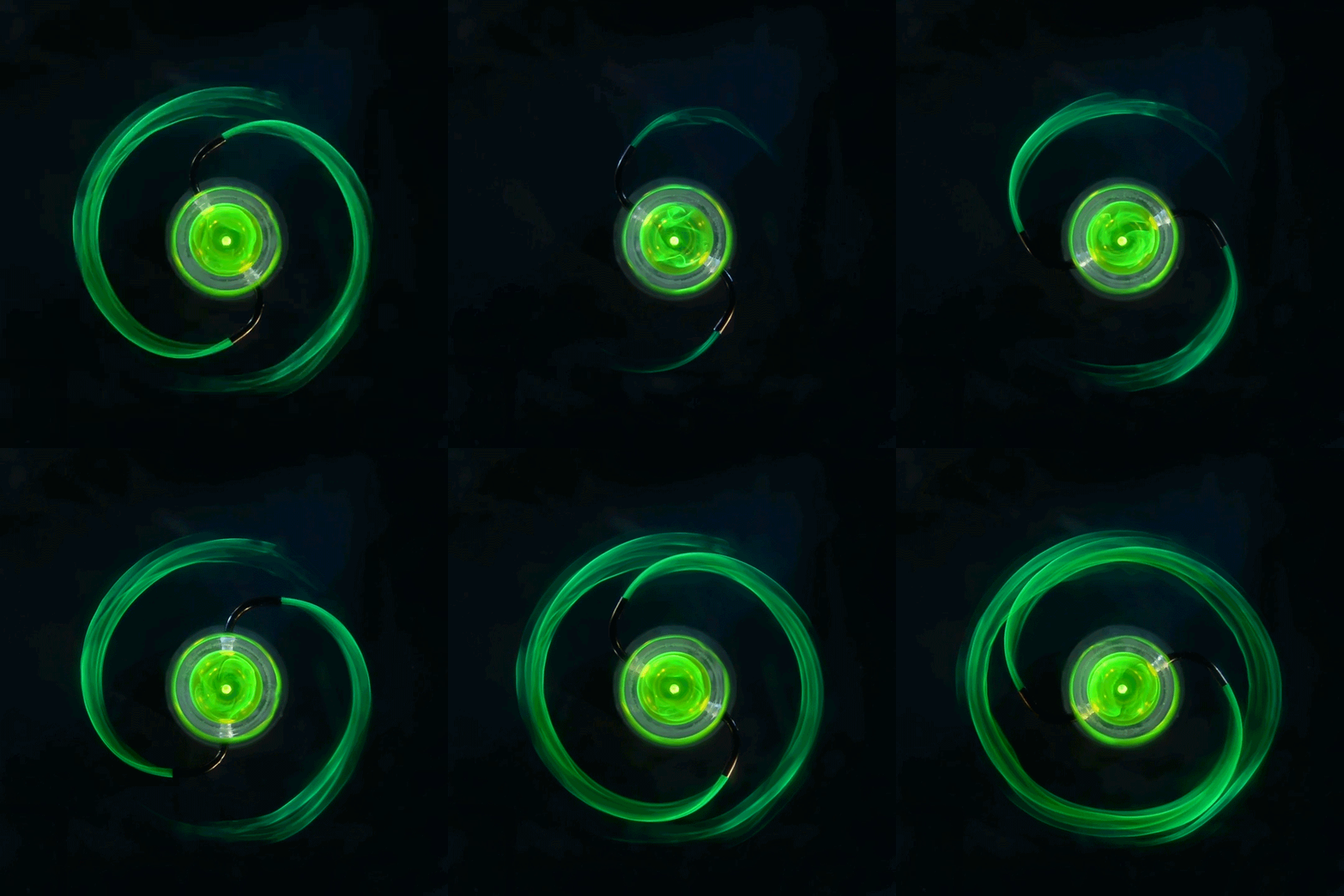
    In graduate school, my advisor introduced us to a particularly vexing fluid dynamical thought experiment known as the Feynman sprinkler. After observing an S-shaped sprinkler that rotated when water shot out its arms, physicist Richard Feynman wondered what would happen if the device were placed in a tank of water with the flow reversed. If the sprinkler was sucking in water, would it rotate and, if so, in what direction?

    This seemingly simple question has confounded physicists ever since, in part because you can make believable arguments for multiple different results. Attempts to build the apparatus experimentally produced differing results, too — often due to variables that don’t appear in the thought experiment, like friction in the sprinkler’s bearing. But, at long last, a group posits they have the final answer to the problem.

    Schematic of the "floating" sprinkler apparatus used in the experiment.

    They cleverly built their sprinkler so that it floats in its tank, with the addition or removal of water from the sprinkler controlled by a second siphon-connected tank. With no solid-solid contacts, the sprinkler can rotate with very little friction.
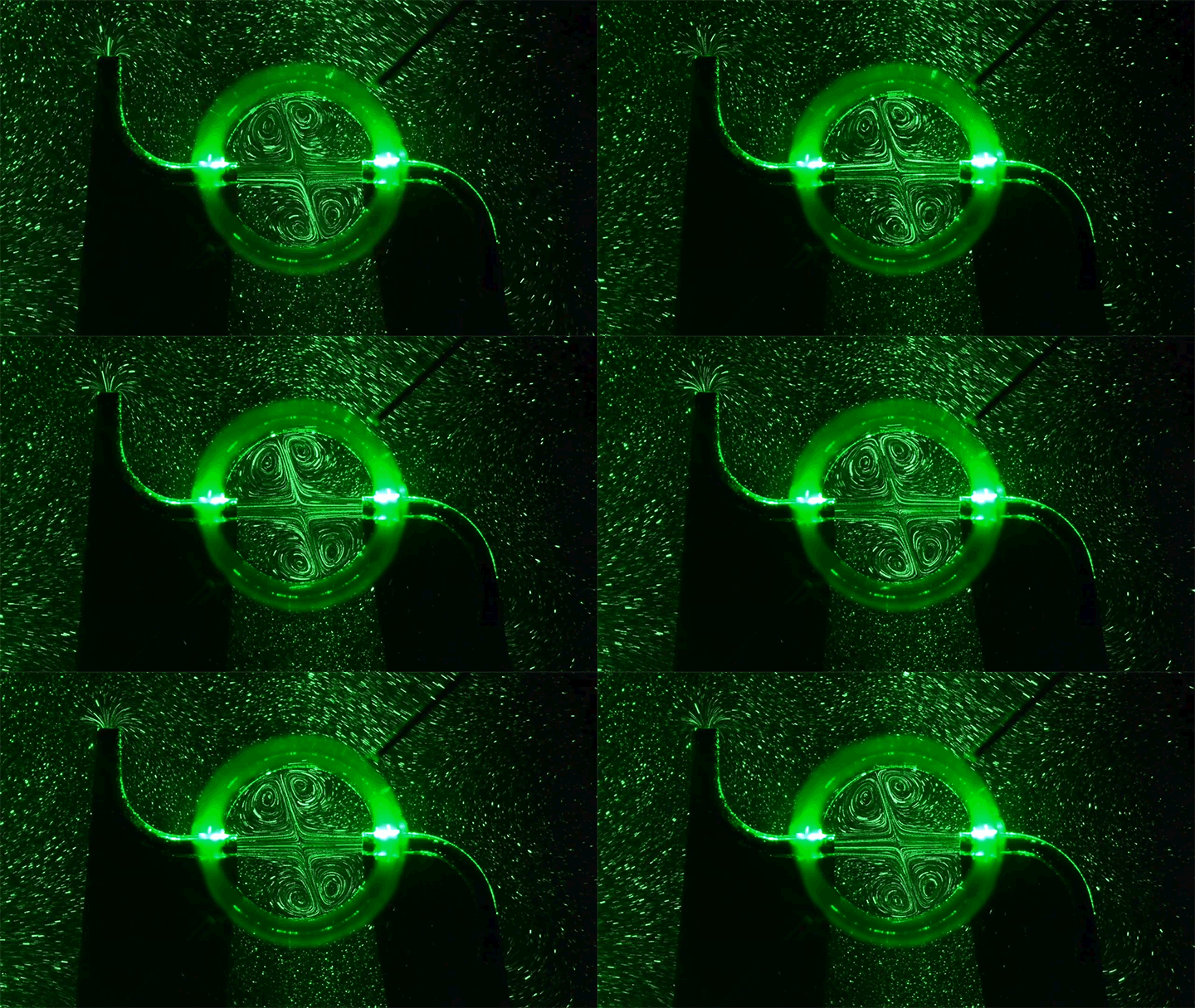
    Flow visualization of the sprinkler in reverse (suction) mode. For image clarity, the device is held in place to prevent spinning. Notice how the jets coming into the hub glance off one another and form counter-rotating vortex pairs at an angle. This asymmetry is the source of the sprinkler's rotation when allowed to move.
    Flow visualization of the sprinkler in reverse (suction) mode. For image clarity, the device is held in place to prevent spinning. Notice how the jets coming into the hub glance off one another and form counter-rotating vortex pairs at an angle. This asymmetry is the source of the sprinkler’s rotation when allowed to move.

    The team found that sucking water into the sprinkler does, indeed, reverse the sprinkler’s rotation, but it’s not a simple reversal of the forward sprinkler’s flow. To see why, check out the video above, which visualizes flow inside the sprinkler during suction. For clarity, the device is held fixed in place during flow visualization. Notice that the two arms of the sprinkler sit directly opposite one another in the hub. Thus, you’d expect their two jets to collide and form counter-rotating vortices along a vertical axis. But the vortex pairs are offset from the centerline.

    This asymmetry takes place because the velocity profiles of flow across the hub inlets are skewed. Instead of the largest velocity occurring on the centerline of the inlet, each occurs slightly to one side. So when the jets collide, they do so off-center and impart a torque to the sprinkler. The reason for the skewed profiles at the inlets lies further upstream in the curved arms of the sprinkler. Centrifugal force from turning the corner leaves a mark on the flow, leading, ultimately, to the skewed velocity profiles, offset jets, and spinning sprinkler. (Image and research credit: K. Wang et al.; via APS Physics)

  • Feynman: The Universe in a Glass of Wine

    Some wisdom for you this Friday from the incomparable Richard Feynman:

    A poet I think it is who once said the whole universe is in a glass of wine. I don’t think we’ll ever know in what sense he meant that for the poets don’t write to be understood. But it is true that if you look at a glass of wine closely enough, you’ll see the entire universe.

    There are the things of physics: the twisting liquid, the reflections in the glass, and our imagination adds the atoms. It evaporates, depending on the wind and weather. The glass is a distillation of the earth’s rocks and in its composition, as we’ve seen, the secret of the universe’s age and the evolution of the stars. What strange array of chemicals are in a wine? How did they come to be? There are the ferments, the enzymes, the substrates and the products, and there in wine was found great generalization: all life is fermentation. Nor can you discover the chemistry of wine without discovering, as did Pasteur, the cause of much disease. How vivid is the claret, pressing its existence into the consciousness that watches it?

    And if our small minds for some convenience divides this glass of wine, this universe, into parts: to physics, biology, geology, astronomy, psychology and all, remember that nature doesn’t know it. So we should put it all back together and not forget at last what it’s for. Let it give us one final pleasure more: drink it up and forget about it all.

    (submitted by @jerrodh)