Tag: remote sensing

  • Predicting Landslides

    Predicting Landslides

    Landslides can cause catastrophic damage, but historically it’s been difficult to monitor susceptible slopes and predict when they’ll fail. But a recent study looking at the 2017 Mud Creek landslide in California shows that new methods could provide a heads up.

    The researchers used satellite data from the months preceding the landslide to study how areas on the slope moved relative to one another. Within their survey region, they found sub-regions where ground locations largely moved together. These sub-regions, called communities in the researchers’ parlance, were remarkably persistent, showing little variation over long periods. But 56 days before the landslide, the researchers saw a sudden change between the communities on the slope. They believe their methodology could help identify slopes in danger of imminent slides.

    So far, though, they’ve only applied this method to the Mud Creek landslide. It’s a promising start, but they’ll need to show that the technique works for other slides as well. If so, it will be a major step forward in landslide prediction. (Image credit: USGS; research credit: V. Desai et al.; via APS Physics)

  • Seeing Past the Surface

    Seeing Past the Surface

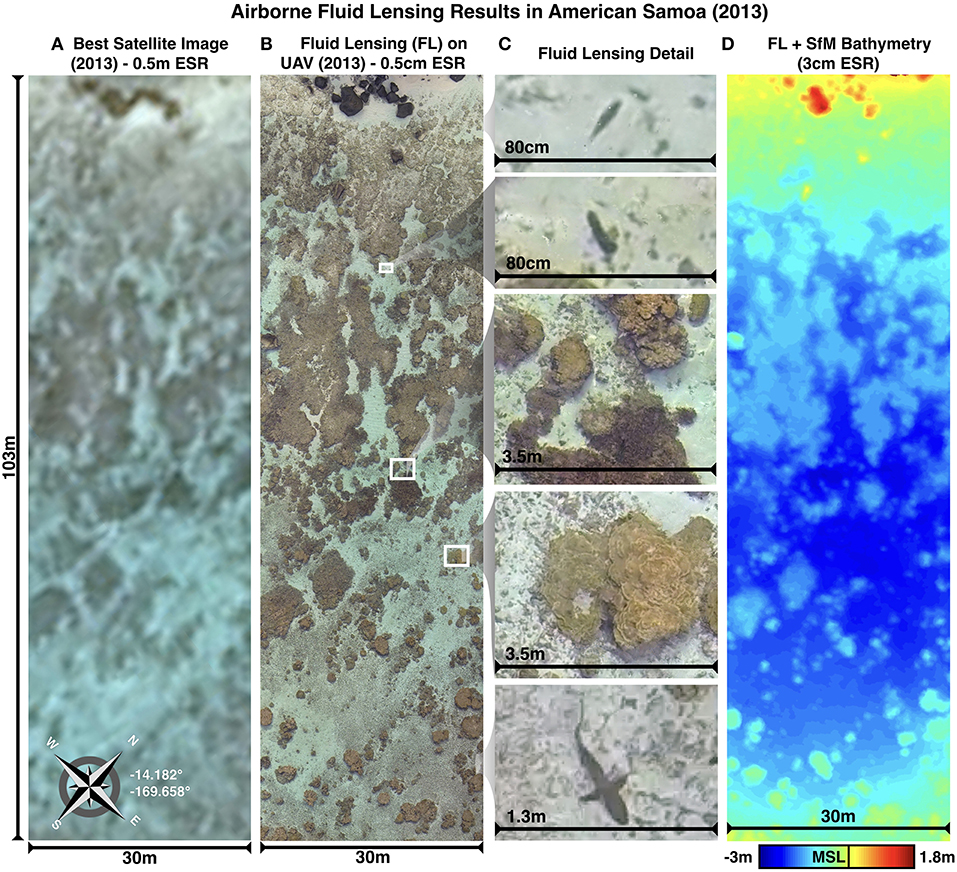
    Satellite imagery has revolutionized remote sensing and our ability to observe the world around us. But peering past the surface of water has always been next to impossible. We might be able to see the extent of a coral reef from a photo, but thanks to the interplay of light and water, the details are too blurry to identify what species we’re looking at.

    To solve this issue, researchers decided to work backwards, taking everything we understand about the physics of light – refraction, reflections, and so on – and using it to remove the distortions. The result is NASA’s FluidCam, an instrument capable of of taking a video of shallow waters less than 10 m deep, processing it, and producing images with sub-centimeter accuracy showing what lies beneath. Tests in American Samoa revealed details fine enough that scientists were able to identify multiple coral species as well as many of the species of fish inhabiting the reef. 

    With coral reefs changing quickly, this technology may be invaluable for monitoring coral health without actively disrupting these delicate systems. (Image credit: N. Usry; research credit: V. Chirayath and A. Li; via OceanBites; submitted by Kam-Yung Soh