Tag: reader question

  • Reader Question: Kinetic Sand

    Reader Question: Kinetic Sand

    An inquiring reader wants to know:

    How does kinetic sand work to make it flow like a liquid?  Thanks!

    – 3 Year Olds Everywhere

    I confess I don’t have any firsthand experience with Kinetic Sand, but it certainly looks fun. It’s a colorful, moldable sand toy that holds together far better than your typical pile of sand. From what I’ve been able to find, the secret ingredients are a little bit of polydimethylsiloxane (PDMS) — a type of silicon-based polymer — and olive oil, which coats the sand and keeps it from drying out.

    PDMS is viscoelastic, which is what gives the Kinetic Sand its unique properties. When a force is applied quickly, the material reacts like a solid, which is why you can mold or cut the sand and have it maintain its shape. But when left alone for awhile under gravity’s influence, the sand will flow like a liquid. This combination of behaviors usually comes down to the polymers in the material. When forces try to stretch these long molecules quickly, they resist; that’s what creates the elasticity of the material. On the other hand, when a force is gradual, the complex molecules have the time to untangle and relax, allowing the material to flow. (Image credit: Kinetic Sand, source)

  • Reader Question: Exoplanetary Life

    Reader orbiculator asks:

    I’ve been having this thought regarding biological adaptations to viscous mediums. In a hypothetical exoplanet where the ocean is this thick, aqueous gel – could we assume that the native macroscopic species would have morphologies similar to Earth’s plankton despite their large sizes? That is, instead of being propelled by fins like our fish and whales, they’d go around using large ciliar or flagella?

    Propulsion-wise, that’s a reasonable theory. If the ambient environment were viscous enough that macroscopic creatures would still be limited to laminar flow, then, yes, you could expect them to use something like cilia or flagella to move. They’d be restricted by the same reversibility that microscopic species are here on Earth.

    But there are other factors that could come into play. Many microscopic species rely on diffusion for survival, whether that’s chemical diffusion across their exterior or diffusion within their body. As a species gets larger, the distance diffusion has to occur across grows, and diffusion becomes harder and harder to sustain. 

    So while hydrodynamic constraints might result in an exoplanet’s fauna having features similar to Earth’s microscopic life, it probably wouldn’t be as simple as merely enlarging the species we see here on Earth. Some of the key biophysics that goes on inside cellular life as we know it just doesn’t hold at larger scales.

  • Featured Video Play Icon

    Pascal’s Barrel Follow-Up

    fuckyeahfluiddynamics:

    Pascal’s Law tells us that pressure in a fluid depends on the height and density of the fluid. This is something that you’ve experienced firsthand if you’ve ever tried to dive in deep water. The deeper into the water you swim, the greater the pressure you feel, especially in your ears. Go deep enough and the pressure difference between your inner ear and the water becomes outright painful.

    In the video demonstration above, you’ll see how a tall, thin tube containing only 1 liter of water is able to shatter a 50-liter container of water. Not only does this show just how powerful height is in creating pressure in a fluid, but it shows how a fluid can be used to transmit pressure over a distance – one of the fundamental principles of hydraulics! (Video credit: K. Visnjic et al.; submitted by Frederik B.)

    Reader @hoosierfordman77 writes:

    “They’re pressurizing the line by using a syringe sealed to the tube.  Of course, the volume of water in the tube added to this.  But it was not the only source of pressure.  Also explaining that pressure only has one vector as in the illustration using Hoover Dam is preposterous.  Sir [sic] later stated correctly that pressure is evenly distributed through the inside of a container.  If her demonstration was correct then the pressure of the water in lake Meade is not proportional to the volume of the lake…only proportional to its depth.  Now I’ve not done testing but I do not believe a 100,000 acre lake that’s 1 foot deep would be held back by the walls of a kiddie pool that routinely handle that depth.” (emphasis added)

    Hi, hoosierfordman77, thanks for your comment! It does seem counter-intuitive that pressure in a reservoir is proportional to depth, not volume, but it is correct. If you go swimming 1 meter below the water surface, the pressure you experience is the same whether you’re in a backyard pool or the Gulf of Mexico. And, yes, a 100,000 acre lake that’s 1 foot deep has a static pressure that could be withstood by a kiddie pool.

    Now engineers don’t build it that way for a couple of reasons. 1) Pascal’s Law only describes hydrostatic forces – that is, the force experienced when the water is motionless. In reality, a dam would need to withstand not only the hydrostatic forces caused by the water’s depth but also any forces exerted when the water moves due to wind action, temperature differences, etc. And 2) after evaluating all of the expected forces a structure will endure, engineers add a factor of safety to make the structure strong enough to withstand forces above and beyond what is expected in ordinary or extraordinary operation.

    As for the syringe, it only adds additional pressure to the line if they do not allow a gap for air in the line to escape. That can be a bit of a challenge, as they acknowledge in the video when they discuss the effects of air bubbles in the line. However, there is every indication that they were aware of this potential in their demonstration and did everything they could to ensure that it was not affecting the result. The fact remains, however, that extra pressure in the line is unnecessary – the 1 liter of water’s depth alone will shatter that container.

  • Reader Question: Submarines

    Reader Question: Submarines

    Reader elimik asks:

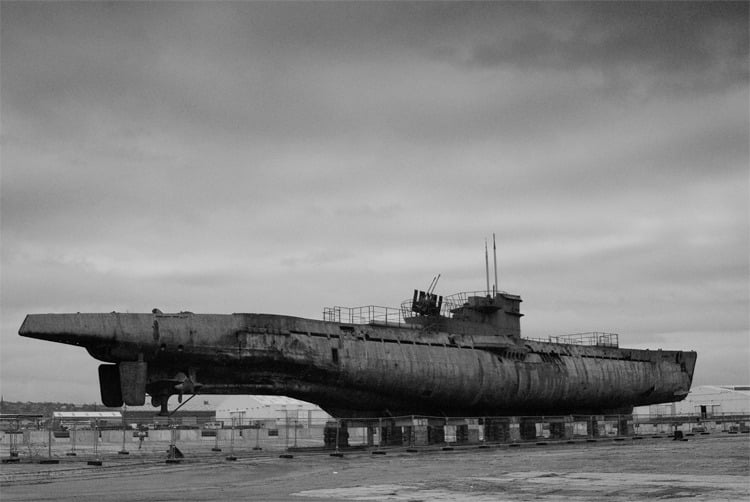
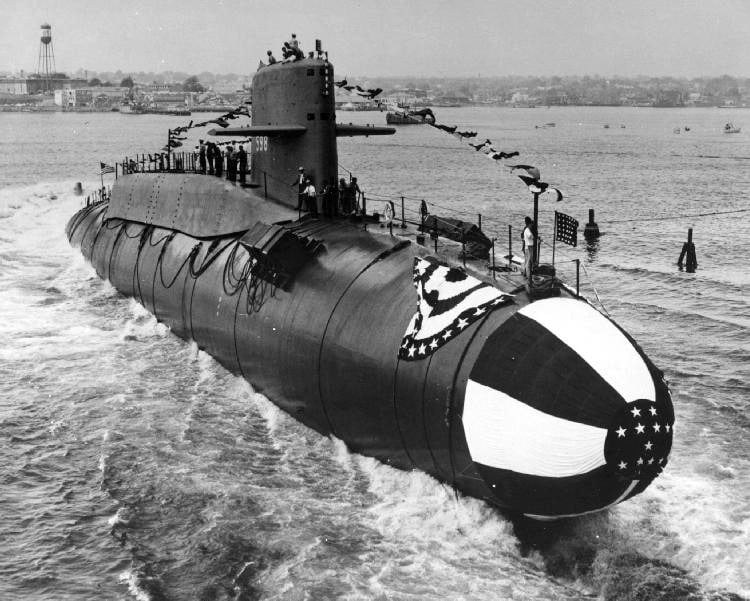
    Why do modern submarines have round bows instead of pointy ones, like the early WWII ones?

    Interestingly, there are more factors that affect this design choice than I originally thought! Perhaps the biggest factor, though, is propulsion. Although early submarines ran through several forms of propulsion from human power to steam, by World War II many subs were driven by diesel-power on the surface and relied on battery power when submerged. Power limitations meant that submarines of that era did most of their travel while at the surface, not underwater. As a result, the ships had better control and decreased drag with a pointed bow similar to that of a surface ship. It wasn’t until the advent of the nuclear-powered submarine that it became practical for submarines to spend most of their time submerged. Once fully-underwater travel was feasible (and, indeed, preferable), many subs transitioned to a blunter, rounded bow that’s more hydrodynamic underwater–and simultaneously more problematic control-wise when moving on the surface.

    Another factor separating WW-era submarines and modern subs is the depth to which they submerge. The deeper a submarine dives, the greater the pressure it must withstand. Rounded or cylindrical shapes make much better pressure vessels because they distribute pressure evenly around a surface. Historically, many subs have balanced control and hydrodynamics against pressure requirements by having two hulls, an outer one for cutting through surface waters and an inner cylindrical one that bears the brunt of the hydrostatic pressure. As we developed stronger materials, though, submarines have achieved greater depths. The German Type VII submarine, the most common U-boat of WWII, had a test depth of 230 m, whereas today’s Los-Angeles-class U.S. submarine can operate at 290 m. (Each 10 meters of depth adds about one atmosphere’s worth of pressure.) The combination of nuclear power for subsurface propulsion and stronger materials that allow deeper dives enables many modern submarines to have a single hull–the rounded hydrodynamic and pressure-resistant bow we commonly see.  (Image credits: U534 by P. Adams and USS George Washington by U.S. Navy)

  • Reader Question: What is Surface Tension?

    Reader Question: What is Surface Tension?

    Last week reader thesnazz asked:

    Is there a difference between surface tension and viscosity, or are they two manifestations of the same process and/or principles? If you know a given fluid’s surface tension, can you predict its viscosity, and vice versa?

    I’m tackling this one in parts, and you can click here to read about viscosity.

    Surface tension’s intermolecular origins are a bit clearer than those of viscosity. Essentially, within the interior of a water drop, you can imagine water molecules all hanging out with other water molecules. They tug on one another, but because they are surrounded on all sides by other water molecules, the net force of all these interactions on any molecule is zero. Not so at the surface of the drop. The surface is also called an interface; it’s a place where the fluid ends and something else–another fluid or perhaps a solid–begins. For a water molecule at that interface, the forces exerted by neighboring molecules are not balanced to zero. Instead, the imbalance causes the water molecules to be tugged inward. We call this effect surface tension.

    Because surface tension is an interfacial effect, it is not completely dependent on the fluid alone. For example, a drop of water sitting on a solid surface can take a variety of shapes depending on the properties of the solid (see also hydrophobicity) and the surrounding air as well as those of the water. This is only one of many manifestations of surface tension. Wikipedia has a pretty good overview of some others, if you’d like to learn more. Like viscosity, surface tension is usually measured rather than calculated from first principles.

    In the end, both surface tension and viscosity have molecular origins, but they are two very different and independent properties. Viscosity is inherent to a fluid, whereas surface tension depends on the fluid and its neighboring substance. Both quantities are more easily measured than calculated. Thanks again to thesnazz for a great question! As always, you can ask questions or submit post ideas here on Tumblr or via Twitter or email. (Image credit: Wikimedia)

  • Reader Question: What is Viscosity?

    Reader Question: What is Viscosity?

    Reader thesnazz asks:

    Is there a difference between surface tension and viscosity, or are they two manifestations of the same process and/or principles? If you know a given fluid’s surface tension, can you predict its viscosity, and vice versa?

    This is a good question! To answer it, let’s think about where surface tension and viscosity come from. Like many concepts in fluid dynamics, these quantities describe for a whole fluid the properties that arise from interactions between molecules.

    To prevent this becoming overly long, I’m going to tackle this over a couple posts. Today, I’ll talk about viscosity.

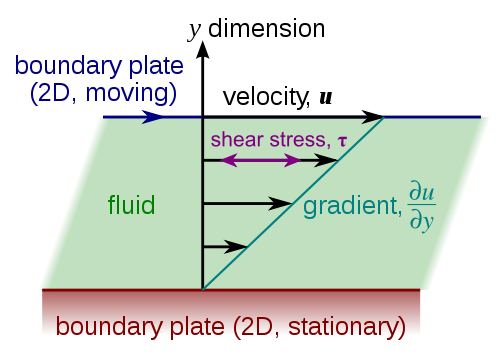
    One way to describe a fluid’s viscosity is as a measure of its resistance to deformation. Another way to think of it is how easily momentum is transmitted from one part of the fluid to another. The diagram above is the classic representation. A layer of fluid is sandwiched between two flat plates. If the top plate moves, friction requires that the fluid particles in contact with the plate get dragged along. This shears the fluid just below that and drags it along, but not quite as much. Those fluid particles do the same to their neighbors and so on down to the stationary second plate, where the fluid is at rest.

    Viscosity is the property that determines how much those neighboring fluid particles move; the more viscous the fluid, the more the neighboring bits of fluid resist getting pulled along. This is a property that’s inherent to a fluid. It comes from how the molecules of the fluid interact with one another, but there are no simple expressions to calculate the viscosity of a liquid or a gas from the individual interactions of its molecules. Instead we experimentally measure viscosity values and use empirical formulas to approximate how viscosity changes with temperature and other effects. (Image credit: Wikimedia)

  • Reader Question: Heat Shimmer

    Reader Question: Heat Shimmer

    Reader dialectical-induction asks:

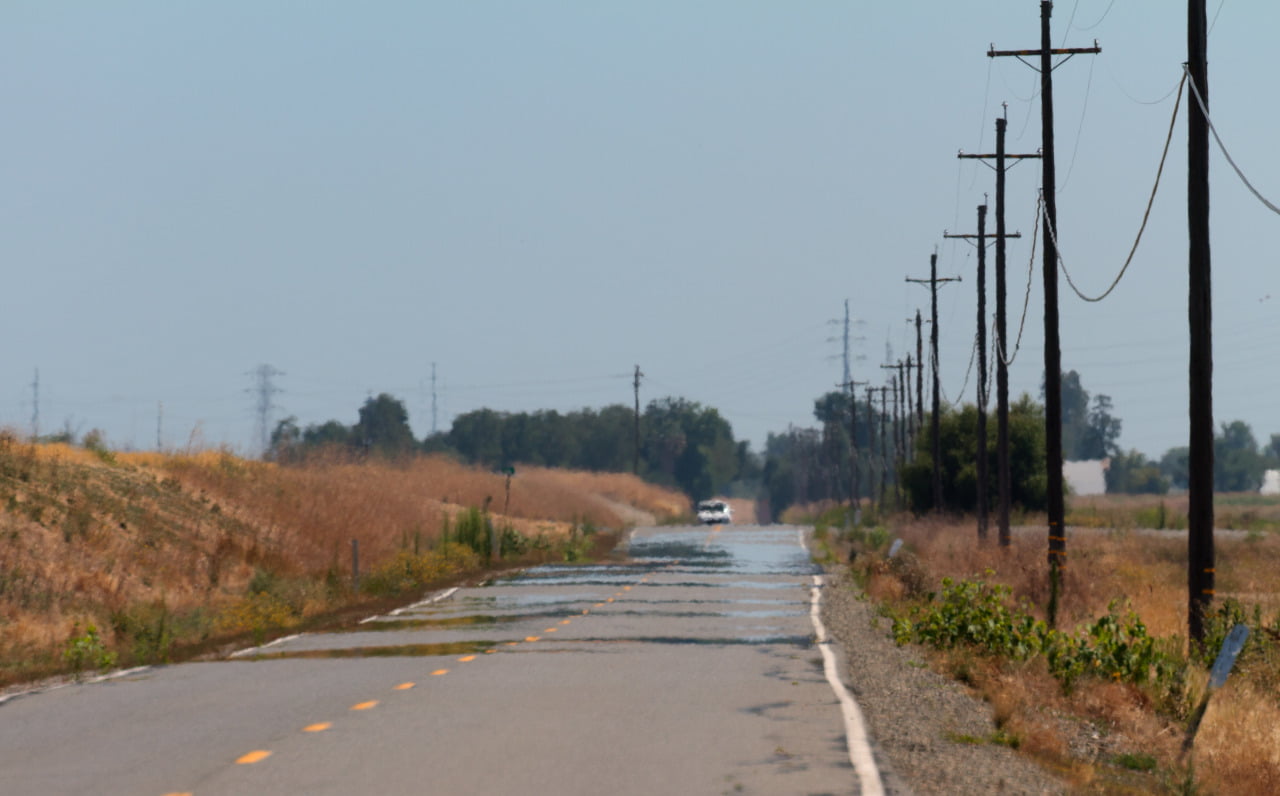
    Being as its pretty hot right now where I am, I was always curious, what exactly is occurring when the air is seemingly rippling on a hot day. I’ve noticed this phenomenon most often close to the pavement or anywhere where it’s really hot. Is it moisture in the air, off the pavement. What’s going on?!

    Good question! This is a pretty common optical illusion to observe, especially when driving on a hot day, and it goes by many names including mirage and heat shimmer. What’s happening is actually a case of refraction, much like when a straw in a glass of water looks bent. Near the ground, the air is significantly hotter (maybe 10 degrees Celsius) than the air about a meter above the surface. Changing air’s temperature also changes its index of refraction. When a ray of light passes from the layer of cooler air into the hotter air near the ground, it encounters a lower index of refraction and will bend upward toward the higher index of refraction. From an observer’s perspective, these distorted rays look like they are coming straight from the ground, making it look as if a refracted image of the sky is the ground. The brain will often interpret this as a spurious puddle reflecting the sky. Getting closer to the mirage makes it disappear because the light bends less (relatively speaking) as the angle between the observer and mirage source increases. The rippling effect you note is typically a result of this refraction occurring through hot, moving air. (Photo credit: M. Fern)