Some of the most important fluid dynamics goes on every moment inside our bodies. After only a few weeks of gestation, the human heart begins its lifelong task of pumping blood throughout tens of thousands of kilometers’ worth of blood vessels. One of our simplest methods for tracking the health of this critical system is a person’s blood pressure, which measures the forces exerted on our blood vessels as our hearts pump. This video gives a brief primer on blood pressure as well as some of the problems that arise when extended bouts of high blood pressure damage our blood vessels. (Image and video credit: TED-Ed)
Tag: pulsatile flow

Inside a Heart
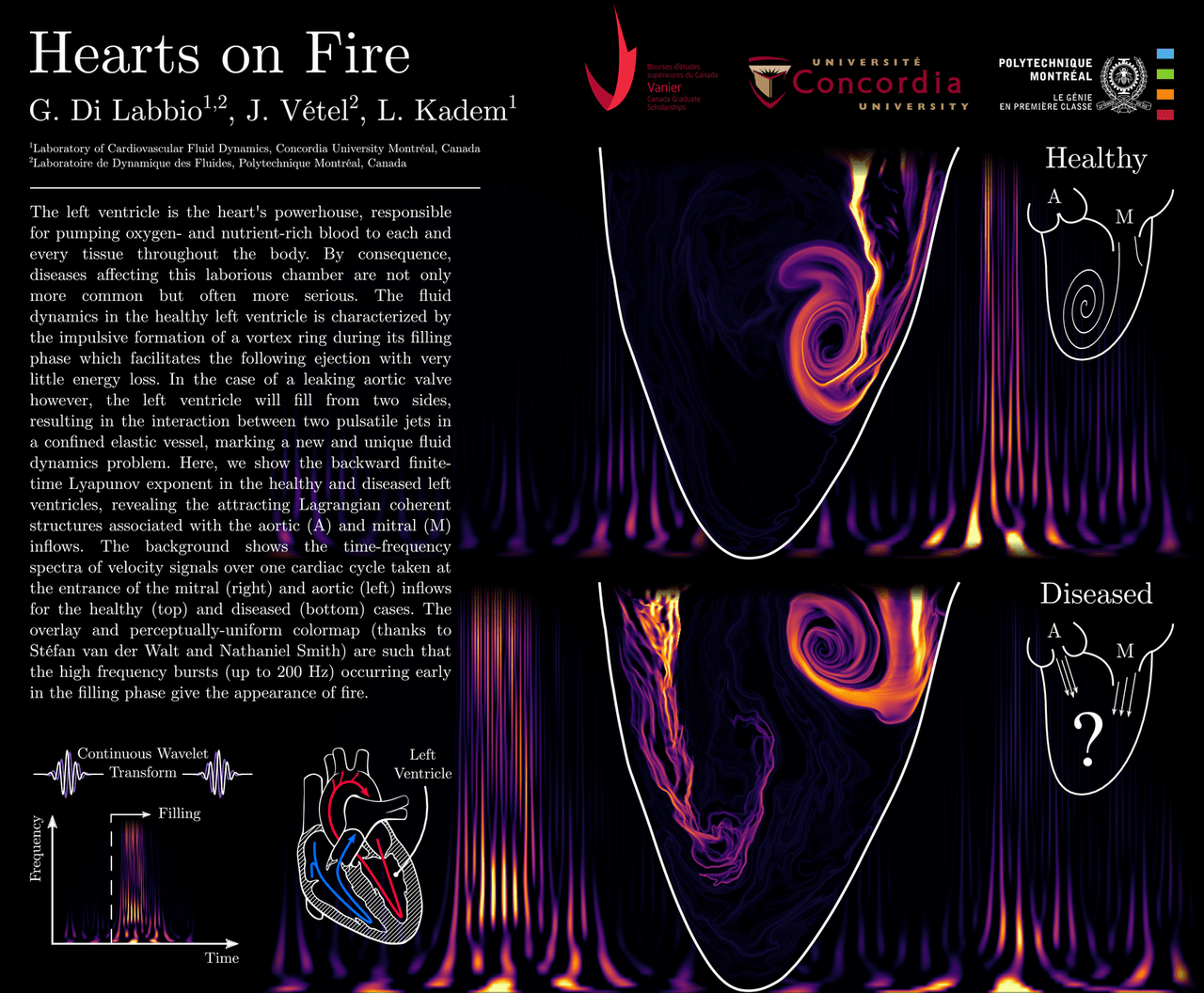
You may not give it much thought, but there is important fluid dynamics happening inside you every moment of every day, especially inside your heart. Of the four chambers of the heart, the left ventricle has the thickest walls, reflecting its important task: pumping oxygenated blood throughout the body. In a healthy heart (top of poster; click here for the full-size version), a vortex ring and trailing jet fill the ventricle when the mitral valve opens. Then the ventricle contracts and pumps blood out the aortic valve and into the rest of the body.
But for individuals with a leaking aortic valve (bottom of poster), things look different. Blood leaks back through the aortic valve at the same time that the mitral valve opens to allow freshly oxygenated blood back in. The two inflows disrupt mixing in the chamber, and, instead of pumping fully-oxygenated blood into the body, the left ventricle has to struggle to pump a less-oxygenated mixture into the body. (Image credit: G. Di Labbio et al.)
ETA: (Research paper: G. Di Labbio et al., arXiv)


