Tag: planetary core formation

  • Wobbling Plasma Could Help Planets Grow

    Wobbling Plasma Could Help Planets Grow

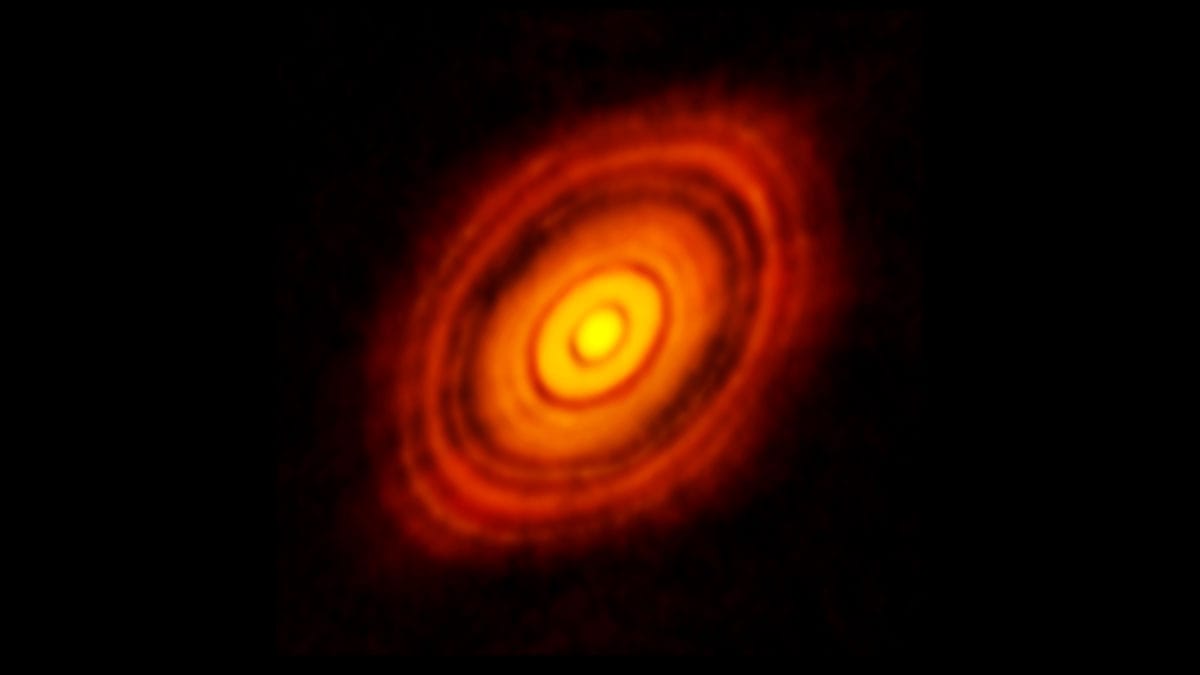
    To form planets, the dust and gas around a star has to start clumping up. While there are many theories as to how this could happen, it’s a difficult process to observe. A recent study shows that a magnetorotational (MR) instability could do the job.

    The team used a Taylor-Couette set-up (where an inner cylinder rotates inside an outer cylinder) filled with a liquid metal alloy. With the cylinders moving relative to one another at over 2,000 rotations per minute, the team measured how the magnetic field changed in the churning fluid. Parts of the liquid metal formed free shear layers, and within these, the MR instability occurred, causing some regions to slow down and others to speed up.

    The experiments suggest that triggering a MR instability is easier to achieve than once thought, which supports the possibility that it occurs in protoplanetary disks, helping to drive dust together into planets. (Image credit: ALMA/ESO/NAOJ/NRAO; research credit: Y. Wang et al.; via Eos)


    Fediverse Reactions
  • Featured Video Play Icon

    Simulating Early Planetary Impacts

    Early in our geological history, Earth was a hellish landscape of molten oceans into which metallic impactors would sometimes collide. Geophysicists have been curious how the impactors behaved after collision: did they maintain their cohesion, or did they break up into a cloud of droplets? Here the UCLA Spinlab simulates this early planetary formation by dropping liquid gallium through a tank of viscous fluid. As the video shows, the impactor’s behavior varies strongly with size. Smaller impactors stick together as a single diapir, but, as the initial size increases, the diapir becomes unstable, eventually breaking down into a cascade of droplets – a metallic rain through an ocean of magma. (Video credit: J. Wacheul et al./UCLA Spinlab; submitted by J. Aurnou)