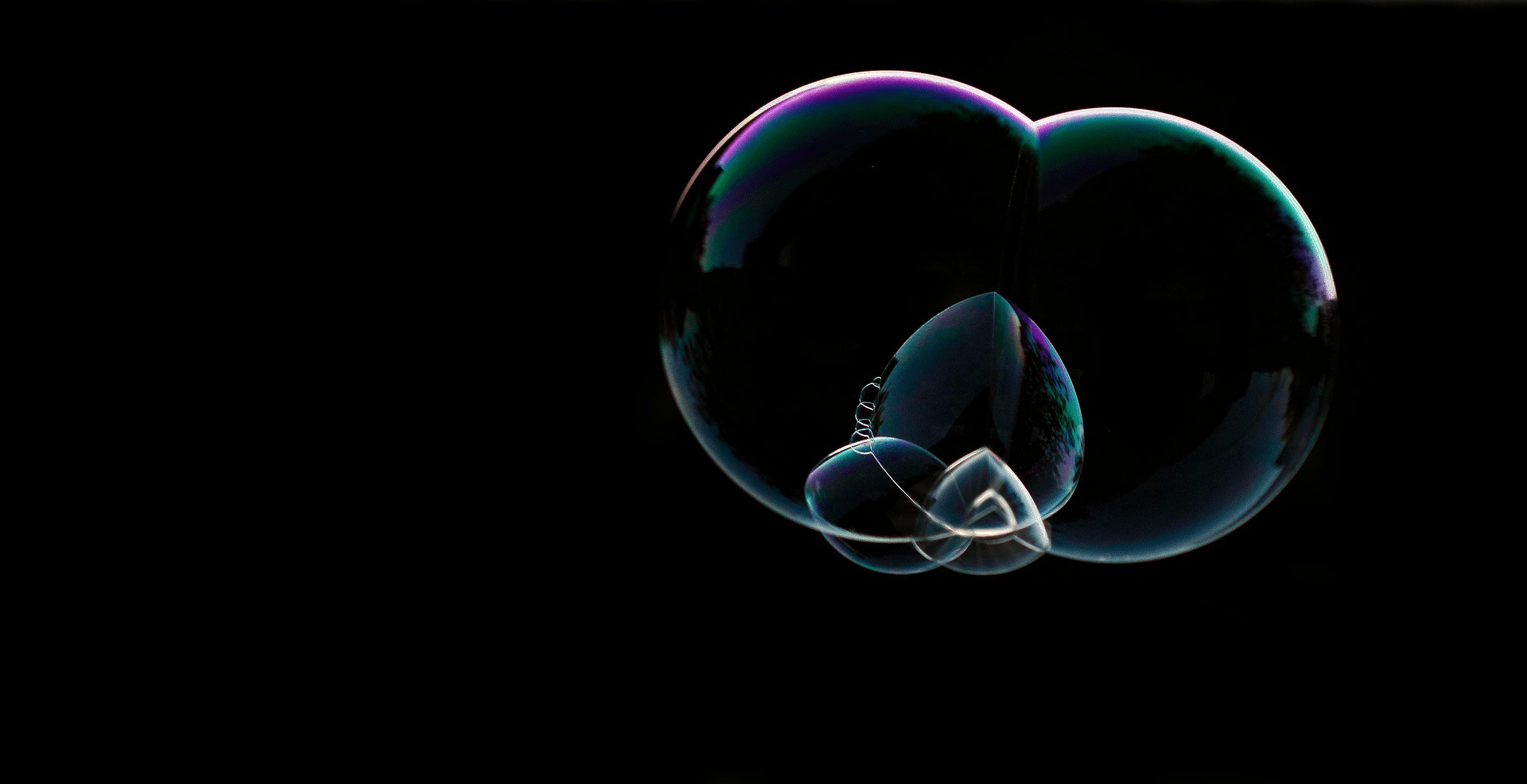
With a bubble wand, it’s quite easy to create clusters of two or more soap bubbles. These clusters seem to instantly find the lowest energy state, forming a shape that minimizes the cluster’s surface area (including interior walls) for the volume of air they enclose. But mathematicians have struggled for thousands of years to prove that this is actually the case.
In 1995, mathematician John Sullivan had a breakthrough conjecture, at least for some types of bubble clusters. A proof for double bubble clusters quickly followed. But then progress stalled out, with the triple bubble version seemingly out of reach. But now a duo of mathematicians have published proofs for Sullivan’s bubble clusters in triple and quadruple clusters. Learn their story over at Quanta. (Image credit: N. Franz; via Quanta Magazine)