Tag: optics

  • Seeing Past the Surface

    Seeing Past the Surface

    Satellite imagery has revolutionized remote sensing and our ability to observe the world around us. But peering past the surface of water has always been next to impossible. We might be able to see the extent of a coral reef from a photo, but thanks to the interplay of light and water, the details are too blurry to identify what species we’re looking at.

    To solve this issue, researchers decided to work backwards, taking everything we understand about the physics of light – refraction, reflections, and so on – and using it to remove the distortions. The result is NASA’s FluidCam, an instrument capable of of taking a video of shallow waters less than 10 m deep, processing it, and producing images with sub-centimeter accuracy showing what lies beneath. Tests in American Samoa revealed details fine enough that scientists were able to identify multiple coral species as well as many of the species of fish inhabiting the reef. 

    With coral reefs changing quickly, this technology may be invaluable for monitoring coral health without actively disrupting these delicate systems. (Image credit: N. Usry; research credit: V. Chirayath and A. Li; via OceanBites; submitted by Kam-Yung Soh

  • Underwater Optical Illusions

    Underwater Optical Illusions

    On a hot day, it’s not unusual to catch a glimpse of a shimmering optical illusion over a hot road, but you probably wouldn’t expect to see the same thing 2,000 meters under the ocean. Yet that’s exactly what a team of scientists saw through the cameras of their unmanned submersible as it explored hydrothermal vents deep in the Pacific Ocean.

    At these depths, the pressure is high enough that water can reach more than 350 degrees Celsius without boiling. The hot fluid from the vents rises and gets caught beneath mineral overhangs, forming a sort of upside-down pool. Since the index of refraction of the hot water is different than that of the colder surrounding water, we see a mirror-like surface at some viewing angles. Be sure to check out the whole video for more examples of the illusion. (Image and video credit: Schmidt Ocean; via Smithsonian; submitted by Kam-Yung Soh)

  • The Color of Droplets

    The Color of Droplets

    In nature, color comes from many sources: like the pigmentation of skin and hair, the structural iridescence of a butterfly’s wings, or the refraction of a rainbow from water droplets. Recently, scientists discovered another source of brilliant color in simple, hemispherical water droplets.

    When small droplets form on a transparent surface, they form concave shapes capable of total internal reflection. This means that two light rays entering from the same angle can follow different paths inside the droplet. After reflecting several times, the light rays exit the droplet with a phase difference and how large that phase difference is determines the color. Check out the video below for some brightly colored examples of the effect. The researchers hope the technique will eventually be suitable for creating dye-free, color-changing technologies. (Image credit: F. Frankel; video credit: MIT News; research credit: A. Goodling et al.)

  • Supernumerary Bows

    Supernumerary Bows

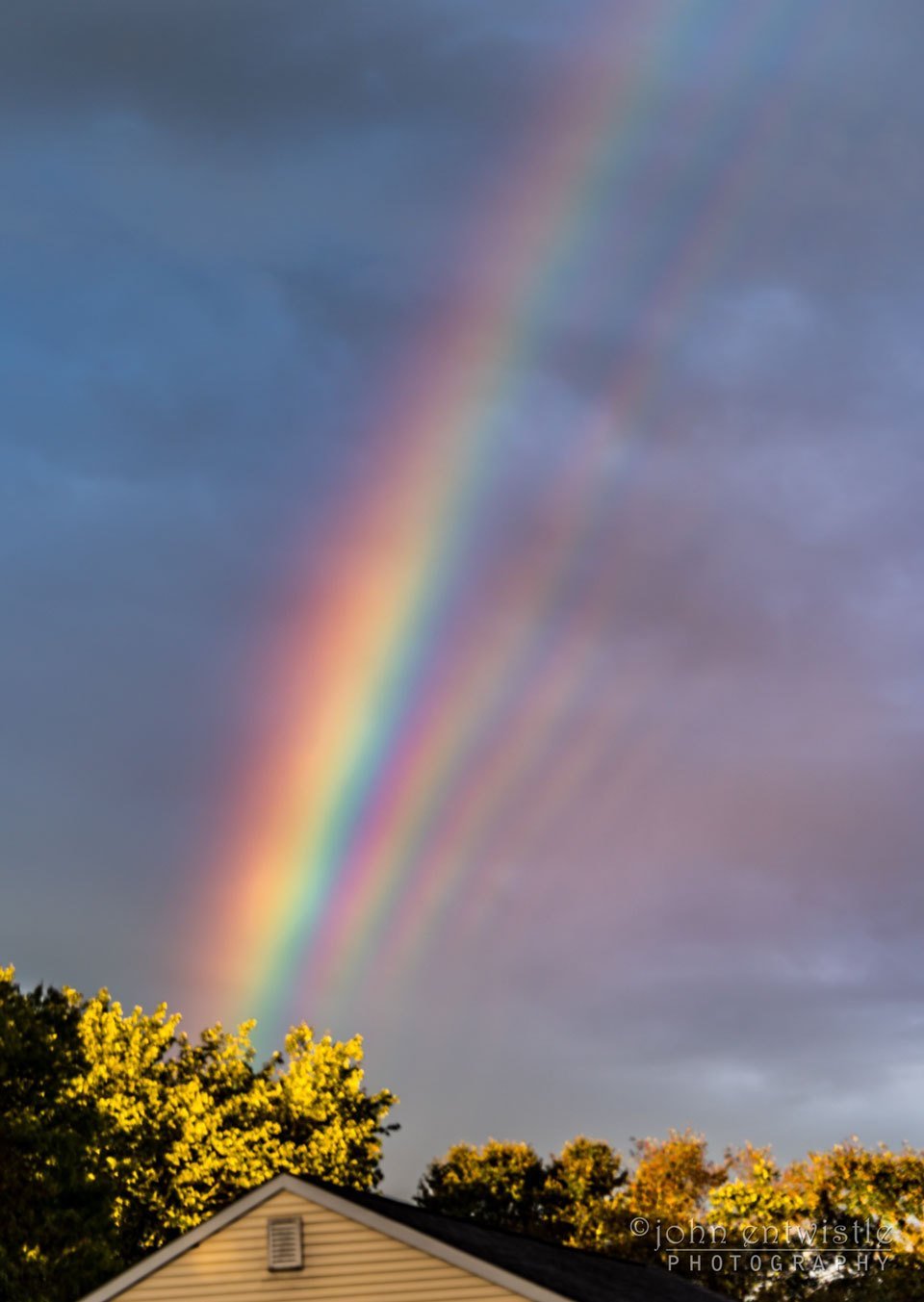
    After the rain of Hurricane Florence came the rainbow, or rainbows, in this case. Photographer John Entwistle captured this image of a rainbow with several additional supernumerary bows. The inner fringes seen here form when light passes through water droplets that are all close to the same size; given the spread seen here, the droplets are likely smaller than a millimeter in diameter. Supernumerary rainbows cannot be explained with a purely geometric theory of optics; instead, they require acknowledging the wave nature of light. (Image credit: J. Entwistle; via APOD; submitted by Kam-Yung Soh)

  • Featured Video Play Icon

    Songs in Soap

    There are many beautiful ways to visualize sound and music – Chris Stanford’s fantastic “Cymatics” music video comes to mind – but this is one I haven’t seen. This visualization uses a soap film on the end of an open tube with music playing from the other end. You can see the set-up here. The result is a fascinating interplay of acoustics, fluid dynamics, and optics. As sound travels through the tube, certain frequencies resonant, vibrating the soap film with a standing wave pattern (3:20). At the same time, interference between light waves reflecting off the front and back of the soap film create vibrant colors that show the film’s thickness and flow.

    When the frequency and amplitude are just right, the sound excites counter-rotating vortex pairs in the film (0:05), mixing areas of different thicknesses. With just a single note, the vortex pairs appear and disappear, but with the music, their disappearance comes from the changing tones. Watching the patterns shift as the film drains and the black areas grow is pretty fascinating, but one of the coolest behaviors is how the acoustic interactions are actually able to replenish the draining film (2:15). Because the tube was dipped in soap solution, some fluid is still inside the tube, lining the walls. With the right acoustic forcing, that fresh fluid actually gets driven into the soap film, thickening it.

    There are several more videos with different songs here – “Carmen Bizet” is particularly neat – as well as a short article summarizing the relevant physics for those who are interested. (Video and research credit: C. Gaulon et al.; more videos here)

  • Featured Video Play Icon

    Seeing the Invisible

    Schlieren photography is a common experimental flow visualization technique, especially in supersonic flows (where it enables one to see shock waves). Here the Science Channel’s “Cool Stuff: How It Works” show explains the technique and shows some examples from everyday life.

  • Featured Video Play Icon

    Seeing Shock Waves with Schlieren

    Schlieren photography is actually a pretty commonly used system in high-speed experimental aerodynamics. A typical schlieren system will shine a collimated light source on the target (a wind tunnel test section or, above, a candle), bounce that light off a mirror, block half the light with a knife-edge at the focal point, and then record the subsequent images with a camera (high-speed or otherwise). The density of air is closely related to its index of refraction, so light that hits air of a different density will be bent more or less than a neighboring ray. This uneven bending of the light rays due to density gradients is what causes the light and dark areas on the schlieren images. Since the density of air changes drastically across a shock wave, the schlieren system is perfect for visualizing shock waves and has, in fact, been used for that purpose since 1864!