Tag: nanoscale

  • Blocking Bubbles

    Blocking Bubbles

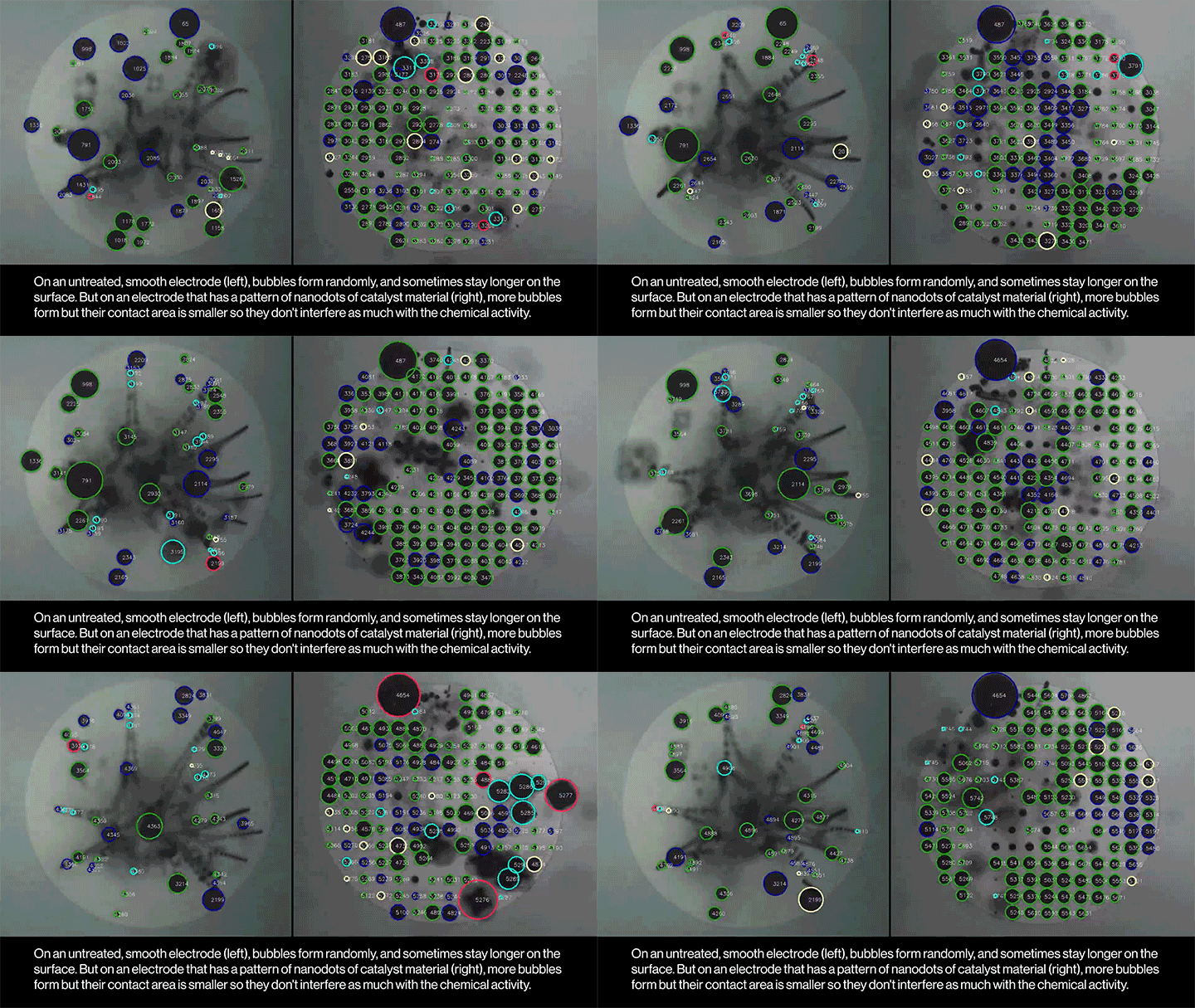
    Many industrial processes, including those producing aluminum and “green” hydrogen, use electrodes to speed up chemical reactions. Unfortunately, bubbles that form on the electrode reduce its efficiency anywhere from 10 to 25 percent by blocking parts of the electrode. The assumption has been that any area shadowed by bubbles is blocked, but a recent study shows that’s not the case. Instead, it’s only the electrode area in direct contact with the bubble that’s blocked.

    To show this, researchers looked at a smooth electrode where bubbles formed randomly (left) and a nanotextured one with many spots where bubbles could form (right). In the animation above, bubble shadows are highlighted with circles. There are clearly more bubbles on the nanotextured electrode, but it actually performs better than the smooth electrode because the bubble contact area is smaller. (Image and research credit: J. Lake et al.; via MIT News)

  • Featured Video Play Icon

    Sandgrouse Soak in Water

    Desert-dwelling sandgrouse resemble pigeons or doves, but they have a very different superpower: males can soak in and hold 25 milliliters of water in their feathers, which they carry tens of kilometers back to their chicks. The key to this ability is the microstructure of the bird’s breast feathers. Unlike other species, where feathers have hooks and grooves that “zip” them together, the sandgrouse’s specialized feathers have tiny barbules with varying bending stresses. When dipped in water, their curled shape unwinds, allowing water to soak in through capillary action. Barbules at the tips curl inward, holding the water in place so that the sandgrouse can fly home with it.

    Studying nature’s solutions for water-carrying will help engineers design better materials for human use, whether that’s a water bottle that avoids sloshing or a medical swab that’s better at absorbing and releasing fluids. (Image and video credit: Johns Hopkins; research credit: J. Mueller and L. Gibson; via Forbes; submitted by Kam-Yung Soh)

  • Featured Video Play Icon

    Rolling Off a Duck’s Back

    Ducks and other water fowl need protection from the elements. Fortunately for them, the structure of their feathers cleverly helps them shed water. As seen in this video, feathers have tiny hooks, called barbicels, that act like Velcro, zipping the individual barbs of a feather together to keep water out. When birds preen, they’re using their bills to rezip any sections that came loose. They also use their bills to spread a waxy substance onto the feathers to give them even more waterproofing. All together, these measures help the birds keep out cold water and trap warm air in the down near their skin. (Image and video credit: Deep Look)

  • Collecting Water in the Desert

    Collecting Water in the Desert

    Desert-dwelling plants like cactuses have to be efficient collectors of water. Many types of cactus are particularly good at gathering water from fog that condenses on their spines. Droplets that form near a spine’s tip move slowly but inexorably toward the base of the spine so that the cactus can absorb them. The secret to this clever transport lies in the microstructure of the spine’s surface. The

    Gymnocalycium baldianum cactus, for example, has splayed scales along its spines. Capillary interactions with the scales result in differences in curvature on either side of the droplet. Curved fluid surfaces generate what’s known as Laplace pressure, with a tighter radius of curvature causing a larger Laplace pressure. Because the curvature of the droplet varies from the base side to the tip side of the spine, the difference in Laplace pressures across the droplet creates a force that drives the droplet toward the spine’s base. (Image credit: C. Liu et al., source)