Tag: kinematic reversibility

  • Tiny Symmetric Swimmers

    Tiny Symmetric Swimmers

    Microswimmers live in a world dominated by viscosity, and in viscous fluids, symmetric motion provides no propulsion. That’s why bacteria and other tiny organisms use cilia, corkscrew flagella, and other asymmetric means to swim. But a new study decouples the symmetry of a swimmer’s motion from the motion of the fluid, thereby creating a tiny symmetrically-driven swimmer that does swim.

    Their microswimmer consists of two beads, which attract one another via surface tension and are repelled using external magnetic fields. This effectively creates a spring-like connection between the two beads, making them move in and out symmetrically in time. But since one bead is larger than the other, its greater inertia makes it slower to start moving and slower to coast to a stop. This inertial imbalance between the two is significant enough for the beads to swim. The key here is that though the beads’ motion relative to one another is symmetric, their motion relative to the fluid is not! (Image and research credit: M. Hubert et al.; via Science; submitted by Kam-Yung Soh)
  • Chaotic Mixing in Porous Media

    Chaotic Mixing in Porous Media

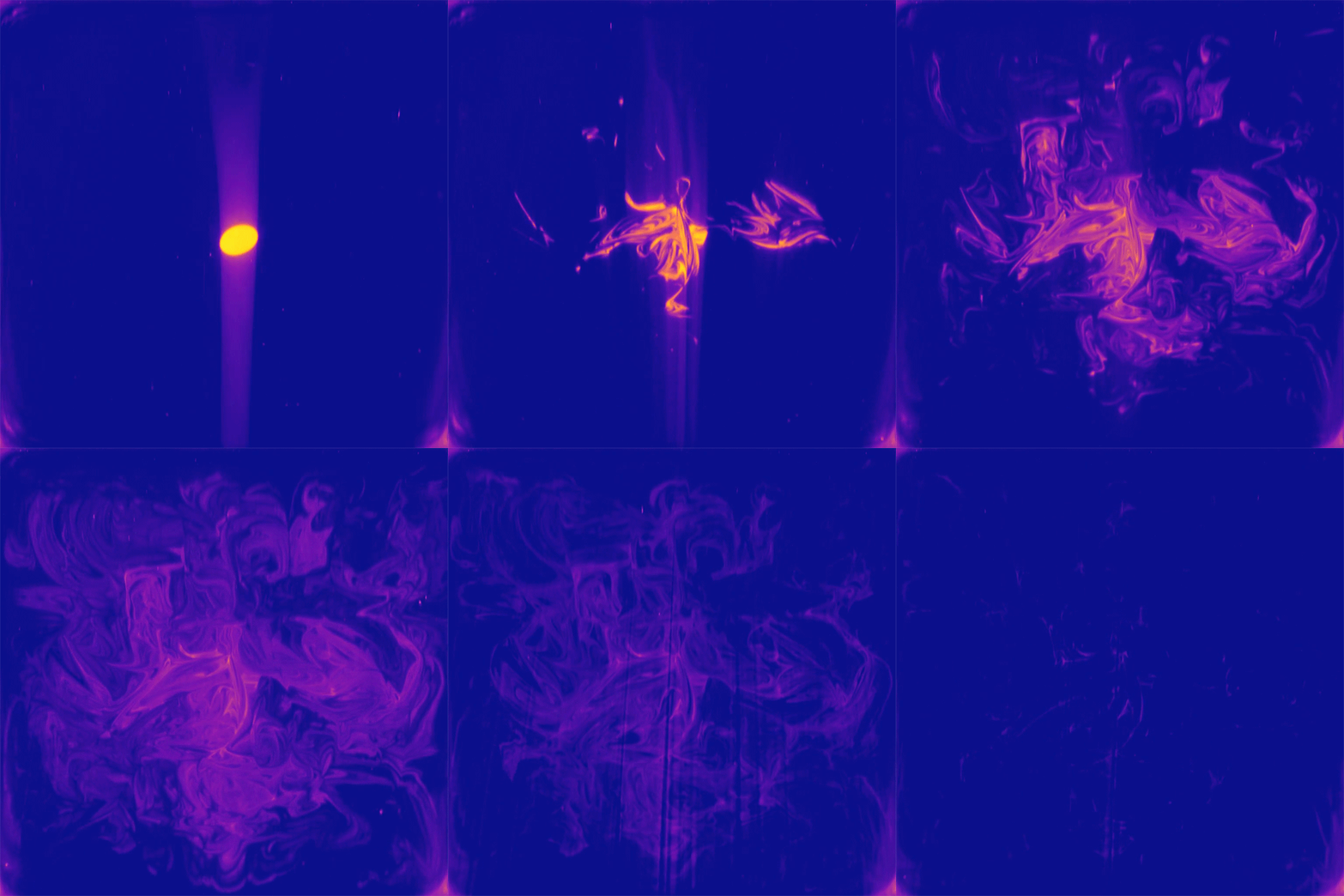
    One of the peculiar characteristics of viscous, laminar flows is that they are reversible. Squirt dye into glycerin, stir it one way, then the opposite direction, and the dye returns to its initial position. But this neat trick only works in simple geometries; in a more complex environment, like the pores between packed gravel, flows cannot make their way back to their initial state.

    That’s the idea at the heart of this new study of mixing in porous media. Researchers took a bed of packed beads and pushed a slow, steady flow of dye into the bed. Then they steadily withdrew fluid to reverse the flow and observed how the dye they’d injected appeared at the surface of the bed (top image). If the flow were perfectly reversible, we’d expect the dye to return to its injection point. But instead the dye is spread chaotically across the surface, giving researchers a snapshot of the chaotic mixing taking place between beads. (Image and research credit: J. Heyman et al.; via APS Physics)

  • Featured Video Play Icon

    Fluids Round-up – 13 October 2013

    There were so many good fluids links this week that I decided for an off-week fluids round-up. Here we go!

    (Video credit: #5facts/Sesame Street)

  • Featured Video Play Icon

    Swimming in Corn Syrup

    Highly viscous laminar flows exhibit kinematic reversibility, meaning: if you move the fluid one direction and then execute the same motion in the opposite direction, every fluid particle will return to its initial, undisturbed position. Above, you see a swimming device attempting to move through corn syrup by flapping. Because of this kinematic reversibility, it cannot propel itself. For the same reason, many microscopic organisms do not utilize flapping to move.