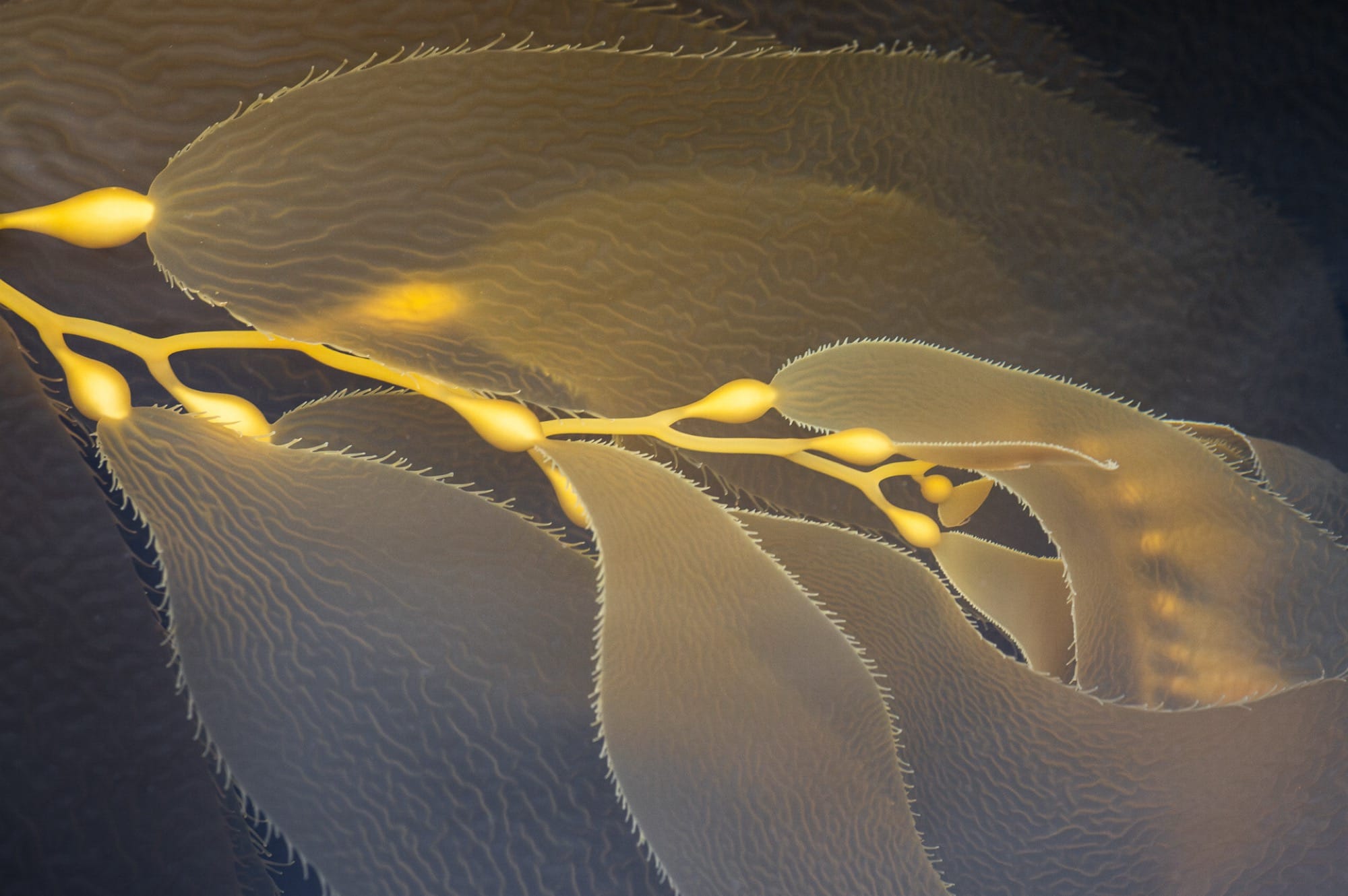
This CUPOTY-shortlisted photo by Sigfrido Zimmerman shows giant kelp drifting in the current. At the base of each blade is an inflated bladder that helps keep the algae buoyant. The blades themselves are furrowed on their surface, with patterns reminiscent of sand ripples. Though giant kelp can grow to as large as 60 meters, the species lives in constant flux, pushed and pulled by the currents that run along its length. (Image credit: S. Zimmerman/CUPOTY; via Colossal)
Tag: kelp

The Flutter of Kelp


Many species of kelp change their blade shape depending on the current they experience. In fast-moving waters, the kelp grows flat blades, but when the water around them is slower, the same plant will grow ruffled edges on its blades. In a slow current, the ruffled version’s extra drag causes it to flutter up and down with a large amplitude. That helps spread the blades out to catch more sunlight and increase photosynthesis, but it comes at the cost of higher drag, which could tear the plant from its holdfast.
In contrast, the flat-bladed kelp collapses into a more hydrodynamic shape. This clumps the flat blades together, making photosynthesis harder, but it streamlines the kelp, making it easier to resist getting ripped out by fast-moving tides. (Image credit: J. Hildering; research credit: M. Koehl et al.; submission by Marc A.)