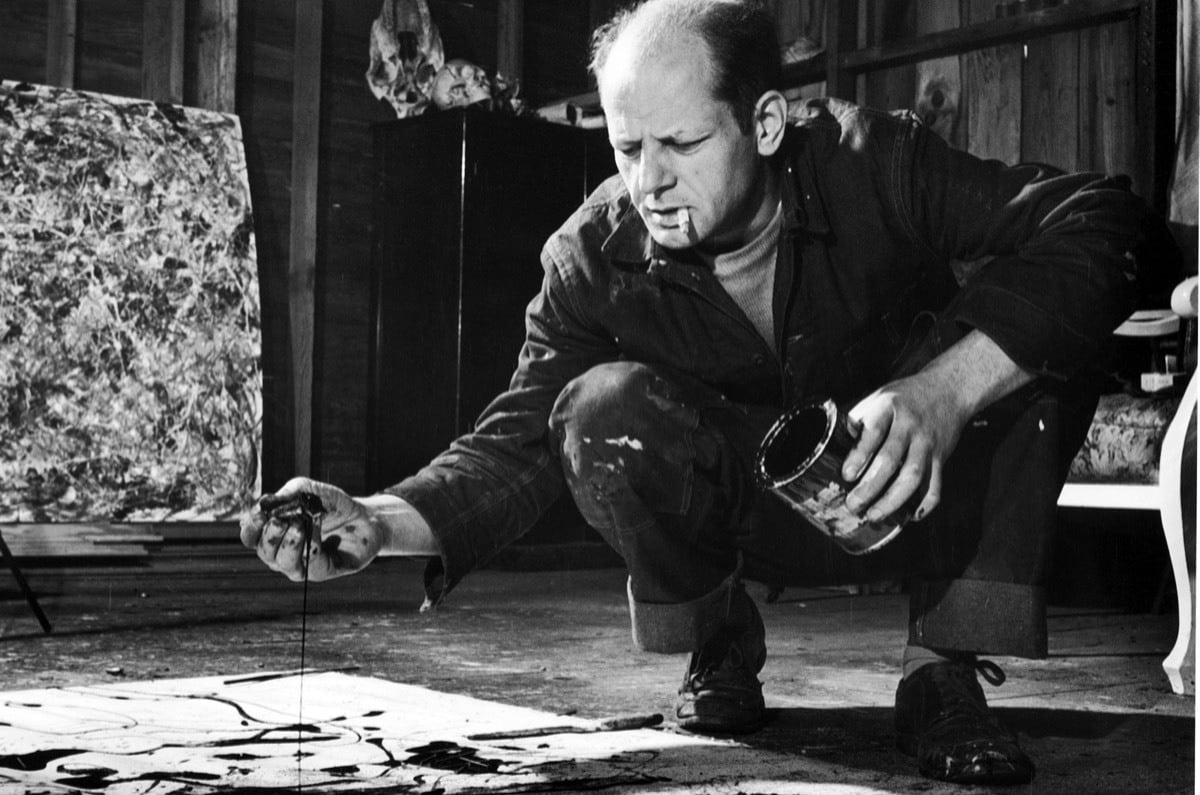

Artists are often empirical masters of fluid dynamics, as they must be to achieve the effects they want. Jackson Pollock was particularly known for his so-called dripping technique, in which he dropped filaments of paint from brushes, cans, and even syringes as he moved around a horizontal canvas. (Scientifically speaking, this wasn’t really dripping since the paint wasn’t breaking up into droplets for the most part, but that’s another story.)
What Pollock was doing, fluid dynamically speaking, is the subject of a new study. Researchers analyzed historical footage of Pollock painting to measure the typical heights from which he dropped paint and the speed at which he moved. Then they built their own apparatus to mimic the painting style with modern paints and study the flow regime Pollock’s technique falls into.
Since much of the paint falls in a steady stream, like syrup falling onto pancakes, the researchers wondered whether the paint was likely to coil the way other viscous fluids do. What they found, however, is that Pollock’s choice of height and speed when applying paint seems deliberately designed to avoid the coiling instability. That fact suggests that art historians might identify forged paintings in part from the presence of too much coiling among the paint filaments. (Image credits: photo – M. Holmes/LIFE, painting – J. Pollock; research credit: B. Palacios et al; via Ars Technica; submitted by Kam-Yung Soh)
