Tag: hummingbird

  • Hovering Hummingbirds

    Hovering Hummingbirds

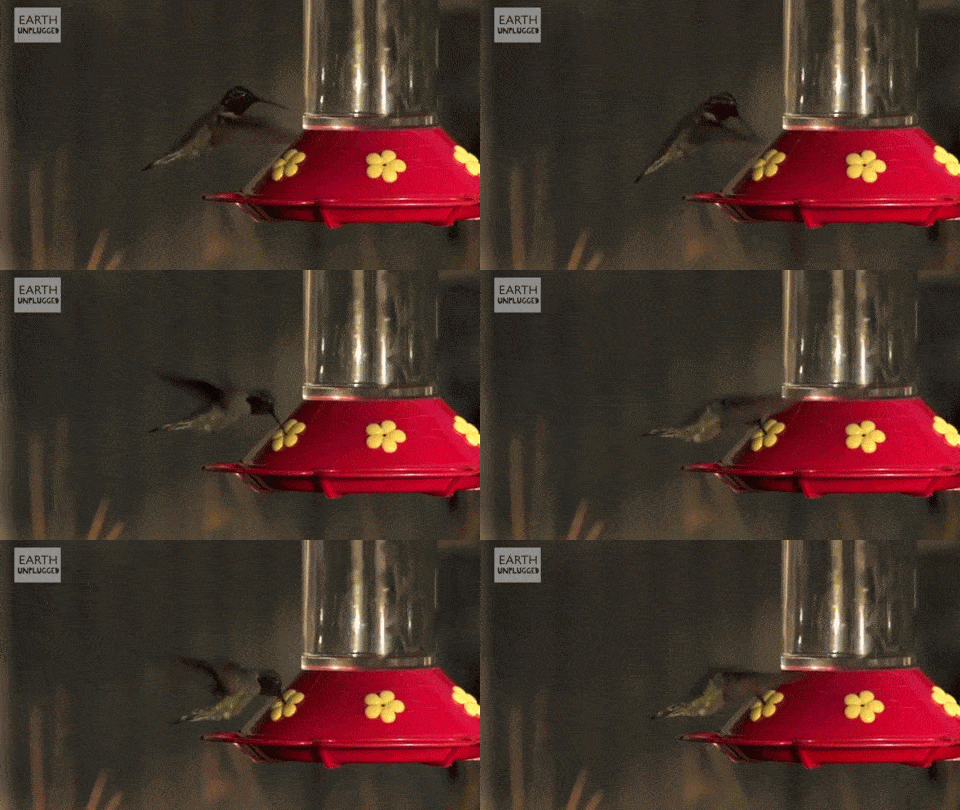
    Hummingbirds are incredible flyers, especially when it comes to hovering. To hover stationary and stable enough to feed, the hummingbird’s flapping pattern not only has to generate enough lift, or vertical force, to counteract their weight, but the bird must balance any forward or backward forces generated during flapping.

    As you can see in the animations above, when hovering the hummingbird’s wings move forward and back rather than up and down. When slowed down even further, the figure-8 motion of the wings becomes apparent. This careful motion is key to the hover; it allows the bird to generate about 70% of its lift on the downstroke when the wings move forward and creates the remainder of the lift needed on the upstroke. For much more high-speed footage of hummingbirds, check out the full BBC Earth Unplugged video, but be warned: you may experience a cuteness overdose! (Image credit: BBC Earth Unplugged, source)

  • Featured Video Play Icon

    Hummingbird Hovering

    Hummingbirds have a unique way of flying among birds. By flapping in a figure-8 motion, they generate lift on both the upstroke and the downstroke, which enables them to fly forward, backward, and even hover for extended periods. Such mid-air acrobatics are necessary for a species that feeds on flower nectar. What is especially impressive about the birds, though, is how they hold up even in adverse conditions like wind or rain. By placing birds in a wind tunnel and filming with high-speed video, researchers can see how hummingbirds maintain their feeding position even in 20 mph (32 kph) winds. By fanning out their tail feathers like a rudder, they can control their body orientation despite turbulent gusts. Not even rain stops them. The birds will periodically shake themselves dry, much like a dog if a dog could manage to fly while shaking itself. (Video credit: Deep Look; submitted by entropy-perturbation)

  • Hummingbird Hovering

    Hummingbird Hovering

    The hummingbird has long been admired for its ability to hover in flight. The key to this behavior is the bird’s capability to produce lift on both its downstroke and its upstroke. The animation above shows a simulation of hovering hummingbird. The kinematics of the bird’s flapping–the figure-8 motion and the twist of the wings through each cycle–are based on high-speed video of actual hummingbirds. These data were then used to construct a digital model of a hummingbird, about which scientists simulated airflow. About 70% of the lift each cycle is generated by the downstroke, much of it coming from the leading-edge vortex that develops on the wing. The remainder of the lift is creating during the upstroke as the bird pulls its wings back. During this part of the cycle, the flexible hummingbird twists its wings to a very high angle of attack, which is necessary to generate and maintain a leading-edge vortex on the upstroke. The full-scale animation is here. (Image credit: J. Song et al.; via Wired; submitted by averagegrdy)

  • Featured Video Play Icon

    Hummingbirds Singing with their Tail Feathers

    Aeroelastic flutter occurs when fluid mechanical forces and structural forces get coupled together, one feeding the other. Usually, we think of it as a destructive mechanism, but, for hummingbirds, it’s part of courtship. When a male hummingbird looks to attract a mate, he’ll climb and dive, flaring his tail feathers one or more times. As he does so, air flow over the feathers causes them to vibrate and produce noise. Researchers studied such tail feathers in a wind tunnel, finding a variety of vibrational behaviors, including a tendency for constructive interference–in other words two feathers vibrating in proximity is much louder than either individually. For more, check out the original Science article or the write-up at phys.org. (Video credit: C. Clark et al.)