Tag: flight test

  • Aerodynamic Flight Testing

    Aerodynamic Flight Testing

    Flight testing models has a long history in aerodynamics. Above you see a Curtiss JN-4 biplane in flight with a model wing suspended below the fuselage. This test was conducted circa 1921 by NASA’s predecessor, NACA. At the time, of course, computational simulations were non-existent, and, although wind tunnels existed, presumably they could not recreate the exact circumstances needed for the test. Available wind tunnels might have lacked the power to reach the speeds engineers wanted, or they could have been too small for the model or had too many disturbances compared to the pristine flight environment. Any or all of these concerns can drive decisions to use flight testing instead of ground tests.

    Flight testing in aerodynamics is still used today, albeit sparingly. The second image shows a crew of Texas A&M graduate students (including yours truly) with a swept wing model we were about to test with a Cessna O-2 aircraft. By this point (roughly 10 years ago), we had wind tunnels capable of overlapping the conditions we could achieve in flight, but flight testing still gave us a larger range of conditions than working solely in the wind tunnel. (Image credits: JN-4 – NASA, O-2 – M. Woodruff; via Rainmaker1973; submitted by Marc A.)

  • HIFiRE

    HIFiRE

    Earlier this month, an international team launched a successful hypersonic flight test in Australia. The Hypersonic International Research Experimentation (HIFiRE) Flight 5b was launched atop a two-stage rocket and reached its maximum speed of Mach 7.5, well above Mach 5, which defines the start of the hypersonic regime. The purpose of this particular flight test was not to test new propulsion technologies – there was no scramjet engine on this flight. Instead, researchers wanted to study aerodynamics at high Mach number, specifically the behavior of the air very close to the vehicle, its boundary layer.

    The payload being tested was an elliptical cone mounted on the front of the vehicle and shown in images above. The shape of the payload is such that flow will curve around the cone rather than following straight lines. The image on the lower right contains black streamlines that show how air twists around the cone. This complex flowfield complicates the physics of the boundary layer near the cone’s surface and increases the likelihood that the boundary layer will transition from laminar flow to turbulent flow, thereby increasing heating on the payload. Ideally, the data from the test flight will let engineers test their ability to understand and predict this boundary layer transition in the future. For more on boundary layer transition and its effects at hypersonic speeds, check out my latest FYFD video. (Image credit: Australia Department of Defense, R. Kimmel et al., F. Li et al.; topic requested by Guido)

  • Visualizing F-18 Flow

    Visualizing F-18 Flow

    Flow visualization techniques are helpful outside of wind and water tunnels, too. The photo above comes from the  F-18 High Alpha Research Vehicle (HARV) program in which techniques like smoke and dye visualization were used in-flight to visualize airflow around an F-18 at large angles of attack. During flight a glycol-based liquid dye was released from tiny holes along the plane’s forebody, creating the pattern seen here later on the ground. This particular test corresponded to about 26 degrees angle of attack. (Photo credit: NASA Dryden)

  • X-51A Scramjet Test Flight

    X-51A Scramjet Test Flight

    The X-51A Waverider hypersonic aircraft had its second test flight earlier this week. Unfortunately, its supersonic combustion ramjet (scramjet) engine failed to transition from its start-up fuel to its primary fuel. According to the US Air Force Research Laboratory:

    A US Air Force B-52H Stratofortress released the experimental vehicle from an altitude of approximately 50,000 feet. After release the X-51A was initially accelerated by a solid rocket booster to a speed just over Mach 5. The experimental aircraft’s air breathing scramjet engine lit on ethylene and attempted to transition to JP7 fuel operation when the vehicle experienced an inlet un-start. The hypersonic vehicle attempted to restart and oriented itself to optimize engine start conditions, but was unsuccessful. The vehicle continued in a controlled flight orientation until it flew into the ocean within the test range. #

    Un-starting is the term used when supersonic flow is lost in an engine or wind tunnel. If the pressure or temperature in the engine deviates too far from the ideal conditions, the upstream mass flow through the engine will be greater than the downstream mass flow and the engine will choke (video). A shock wave forms and travels upstream, leaving subsonic flow in its wake. Loss of supersonic flow inside the engine would likely also result in losing ignition of the fuel/air mixture, resulting in flameout. #

    If you haven’t guessed already, engineers like to make up words.

  • Wind Tunnel Testing

    Wind Tunnel Testing

    This photo shows a prototype of the X-48C blended wing body aircraft being tested in NASA Langley’s 12-Foot Low-Speed Tunnel. Blended wing bodies have many advantages over conventional tube-and-wing designs: the entire surface of the craft can generate lift; the usable cargo/passenger area of the craft is increased; and, structurally, the craft is easier to manufacture. Flight tests of a remote-controlled version of the craft have also taken place.

  • Happy Anniversary, Enterprise!

    Happy Anniversary, Enterprise!

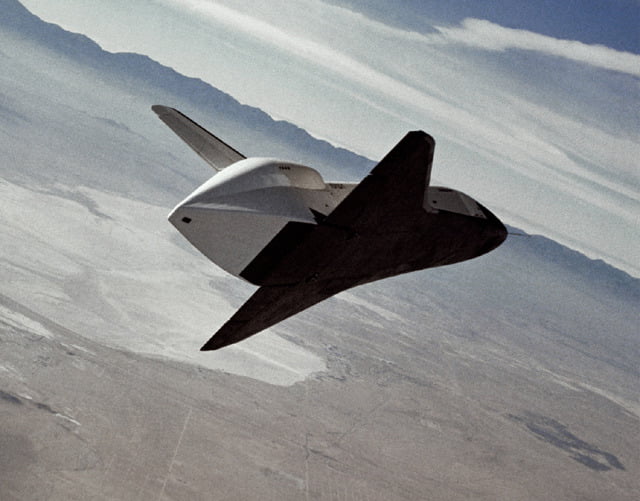
    Wind tunnels are great, but there’s nothing like a flight test to learn about the aerodynamics of a new vehicle. Today in 1977, the space shuttle prototype Enterprise flew on its own for the first time. Enterprise was built purely to test the shuttle’s aerodynamic behavior during gliding and landing. Check out this video of one of Enterprise’s gliding and landing tests.