Tag: flight stability

  • Gliding Birds Get Extra Lift From Their Tails

    Gliding Birds Get Extra Lift From Their Tails

    Gorgeous new research highlights some of the differences between fixed-wing flight and birds. Researchers trained a barn owl, tawny owl, and goshawk to glide through a cloud of helium-filled bubbles illuminated by a light sheet. By tracking bubbles’ movement after the birds’ passage, researchers could reconstruct the wake of these flyers.

    As you can see in the animations above and the video below, the birds shed distinctive wingtip vortices similar to those seen behind aircraft. But if you look closely, you’ll see a second set of vortices, shed from the birds’ tails. This is decidedly different from aircraft, which actually generate negative lift with their tails in order to stabilize themselves.

    Instead, gliding birds generate extra lift with their maneuverable tails, using them more like a pilot uses wing flaps during approach and landing. Unlike airplanes, though, birds rely on this mechanism for more than avoiding stall. It seems their tails actually help reduce their overall drag! (Image and research credit: J. Usherwood et al.; video credit: Nature News; submitted by Jorn C. and Kam-Yung Soh)

  • Featured Video Play Icon

    Understanding Meteorite Geometry

    Back in February 2013, the skies over Russia were lit by the fall and explosion of a large meteor. The scavenger hunt for meteorite pieces that followed turned up lots of conically-shaped chunks of rock, consistent with other meteors. Why do so many meteorites end up in this shape? There are a couple factors influencing it.

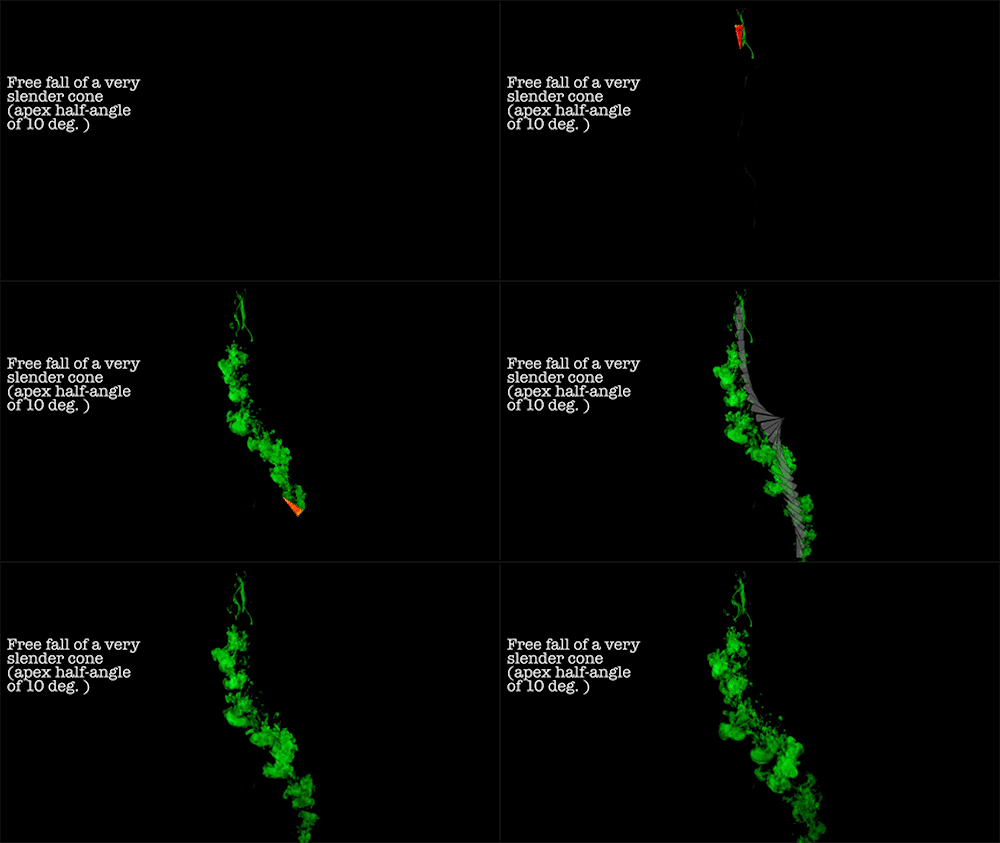
    The first is that erosion during flight tends to shape initially spherical meteor chunks into broad cones. And that shape, it turns out, is remarkably stable in flight. By dropping cones of various geometries, researchers can test how stable they are in flight: do they change orientation, flutter back and forth, or drop straight down? Slender cones (below) tend to invert and tumble. Very broad cones flutter back and forth as they fall. But for an intermediate cone angle – similar to the one found in meteorites – the cones stay perfectly oriented, so once the rock erodes into that cone, it will keep that shape. (Image and video credit: K. Amin et al.)