Tag: extrusion

  • How Wombats Make Stackable Feces

    How Wombats Make Stackable Feces

    Wombats are unique among the animal kingdom for their ability to produce cubic feces approximately the size and shape of dice. Researchers found that wombats accomplish this geometric feat thanks to the structure of their intestines, which have bands of differing stiffness that run the full length of their guts. When the intestines contract, the stiffer bands contract first, gradually shaping and sculpting the corners of the feces.

    The results have implications both for manufacturing soft materials and for human health. One of the early effects of colon cancer is a stiffening of portions of the intestine; that means that doctors may be able to use changes in the shape of a patient’s feces as a warning sign for diagnosis. (Image and research credit: P. Yang et al.; video credit: Royal Society of Chemistry; via Gizmodo)

  • Wild Extrusions

    Wild Extrusions

    In their continuing quest to squish all the things, the Hydraulic Press channel recently debuted a tool with a series of small holes they can extrude various substances through. The video features several great extrusions, including oobleck, temperature-sensitive putty, cheese, and crayons (above). Most of these substances are non-Newtonian fluids of some kind, and the extreme forces the hydraulic press causes makes for some wild effects.

    Many of the substances, including the crayons above, display signs of the sharkskin instability in their rough edges. When non-Newtonian fluids (like the paraffin wax in crayons) get extruded quickly, the material at the edges experiences a lot of friction and shear when trying to flow along the wall of the hole. When the fluid finally breaks free, the region along the outside accelerates to match the speed of fluid at the center of the extrusion. Parts of the mixture may resist that acceleration, resulting in the uneven edges seen above. (Video credit: Hydraulic Press Channel; GIF via Colossal)

  • Sharkskin Instability

    Sharkskin Instability

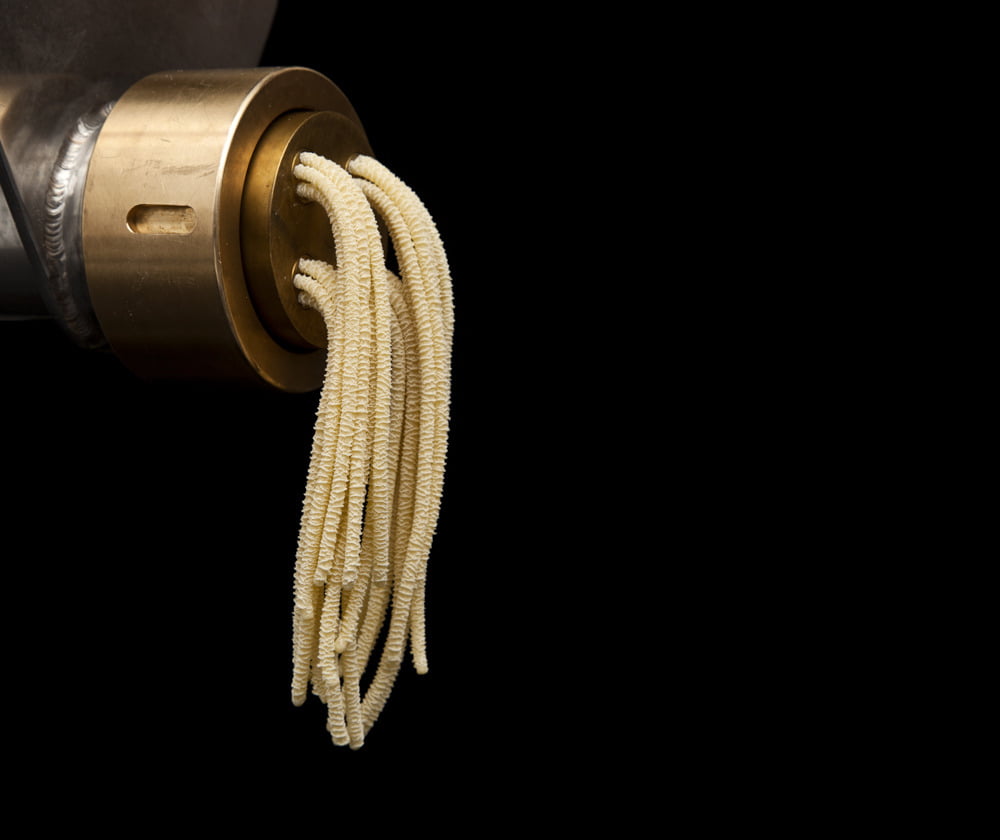
    Homemade spaghetti noodles exhibit a roughened surface that’s the result of viscoelastic behavior known as the sharkskin instability. It’s usually observed in the industrial extrusion of polymer plastics. In the case of spaghetti, the long, complex polymer molecules necessary for the instability come from the proteins in eggs. The characteristically rough surface of the extruded material is caused by the transition from flow through the die to air. Inside the die, friction from the walls exerts a strong shear force on the outer part of the fluid while the inner portion flows freely. When the material exits the die, the sudden lack of friction on the outer portion of the fluid causes it to accelerate to the same velocity as the middle of the flow. This acceleration stretches the polymers until they snap free of the die; after the strained polymers relax, the material keeps a rough, saw-tooth pattern. In industry, the sharkskin instability can be prevented by regulating temperature or flow speed. In the case of spaghetti, though, Modernist Cuisine suggests the roughness is desirable because it helps trap the pasta sauce. Bon appetit!  (Image credit: Modernist Cuisine)

  • Melt Fracture in Plastics

    Melt Fracture in Plastics

    Liquid plastics are often extruded–or pressure-driven through a die–during manufacturing. Early on manufacturers discovered that they could only extrude plastic at low flow rates, otherwise the plastic’s surface begins undulating in what became known as melt fracture. These corrugations result from the viscoelasticity of the plastic. Viscoelastic fluids have a response to deformation that is part viscous–like any fluid–and part elastic. At low flow rates, viscous forces dominate in the plastic, but at higher speeds, elasticity increases and the polymers in the plastic get stretched along the direction of flow. In response to this stretching, the polymers exert normal stresses, much like a rubber band that’s being stretched. Because this force acts only along the flow direction, different parts of the fluid are experiencing different forces, and these internal stresses cause the plastic to change shape. (Image credit: D. Bonn et al.)