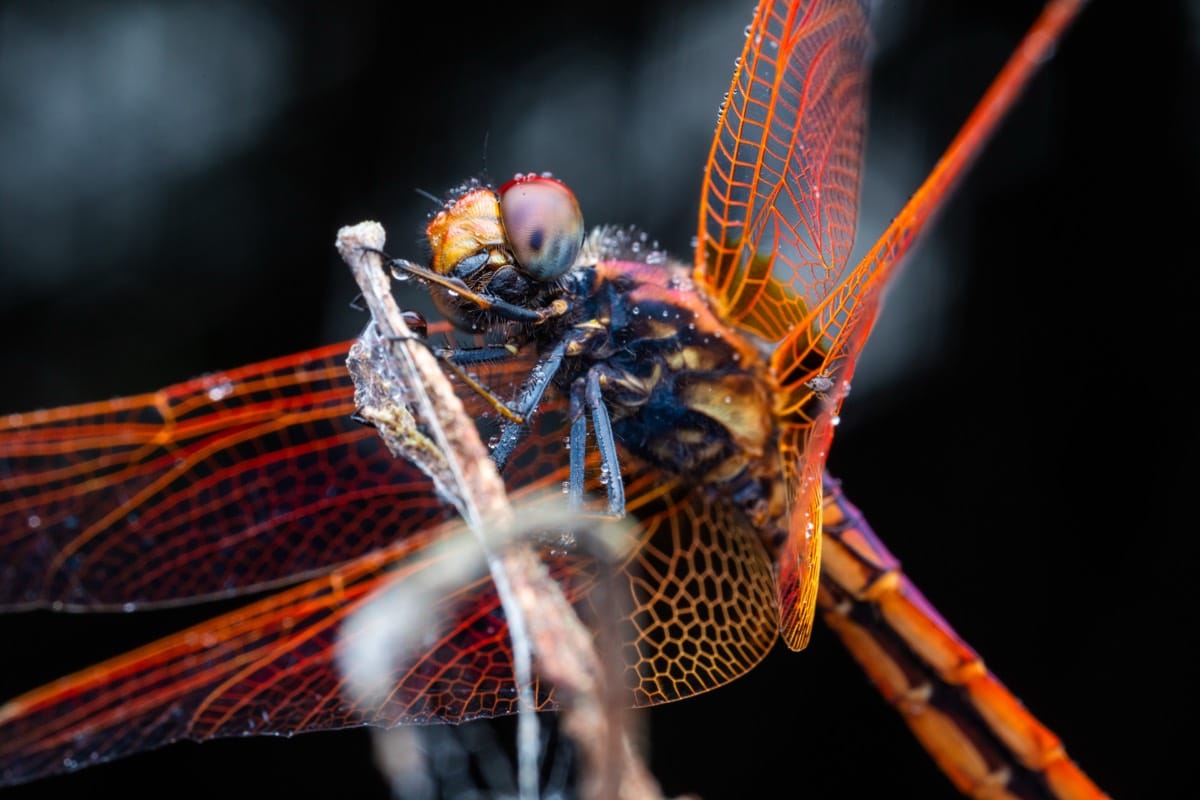
Tag: dragonfly

  • Where are Titan’s Deltas?

    Where are Titan’s Deltas?

    Saturn’s moon Titan is the only other planetary body in our solar system known to have bodies of liquid on its surface. But where Earth has lakes and seas of water, Titan’s are hydrocarbon-based, primarily ethane and methane. As on Earth, these liquids rain from skies and run down rivers and streams into larger bodies. What they do not do, as far as scientists can tell, is form deltas.

    On Earth (and ancient Mars), rivers tend to slow and branch out as they run into larger, still bodies. Many of these river deltas — like the Nile, Ganges, and Mississippi — are visible from space. But so far we’ve seen no equivalent formations on Titan, even though the radar resolution of Cassini should have allowed for it.

    There are currently two hypotheses to explain this absence. One posits that density differences between hydrocarbon rivers and lakes mean that deltas do not form. On Titan, the larger bodies are warmer and do not absorb as much atmospheric nitrogen, making them lighter overall. That means a cold, dense river might just sink immediately beneath the lake without slowing to deposit sediment.

    Another hypothesis is that deltas do form but that the shifting shorelines of Titan’s seas wash them out and make them unrecognizable. There’s evidence that Titan’s northern and southern hemispheres can swap their liquid hydrocarbons back and forth on a 100,000 year timescale. If that’s true, those shifts could obscure any evidence of deltas.

    Experiments are underway to test the first hypothesis, but the final answers may have to wait until NASA’s Dragonfly mission reaches Titan in 2034. (Image credit: Titan – NASA/JPL-Caltech/ASI/Cornell, Alaska – NOAA; via AGU Eos; submitted by Kam-Yung Soh)

  • Titan’s Dragonfly

    Titan’s Dragonfly

    Last week, NASA announced its next New Frontiers mission: a nuclear-powered drone named Dragonfly heading to Titan. This astrobiology mission is set to search our solar system’s second largest moon for signs of life. It’s exciting aerodynamically, as well, since Titan’s thick atmosphere makes it uniquely suited for heavier-than-air flight. Therefore, rather than using wheeled rovers like we have on Mars, Dragonfly is a rotorcraft. It will be capable of traveling up to 8km per flight, which will quickly surpass the fewer than 21km the Curiosity Rover has managed on Mars! 

    Like Earth, Titan has rainfall and open liquid bodies on its surface. I, for one, can’t wait to see the alien vistas Dragonfly sends back as it cruises over methane lakes. (Image and video credit: NASA)

  • Flying Backwards

    Flying Backwards

    Spend a summer afternoon floating in a kayak and chances are you’ll see some impressive aerial acrobatics from dragonflies. One of the dragonfly’s superpowers is its ability to fly backwards, which helps it evade predators and take-off from almost any orientation. To do this, the dragonfly rotates its body so that it is nearly vertical, thereby changing the direction it generates lift. In engineering terms, this is “force-vectoring,” similar to the techniques used by helicopters and vertical-take-off jets. 

    Scientists found that backwards-flying dragonflies could generate forces two to three times their body weight, in part due to the strong leading-edge vortices (bottom image) formed on the forewings. They also found that the hind wings are timed so that their lift is enhanced by catching the trailing vortex of the first pair of wings. Engineers hope to use what they’re learning from insect flight to build more capable flying robots. (Image and research credit: A. Bode-Oke et al., source; via Science)