Tag: double slit experiment

  • Submarine Canyons Focus Waves

    Submarine Canyons Focus Waves

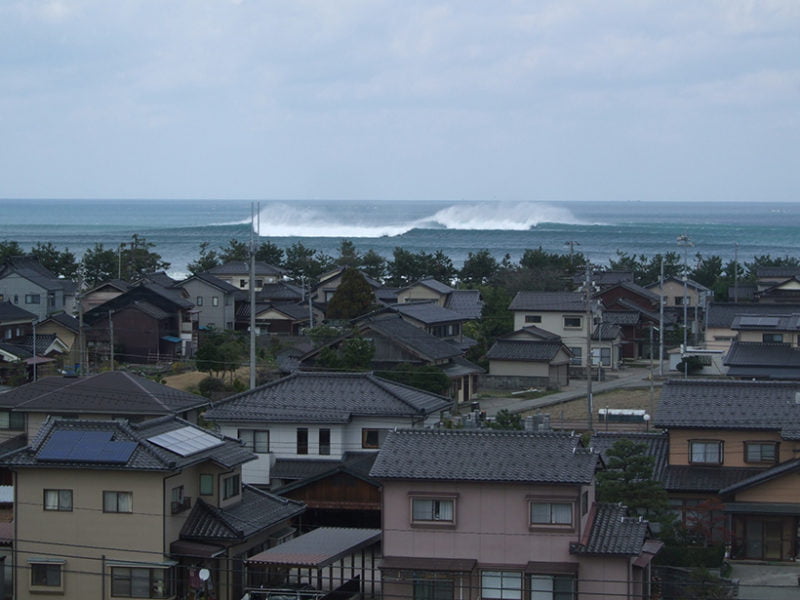
    In winter months Toyama Bay in Japan can get hammered by waves nearly 10 meters in height. These waves, known as YoriMawari-nami, pose dangers to both infrastructure and citizens, and, thus far, are not captured by typical forecasting models.

    A new study indicates that these waves have their origin in the particular topography of Toyama Bay and the physics behind the double-slit experiment. The shape of Toyama Bay is such that only waves from the north-northeast can propagate all the way to shore. That restriction essentially creates a single, coherent source for waves in the bay.

    The bay is also home to submarine canyons that stretch like underwater valleys from the continental shelf down toward the deeper ocean. To the incoming waves, these canyons act much like the slits in the double-slit experiment, creating two sets of waves whose fronts can interfere. In some positions, a wave crest will combine with a wave trough, cancelling one another out. But in other spots, two wave crests will meet and combine, creating the much larger YoriMawari-nami wave.
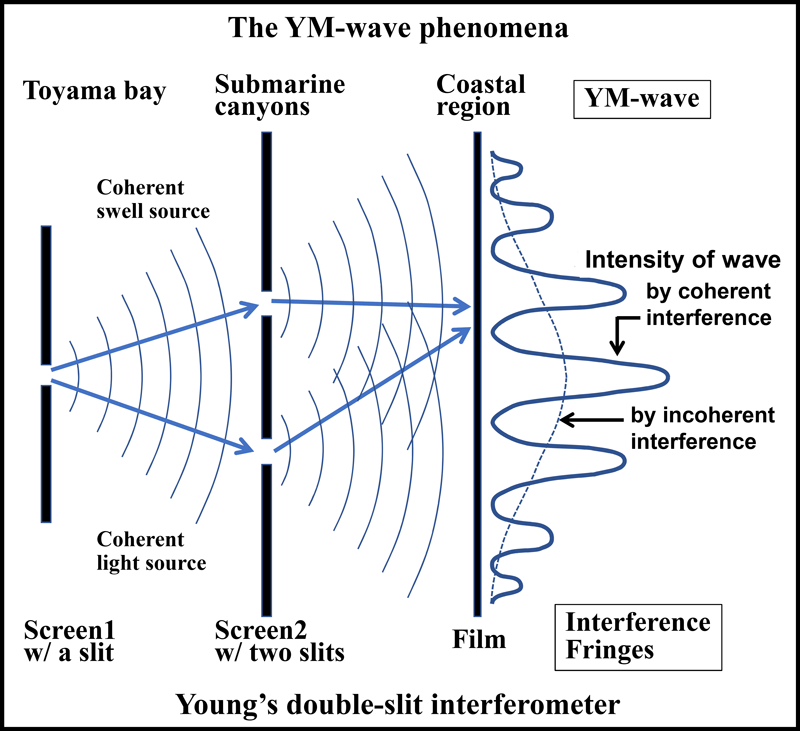
    Diagram illustrating the similarity of the YM-wave phenomenon to Young's double-slit experiment. By H. Tamura et al.

    Toyama Bay is not the only spot in the world where this phenomenon happens. The same physics is behind some of the most popular surf spots in the world, including Half-Moon Bay in California and Nazaré, Portugal. In all of these cases, properly predicting wave heights requires tracking an extra variable — wave phase — that most models leave out. That’s why forecasters have struggled with Toyama Bay’s waves. (Image credit: wave – M. Kawai, diagram – H. Tamura et al.; research credit: H. Tamura et al.; via AGU Eos; submitted by Kam-Yung Soh)

  • Pilot-Wave Hydrodynamics: Slit Experiments

    Pilot-Wave Hydrodynamics: Slit Experiments

    This post is part of a collaborative series with FYP on pilot-wave hydrodynamics. Previous entries: 1) Introduction; 2) Chladni patterns; 3) Faraday instability; 4) Walking droplets; 5) Droplet lattices; 6) Quantum double-slit experiments

    In quantum mechanics, the single and double-slit experiments are foundational. They demonstrate that light and elementary particles like electrons have wave-like and particle-like properties, both of which are necessary to explain the behaviors observed. Similarly, a hydrodynamic walker consists of both a particle and a wave, so, perhaps unsurprisingly, researchers tested them in both single-slit and double-slit experiments.

    When a walker passes through a single-slit (top row), it’s deflected in a seemingly random direction due to its waves interacting with the slit. But if you watch enough walkers traverse the slit, you can put together a statistical representation of where the walker will get deflected. Compare that with the results for a series of photons passing through a slit one-at-a-time, and you’ll see a remarkable match-up.

    If you test the walker instead with two slits, the droplet can only pass through one slit, but its accompanying wave passes through both (bottom row). Let enough walkers through the system one-by-one, and they, like their photonic cousins, build up interference fringes that match the quantum experiment. Diffraction and interference are only a couple of the walkers’ tricks, however. In the next posts, we’ll take a look at another analog to quantum behavior: tunneling.

    (Image and research credits: Couder et al., source, selected papers 1, 2; images courtesy of E. Fort)