Tag: bubble pinch-off

  • Bubble Dynamics Govern Faster Pouring

    Bubble Dynamics Govern Faster Pouring

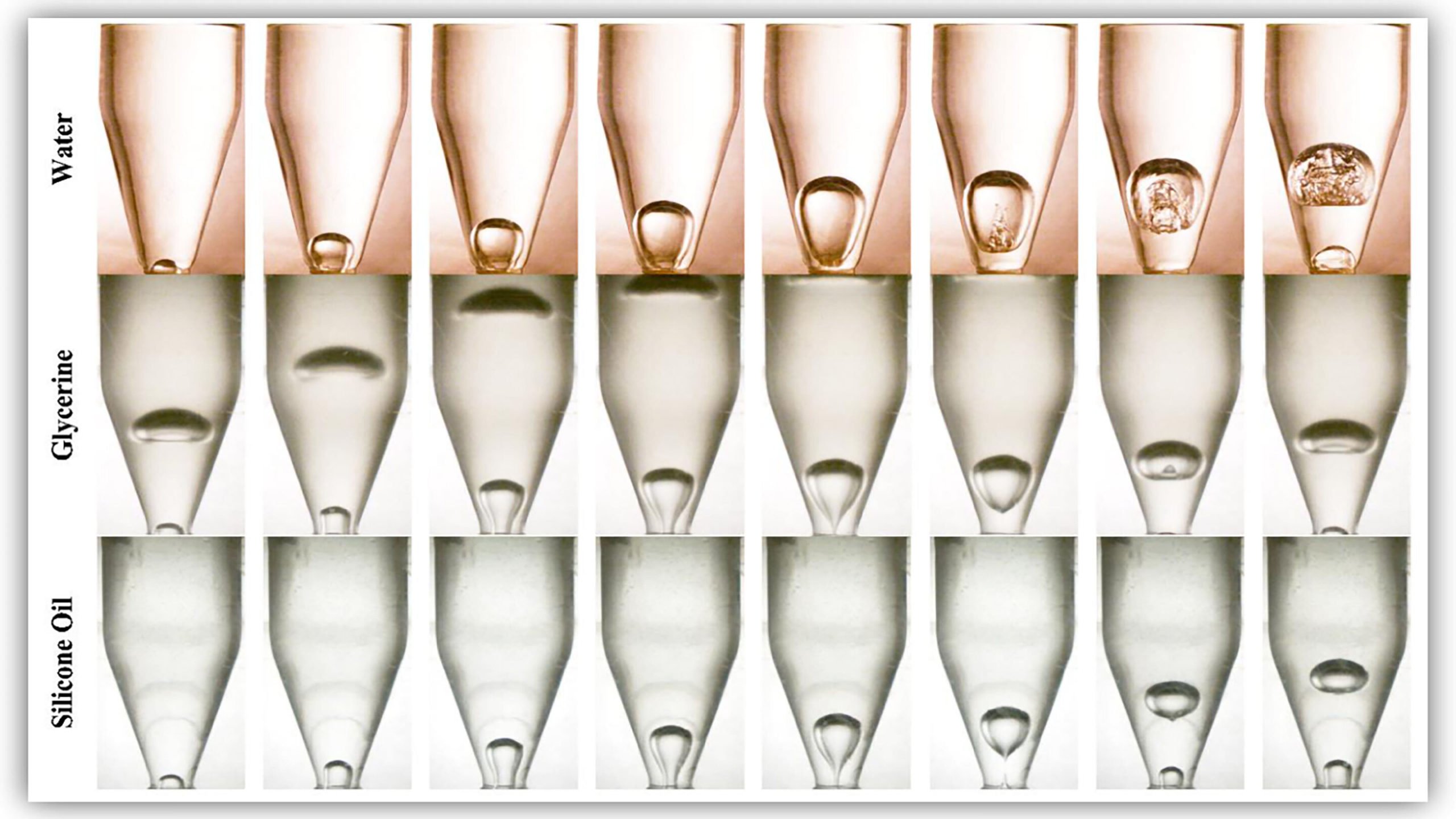
    We’re all familiar with the problem of pouring a liquid from a narrow-necked bottle. To a certain extent, tilting the bottle further will reduce the time it takes to empty, but if you tilt too far, your smooth pour becomes violent glugging as bubbles forming at the bottle’s mouth block liquid from exiting.

    Researchers find that the time it takes to empty a bottle depends both on the qualities of the liquid — its viscosity and surface tension — and on the geometry of the bottle. In particular, they found that the shape of the bottle influences how quickly bubbles grow at the bottle’s mouth when tilted to the critical angle. Their findings suggest that higher tilt angles and faster pours can be achieved by optimizing bottle geometry. (Image and research credit: L. Rohilla and A. Das; via phys.org)
  • Breaking Up

    Breaking Up

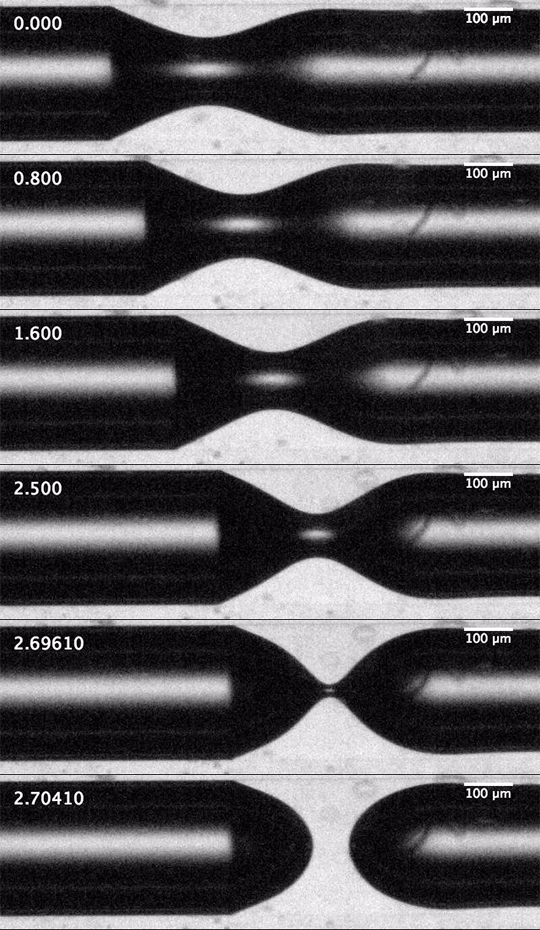
    The dripping of a faucet and the break-up of a jet into droplets is universal. That means that the forces – the inertia of the fluid, the capillary forces governed by surface tension, and the viscous dissipation – balance in such a way that the initial conditions of the jet – its size, speed, etc. – don’t matter to the process of break-up. 

    We’d expect that the inverse situation – the breakup of a gas into bubbles in a liquid – would be similarly universal, but it’s not. When unconfined bubbles pinch off, the way they do so is heavily influenced by initial conditions. But that changes, according to a new study, if you confine the gas to a liquid-filled tube before pinch-off. Confinement forces a different balance between viscous and capillary effects, one which effectively erases the initial conditions of the flow and restores universality to the pinch-off process. (Image and research credit: A. Pahlavan et al.; via phys.org)