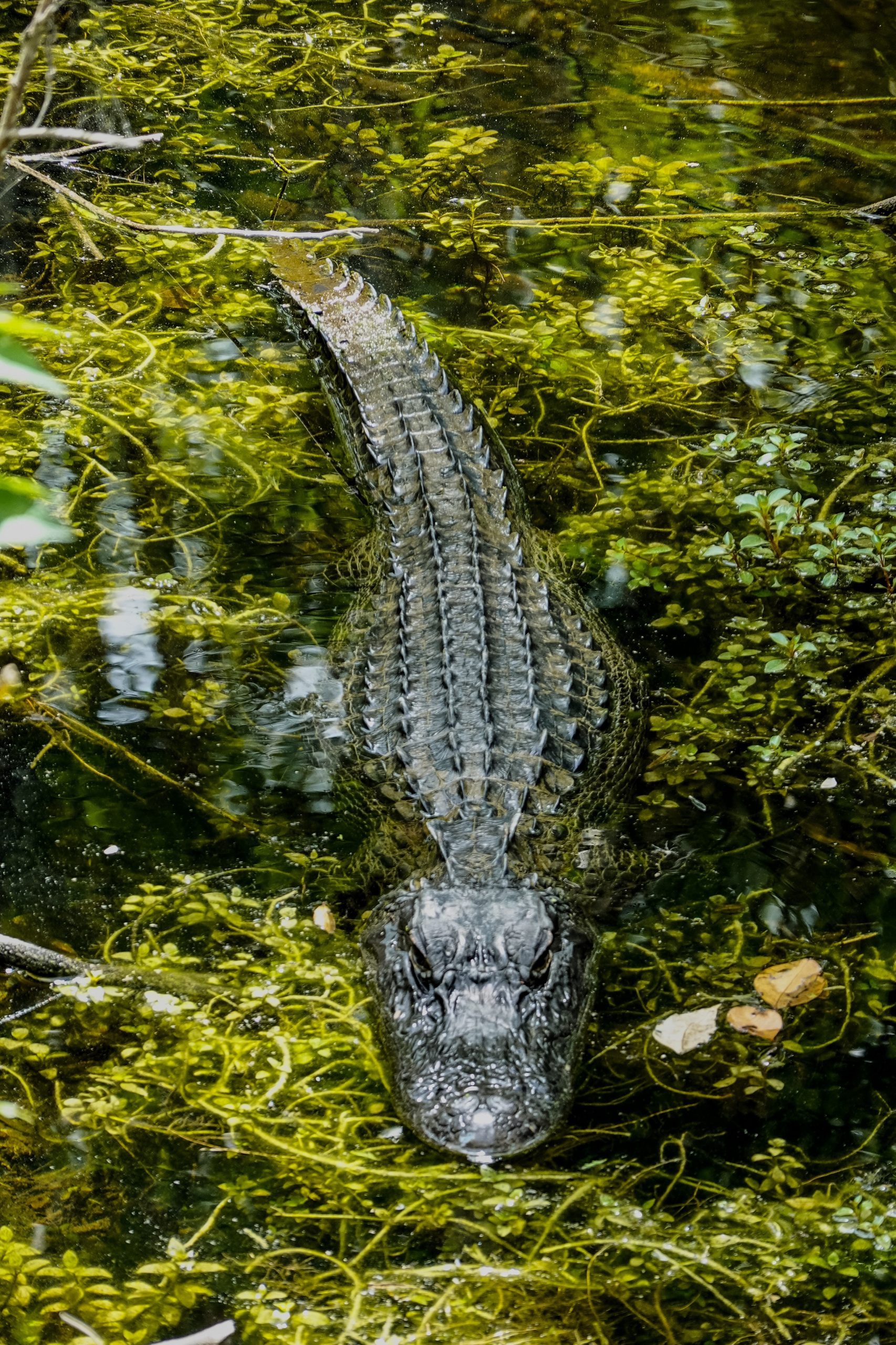
Inspired by crocodilians, young scientist Angela Rofail designed attachments to reduce wind loads on high-rise buildings. When crocodilians swim, the ridges on their back help hide their motion from observation above the surface. Rofail wondered whether similar ridges would reduce the wind-induced swaying of high-rise buildings. Using a scale-model and crocodile-inspired knobs, the Year 10 student (read “high-school freshman” for U.S. readers) conducted wind tunnel tests that showed her modifications reduced drag on the model and kept it from moving in windy conditions. (Image credit: H. Roettger; video credit: CSIRO; via CSIRO; submitted by Kam-Yung Soh)
Tag: biomimicry

Wavy Swimmers
Animals often move in ways engineers find counter-intuitive. Take, for example, the glass knifefish, an undulatory swimmer that controls its motion through wavelike oscillations of its fin. One might expect the knifefish to move its fin so that a single continuous wave moves from one end to the other. Instead two opposing waves move down the knifefish’s fins, one travelling from head to tail and the other travelling from the tail forward. The intersection of these waves is the nodal point, and, by shifting the nodal point fore or aft, the knifefish can hover in place, move forward or swim backward. At first glance, this seems like a wasteful system since a significant portion of each wave cancels the other, but, through mathematical modeling and experiments with a biomimetic robot, the researchers found that the dual-wave locomotion increases both the stability and maneuverability of the fish. (Video credit: N. Cowan et al.; via phys.org)
