Tag: beetle

  • Featured Video Play Icon

    Moths and Beetles in Flight

    Watching insects take flight in high-speed video is always mesmerizing. So often their wings look too small and fragile to lift their bulbous bodies, but they manage the feat easily. I especially like to watch how much their wings flex during each up- and downstroke. So often we think that stiffer wings — like those on airplanes — are better for flight, yet nature demonstrates at so many sizes that flexibility is better, especially in flapping flight. A flexible wing can maximize lift in the downstroke and curl to minimize drag on the upstroke. Even wings that fold away, as many beetle wings do, can do the job of lifting an insect once shaken out. (Image and video credit: Ant Lab)
  • Featherwings in Flight

    Featherwings in Flight

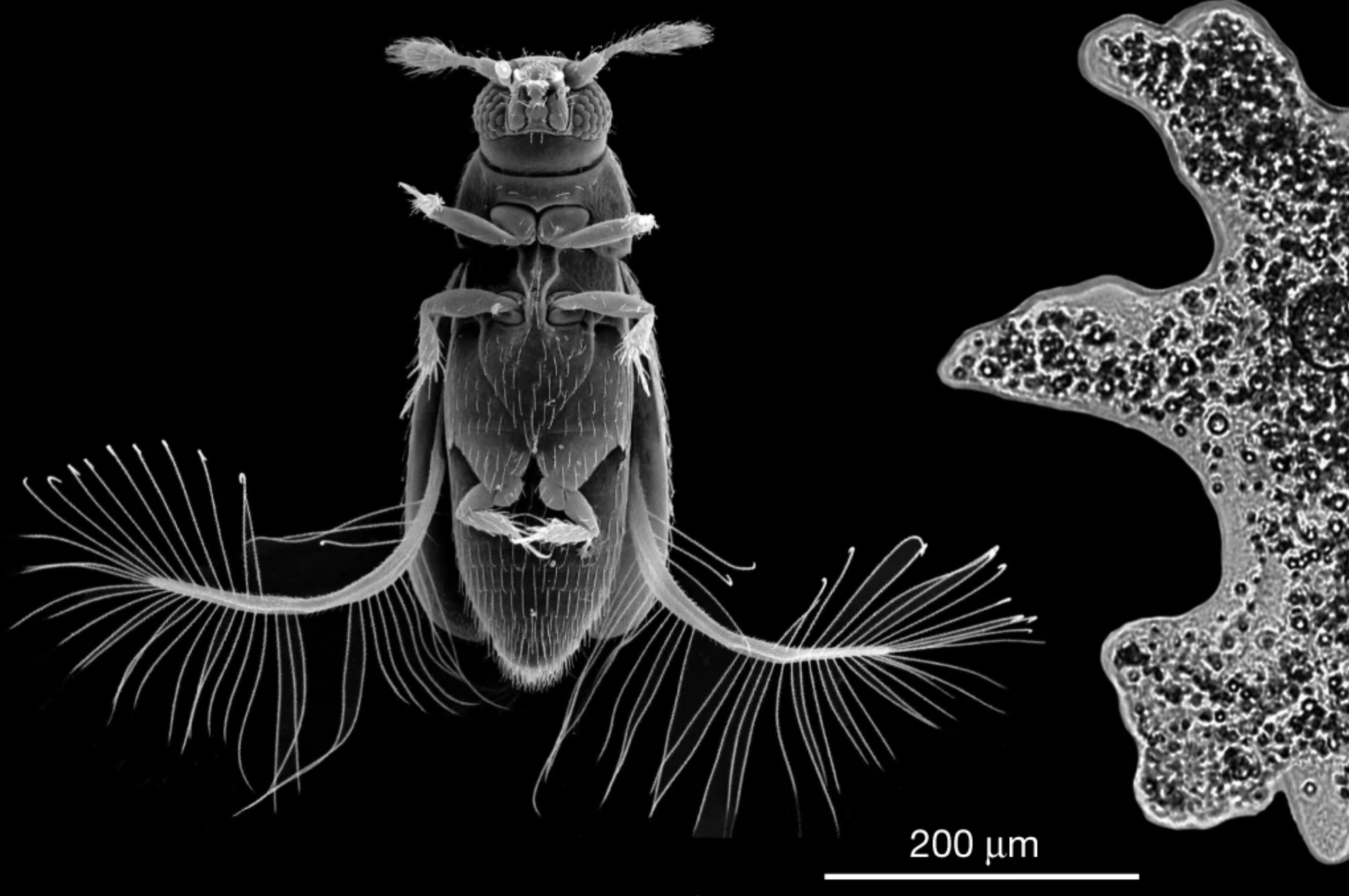
    The featherwing beetle is tiny, less than half a millimeter in length. At that scale, flying is a challenge, with air’s viscosity dominating the forces the insect must overcome. The featherwing beetle, as its name suggests, has feather-like wings rather than the membranes larger beetles use. But a new study shows that these odd wings work surprisingly well.

    The beetle’s bristled wings flap with an exaggerated figure-8 motion, with the wings clapping together in front of and behind the insect. The beetle expends less energy moving its feathery wings than it would if they were solid, and it moves its wing covers at the same time to counter each stroke and keep its body steady. (Image and research credit: S. Farisenkov et al.; video credit: Nature; submitted by Kam-Yung Soh)

  • Breaking the Wave Speed Limit

    Breaking the Wave Speed Limit

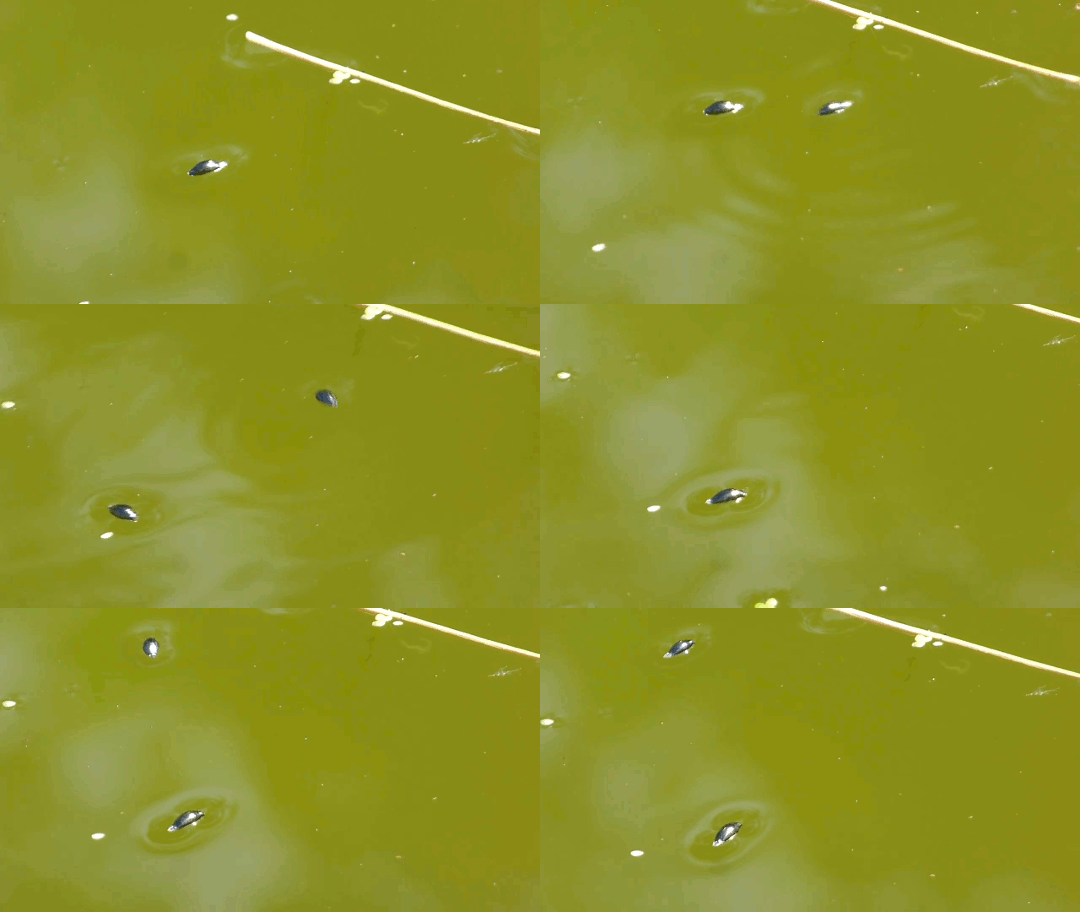
    Whirligig beetles are small surface swimming insects. As they race across the water surface, they create both visible and unnoticeable waves on the water. These waves are the result of both surface tension and gravity. Typically, it’s the wavelength of the gravity waves that limit a swimmer or boat’s speed. When the wavelength of the gravity waves a swimmer creates meets the size of the swimmer, the waves generated ahead of the swimmer start to reinforce the waves forming at the back of the swimmer. This traps the swimmer (or boat) in a trough between its bow and stern waves and limits the max speed of the swimmer since overcoming this critical hull speed requires excessive amounts of power.

    The tiny whirligig beetle overcomes this natural speed limit cleverly. It is smaller than the shortest possible gravity wave in water. Thus, it can never be trapped between its bow and stern waves! This allows the tiny swimmer to zip across the water’s surface at speeds above 0.5 m/s. That’s over 30 beetle body lengths per second! (Image credit: H. L. Drake, source; research credit: V. Tucker; submitted by Marc A.)