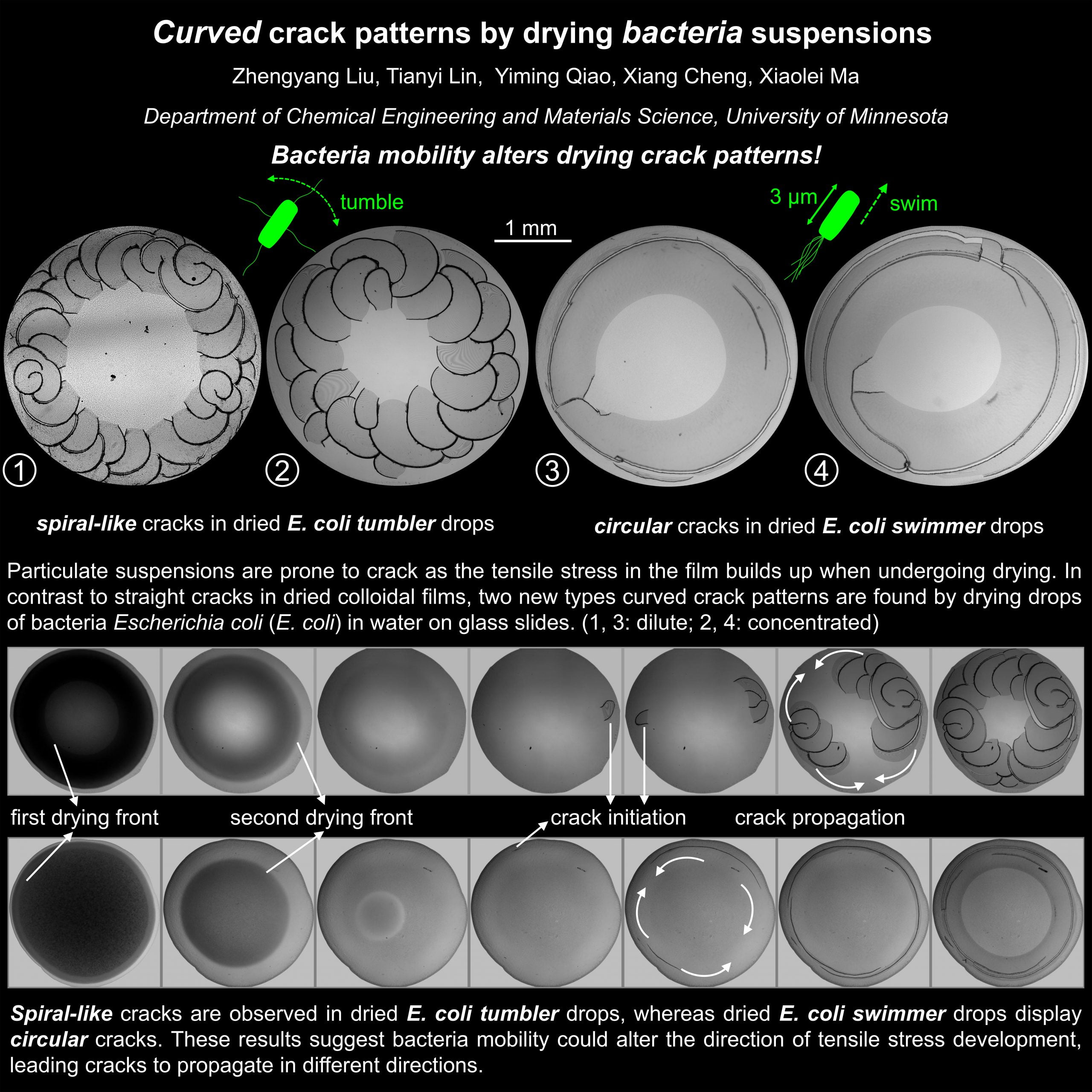
When mixtures of particles and fluids dry, they typically leave a pattern of straight cracks. Here researchers explore what happens when the drying film contains bacteria from the family E. coli. Instead of straight cracks, the films form curved ones. With bacteria that rotate or tumble, the crack pattern is spiral-like. With bacteria that swim, the remaining pattern consists of circular cracks. Thus, the motility of the bacteria affects how cracks form and spread. (Image and research credit: Z. Liu et al.)
Tag: 2020GOFM

Opera Singer Air Flow


What does the air flow from a trained opera singer look like? That’s the question behind this study, which combines music and fluid dynamics. Using an infrared camera tracking carbon dioxide (CO2) exhalations from a singer during a performance allowed researchers to identify several important flow features. When breathing, air flows out the singer’s nose in a tight, downward jet with an initial velocity around 1 m/s.
While singing, air leaves the mouth at a much lower velocity, especially during vowels where the mouth is open. With less momentum behind these exhalations, they can drift upward on the buoyant warmth of the singer’s breath. During consonants — especially plosives like t, k, p, b, d, and g — a rapid burst of air leaves the mouth, traveling at nearly 10 m/s. From the perspective of COVID-19 safety, it’s these plosive jets that are likely to spread contaminated droplets. (Image and video credit: MET Orchestra; research credit: P. Bourrianne et al.; via Improbable Research; submitted by Kam-Yung Soh)

Liquid Umbrellas
Two well-timed and properly aligned droplets combine to create these umbrella-like fluid sculptures. The initial drop creates a jet that shoots upward. When the second drop hits that jet, it forms an expanding sheet of liquid like a miniature parasol. The higher the viscosity of the drops, the less lacy and unstable the sheet’s rim will be.
Although set-ups for these sorts of pictures can be finicky, they’re very doable, even for amateur photographers. In fact, the techniques used here have been around for about a century! (Image and research credit: A. Kiyama et al.)

Wrinkles on Collapsing Bubbles
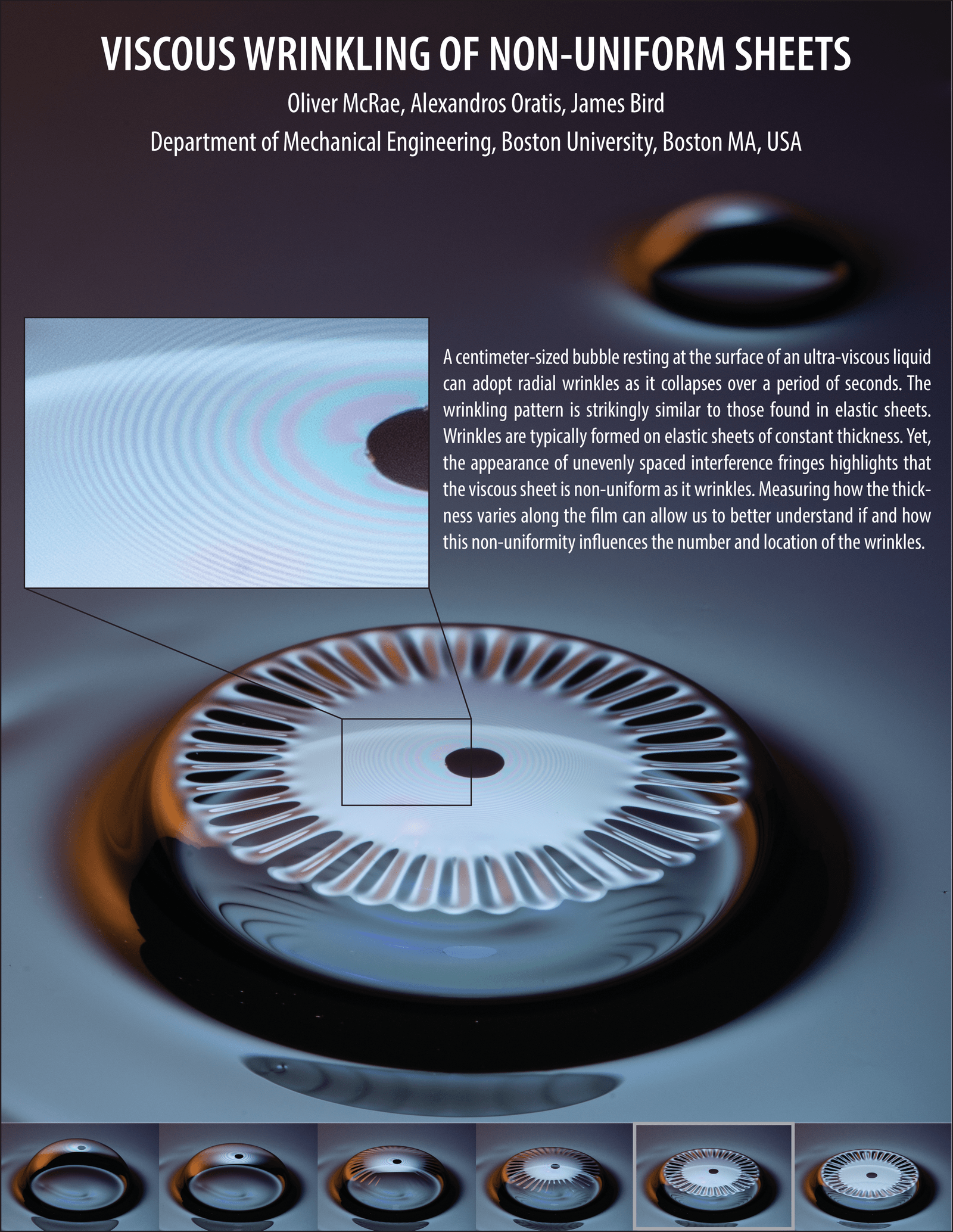
As a bubble sitting on a pool collapses, wrinkles form around its edges. Visually, the result is quite similar to the wrinkles one gets on an elastic sheet. Unlike the solid sheet, though, the bubble’s film varies in thickness; we know this because of the fringes shown in the enlarged inset of the poster. Researchers are studying this non-uniformity to see whether it affects the number and shape of wrinkles that form on the bubble. (Image and research credit: O. McRae et al.)
Viscoplastic Drop Impact


There are many materials that don’t behave exactly as a fluid or a solid, instead displaying characteristics of both. In this video, we see drops of hair gel falling into water. The gel is viscoplastic – showing some of the viscous behavior of a fluid and some of the plastic behavior (the inability to change back to its initial shape) of a solid.
On impact, the gel deforms due to the forces on it, but the final shape does not depend solely on the amount of force; instead, it’s the rate at which the forces are applied that determines the final shape. By tuning the impact speed and the gel stiffness, it’s possible to make many final capsule shapes, something that could be useful in applications like drug manufacturing. (Image and video credit: M. Jalaal et al.)
Rocket Yeast


Usually, microbial colonies are grown on a solid substrate, but what happens when they grow on a liquid surface? That’s the question explored in this Gallery of Fluid Motion video featuring colonies of brewer’s yeast on various liquid substrates. When the viscosity of the liquid is low enough, the colony actually gets pulled apart (Image 2). This behavior is driven by a convective flow in the liquid caused by the colony’s own growth. As the yeast grow, they deplete nearby sugar, creating a density gradient that triggers convection beneath the colony. (Image, video, and research credit: S. Atis et al.)