Search results for: “drag”

  • Featured Video Play Icon

    Ground Effect Vehicles

    Ground effect vehicles (a.k.a. wing-in-ground-effect vehicles) rely on their proximity to a flat surface to inhibit the wingtip vortices that create lift-induced drag. This effectively increases the lifting capabilities of the vehicle in comparison to regular flight, but only so long as the vehicle remains close enough to the ground. This video features many model gliders that rely on ground effect.

  • Featured Video Play Icon

    Hot Spheres Sink Faster

    New research shows that the Leidenfrost effect–which causes water droplets to skitter across a hot pan–can drastically reduce the drag on objects moving through a liquid. When raised to a high enough temperature, a sphere falling water will be coated in a protective layer of vapor (see video above) that acts like a lubricant as the sphere moves through the water. If the temperature of the object drops too low, the vapor layer will dissolve into a mess of bubbles (~35 secs into video). One way that this mechanism reduces drag is by keeping flow attached to the sphere for longer as shown in this video. Preventing this flow separation increases the pressure recovered after the point of lowest pressure (the shoulders of the sphere), which reduces overall drag.

    See also:

  • Featured Video Play Icon

    Feathering on SpaceShipTwo

    Virgin Galactic and Scaled Composites recently performed their first feathered flight with SpaceShipTwo, which is on track to be the first commercial spaceship. Feathering is a re-entry technique devised by Scaled Composites founder Burt Rutan:

    Once out of the atmosphere the entire tail structure of the spaceship can be rotated upwards to about 65º. The feathered configuration allows an automatic control of attitude with the fuselage parallel to the horizon. This creates very high drag as the spacecraft descends through the upper regions of the atmosphere. The feather configuration is also highly stable, effectively giving the pilot a hands-free re-entry capability, something that has not been possible on spacecraft before, without resorting to computer controlled fly-by-wire systems. The combination of high drag and low weight (due to the very light materials used to construct the vehicle) mean that the skin temperature during re-entry stays very low compared to previous manned spacecraft and thermal protection systems such as heat shields or tiles are not needed. During a full sub-orbital spaceflight, at around 70,000ft following re-entry, the feather lowers to its original configuration and the spaceship becomes a glider for the flight back to the spaceport runway. #

    Though it works well for decelerating from sub-orbital speeds, feathering is sadly not useful for orbiting spacecraft due to the much higher kinetic energies that have to be dissipated.

  • Laminar Flow Control

    Laminar Flow Control

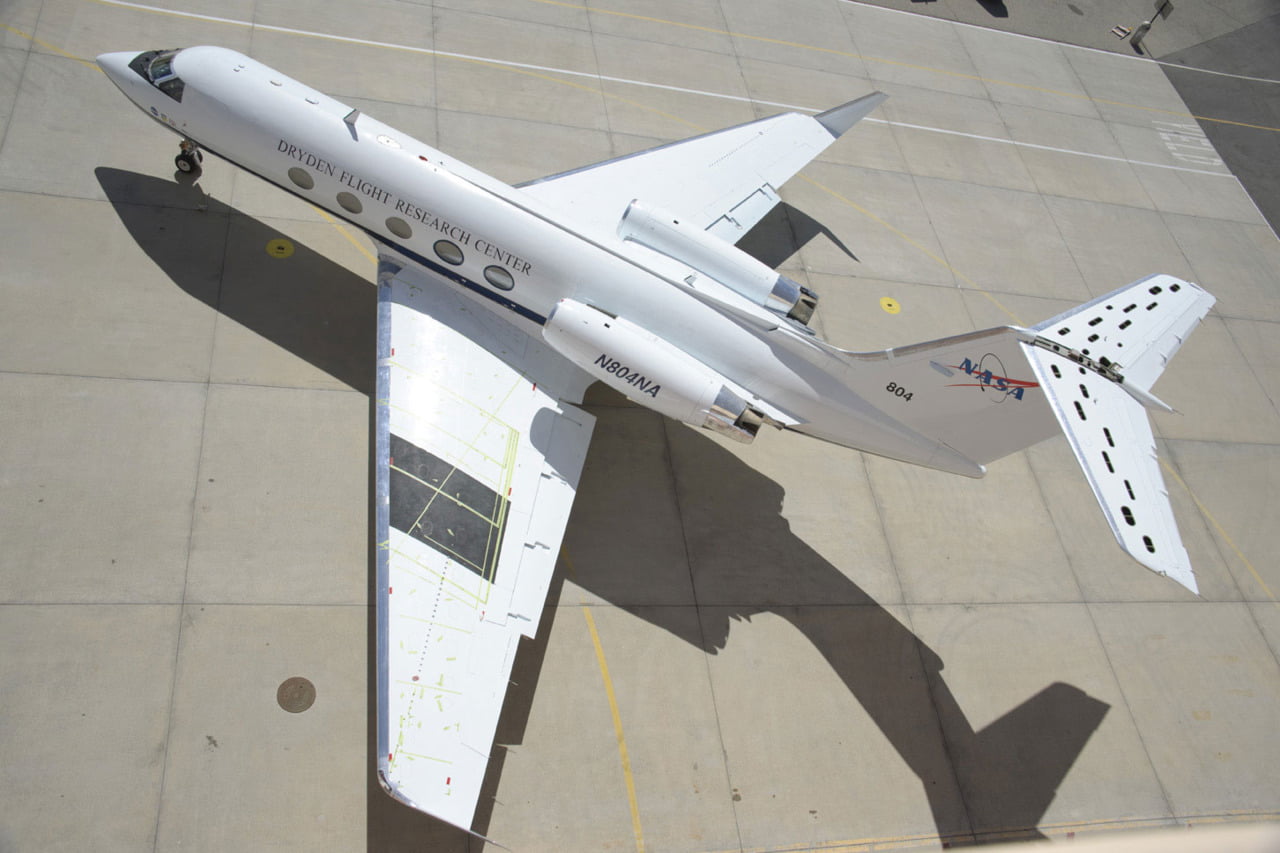
    On Wednesday, March 30, 2011 at 3:00 EDT NASA engineers are holding an online chat about a current project to achieve laminar flow control on business jet-class airplanes. Keeping flow over an airplane’s wings laminar could decrease the total drag on an airplane by as much as 15%. In particular, this project involves placing tiny hockey-puck-shaped discrete roughness elements (DREs) along the front of the wing. These DREs are positioned such that they perturb the mean-flow over the wing at a higher frequency than the naturally most unstable frequency; as a result, flow actually remains laminar over a greater extent of the wing than would normally be the case. For more on the technical ideas, see this NASA blog post or feel free to ask questions in the comments. #

    Full disclosure: This project is being conducted in joint with professors with whom I work, and the subject matter is related to my own research.

  • Featured Video Play Icon

    Aerodynamics with Bill Nye and Samuel L. Jackson

    Bill Nye, Samuel Jackson, golf balls, Reynolds number, dimples, and boundary layers. It doesn’t get much better than this. – Khristopher O (submitter)

    It definitely beats Jackson’s other foray into aerodynamics! The dimples on a golf ball cause turbulent boundary layers, which actually decrease drag on the ball and make it fly farther. Why bluff bodies experience a reduction in drag as speed (and thus Reynolds number) increases was a matter of great confusion for fluid mechanicians early in the twentieth century, but it’s not too hard to see why it happens with some flow visualization.

    On the top sphere, the laminar boundary layer separates from the sphere just past its shoulder. This results in a pressure loss on the backside of the sphere and, thus, an increase in drag. On the bottom sphere, a trip-wire placed just before the shoulder causes a turbulent boundary layer, which separates from the sphere farther along the backside. This late separation results in a thinner wake and a smaller pressure loss behind the sphere, thereby reducing the overall drag when compared to the laminar case. (Photo credit: An Album of Fluid Motion)

  • Discovery Wingtip Vortices

    Discovery Wingtip Vortices

    Wingtip vortices mark the path of Discovery as she makes her final landing. Though not always visible, these vortices are generated by any lifting body planform and can be a major source of induced drag on the craft. Here the vortices are visible because the low pressure in the core of the vortex caused a local temperature drop below the dew point, thus causing condensation. Such vortices persist for significant lengths of time in the wake of aircraft; they are a major source of wake turbulence, which limits how frequently aircraft can take-off or land on a single runway. (Photo by Jen Scheer)

  • Wright Brothers’ Wind Tunnel

    Wright Brothers’ Wind Tunnel

    A large part of the Wright Brothers’ ultimate success in creating the first powered heavier-than-air craft came as a result of work done in their homemade wind tunnel, shown above. In the aftermath of the failure of their 1901 Glider, the brothers decided that the lift and drag data they had used from Otto Lilienthal must be inaccurate. They built this wind tunnel and its force balances to measure lift and drag on two hundred different airfoils themselves and were rewarded with far more successful flights with their 1902 Glider, which led directly to the Wright Flyer in the following year. #

  • Reader Question: Swimming and Buoyancy

    Reader Question: Swimming and Buoyancy

    aniiika asks:

    How does buoyancy relate to swimming?

    Buoyancy is the force that enables a swimmer to float in the water, even when still. Buoyant force is equal to the weight of the fluid displaced by the swimmer; in other words, the density of the fluid multiplied by the volume of the swimmer that is submerged.

    Different people float at different heights in the water depending on many factors, such as body shape, amount of fat, and how much air is in their lungs. All of these things affect a person’s volume and/or density, thereby affecting the buoyant force they experience.

    Because a person’s body is not fully submerged their center of buoyancy–the point where all buoyant forces on the body can be represented by a single force–does not coincide with the center of mass (sometimes referred to as center of gravity). Where those forces are relative to one another determines the stability of a person floating in the water. Everyone’s center of buoyancy is higher than their center of mass, so people always float stably in an upright orientation. Our legs, for example, don’t float as well as our torsos, so, when floating horizontally, one’s legs will tend to sink.

    Swimmers can control their buoyancy to their advantage by actually pressing their upper chests further into the water. This tends to bring one’s hips closer to the surface and can reduce drag (#).

  • Bristling Scales Give Sharks Speed

    Bristling Scales Give Sharks Speed

    The shortfin mako shark is one of the ocean’s fastest and most agile hunters, thanks in part to flexible scales along its body. As water flows around the shark’s body, the scales bristle to angles in excess of 60 degrees. This causes turbulence in the boundary layer along the shark’s body and prevents boundary layer separation which would otherwise increase the shark’s drag. In this respect, the scales serve much the same purpose as dimples on a golf ball. (Abstract, National Geographic article) #

  • Featured Video Play Icon

    The No-Slip Condition

    Viscosity plays an important role near surfaces in fluid mechanics. Friction between the fluid and the solid surface creates a “no slip” condition at the wall. In the video, dye injected near the wall remains there because there is little or no velocity of the fluid near the wall. As the dye filament is pulled away, the speed of the bulk flow–the freestream–is apparent. A strong velocity gradient exists between the wall and the freestream; this narrow region of changing velocity is called a boundary layer and is a major topic of research due to its importance in determining drag and thermal loads on vehicles.