Tag: galapagos

  • Galapagos Week: Sea Turtles

    Galapagos Week: Sea Turtles

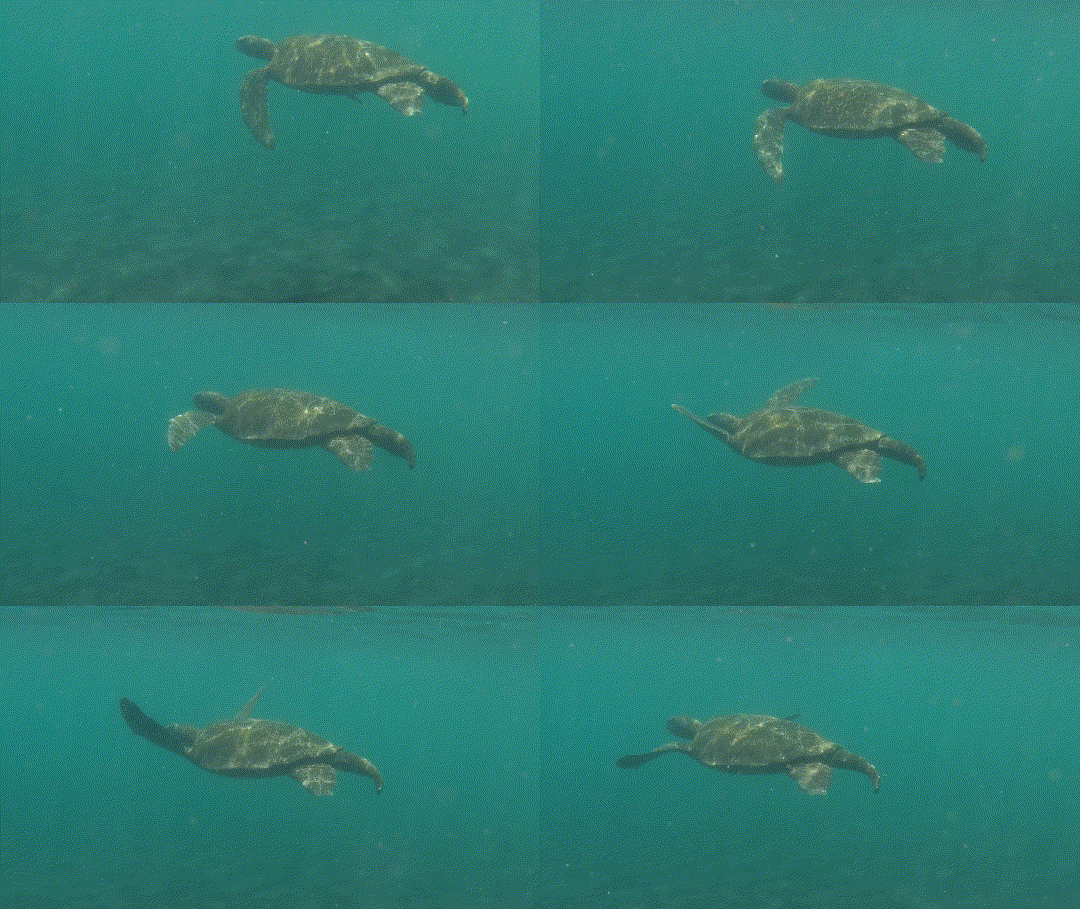
    It’s easy to imagine sea turtles as slow and awkward given our familiarity with their terrestrial cousins, tortoises, but this could hardly be further from the truth. There are currently seven living species of sea turtles and all use a mode of locomotion known as aquatic flight. As the name suggests, swimming sea turtles share a lot in common with birds and other fliers. They generate most of their propulsion by flapping their forelimbs. Like birds, they change the angle of attack of their flippers over the course of both their upstroke and downstroke. 

    Of course, a cruising sea turtle is more interested in thrust than lift, but the efficiency of flapping is far higher than that of a rowing motion. That holds true across a range of speeds and is probably why marine turtles, known for their vast migrations, predominantly use flapping. It’s also remarkable how fast they can move when they want to. The animations above show two species of sea turtles cruising casually at a speed where a snorkeler in fins could follow along. But when the turtles wanted to, they could take off at a clip no human could hope to match! (Image credit: N. Sharp; research credit: J. Davenport et al., J. Walker and M. Westneat, H. Prange, E. Dougherty et al.)

    Today’s post wraps up Galapagos Week here at FYFD, but there’s plenty more Galapagos-relevant fluid dynamics to go around. Here are some previous, related posts: how frigatebirds cruise the seas without getting wet;  aerodynamics of flying fish; hydrodynamics of humpback whales; incredible bioluminescent plankton; and leaping mobula rays

  • Galapagos Week: Diving Birds

    Galapagos Week: Diving Birds

    One of my favorite things to do while we were sailing along the Galapagos was watching the blue-footed boobies hunt. Like the gannets shown above, boobies are plunge divers. They circle overhead until they spot their prey, then they fold their wings and dive headfirst into the water, impacting at speeds of more than 20 m/s (~45 mph). It’s absolutely incredible to watch. The physics involved are impressive, too, especially considering how badly a human would be injured diving at their speeds! 

    Fluid dynamically speaking, there are three important phases to the birds’ entry. The first is the impact phase, which lasts from initial contact until the bird’s head is underwater. In the second phase, an air cavity forms behind the head and around the neck as it enters the water. Finally, when the chest – the widest point of the bird – hits the water, the bird reaches the submerged phase. 

    Mechanically, the most interesting part is the air cavity phase. During this time, the bird’s head is slowing down due to high hydrodynamic drag from the water, but the rest of the bird is still moving fast. That means the bird’s slender neck experiences strong compressive forces, which would tend to make it buckle. Researchers at Virginia Tech examined this very problem and found that the birds’ sizing – its head shape, neck length, and so forth – combined with their typical diving speeds kept these birds well away from the conditions that would cause their necks to buckle. With the added stabilization from the birds’ neck muscles, they estimated that gannets and other plunge divers might be able to safely dive at speeds twice what would kill a human! Check out the BBC video below to see high-speed footage of gannets diving. (Image credits: G. Lecoeur; B. Chang et al.; research credits: B. Chang et al., pdf; video credit: BBC)

    Tomorrow will be the final day of Galapagos Week. Catch up on previous posts here

  • Galapagos Week: Marine Iguanas

    Galapagos Week: Marine Iguanas

    One of the most unique inhabitants of the Galapagos Islands is the marine iguana. These reptiles live in colonies of thousands and subsist entirely on marine algae. Smaller iguanas are intertidal feeders, grazing on green and red algae when it is exposed near low tide. But the largest iguanas feed near midday by swimming out and diving to feed on richer pastures. 

    The iguanas are surprisingly good swimmers, even though marine iguanas exhibit little extra specialization for it compared to other iguana species. They swim both at the surface and underwater with an undulatory motion driven by their tails. The iguana also streamlines its body somewhat by tucking its legs along its sides. Although the marine iguana is a much slower and less efficient swimmer than a bony fish of equal size, swimming is still a good choice for getting around. The marine iguana expends only 75% as much energy per distance swimming as it does walking. The big challenge is staying warm in the cold Galapagos waters. Small iguanas are both less efficient swimmers and lose body heat faster. This is why you’ll only see the biggest iguanas feeding underwater. (Image credits: N. Sharp; research credit: K. Trillmich and F. Trillmich; J. Videler and B. Nolet; G. Bartholomew)

    This is the first post of Galapagos Week here on FYFD. Check back every day for new Galapagos-themed posts!