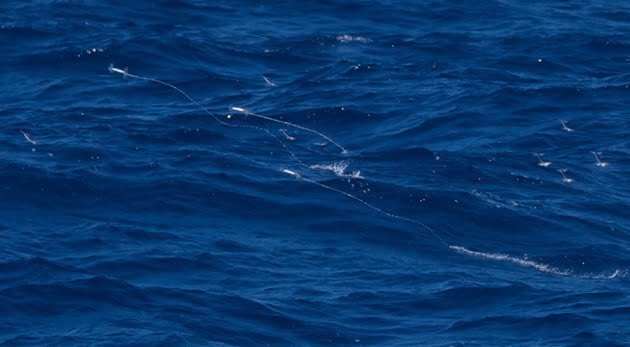
Some species of squid fly at speeds comparable to a motorboat for distances of 50 meters. The cephalopods get into the air the same way they swim underwater: by expelling a jet of water through the center of their body. Once aloft, the squids spread their tentacles to form a semi-rigid wing-like surface for lift. They can also use fins on their mantle as a canard for additional lift or control of their altitude. Researchers suspect the squids use flight as an escape mechanism to put distance between themselves and predators, but it could also be a low-energy migration strategy since a single pulse carries a squid farther in air than in water. (Video and image credit: TED-Ed)
Tag: squid

Bees, Squid, and Oil Plumes
It’s time for another JFM/FYFD collab video! April’s video brings us a taste of spring with research on how bees carry pollen, squid-inspired robotics, and understanding the physics of underwater plumes like the one that occurred in the Deepwater Horizons spill eight years ago. Check it all out in the video below. (Image and video credit: T. Crawford and N. Sharp)

Flying Squid
Ever seen a squid fly? Not many have, but the behavior may be more common than you think. Thanks to a set of photos from an amateur photographer, scientists have managed to estimate the velocity and acceleration of squid as they propel themselves out of the water by squirting a jet behind them. Researchers found that their speeds in air are roughly five times that in water, thanks to decreased drag. Previously it was thought that the flying behavior might be linked to escaping predators, but some now suggest that it enables migration over long distances by saving energy.
Can a Squid Fly?
Evidence is mounting that several kinds of squid will use jets of water to propel themselves into the air where they can actively fly some 50 times their body length.