Tag: ejecta

  • The Shape of Splashes

    The Shape of Splashes

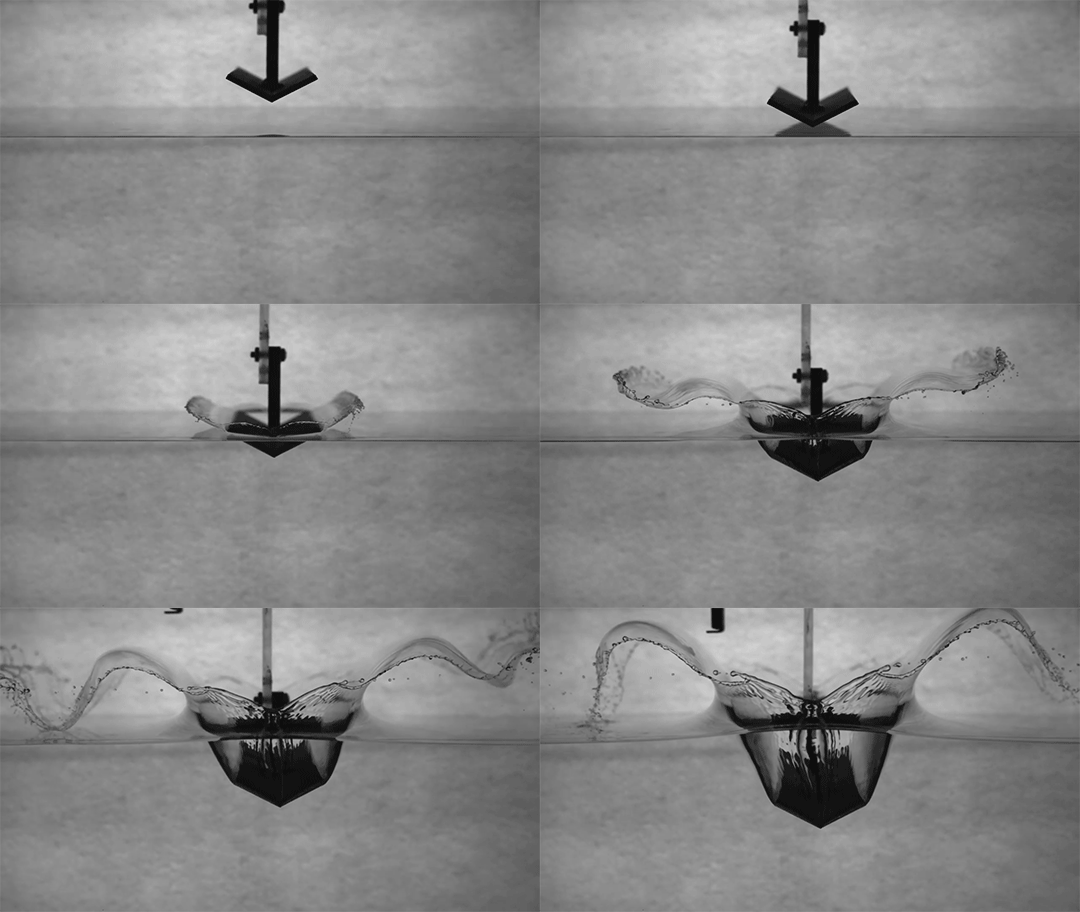
    When a wedge falls into a pool, it creates a distinctive, doubly-curved splash. Here’s how it works. When the front of the wedge first enters the water, it creates a thin sheet of fluid that gets ejected diagonally upward. As the wedge sinks further, the sheet thickens and ejects at a more vertical angle. That creates a low pressure zone in the air beside the splash, which causes outside air to flow inward, generating a sort of Venturi effect under the splash. Because the outer part of the splash sheet is thinner, it’s more strongly affected by the air flow beneath it, and it gets pulled downward, enhancing the splash’s curvature.

    This doubly-curved splash is particular to wedges of the right angle. To see what kind of splashes other shapes make, check out the video below. (Image and video credit: Z. Sakr et al.; for more, see L. Vincent et al.)

  • Rays in Craters

    Rays in Craters

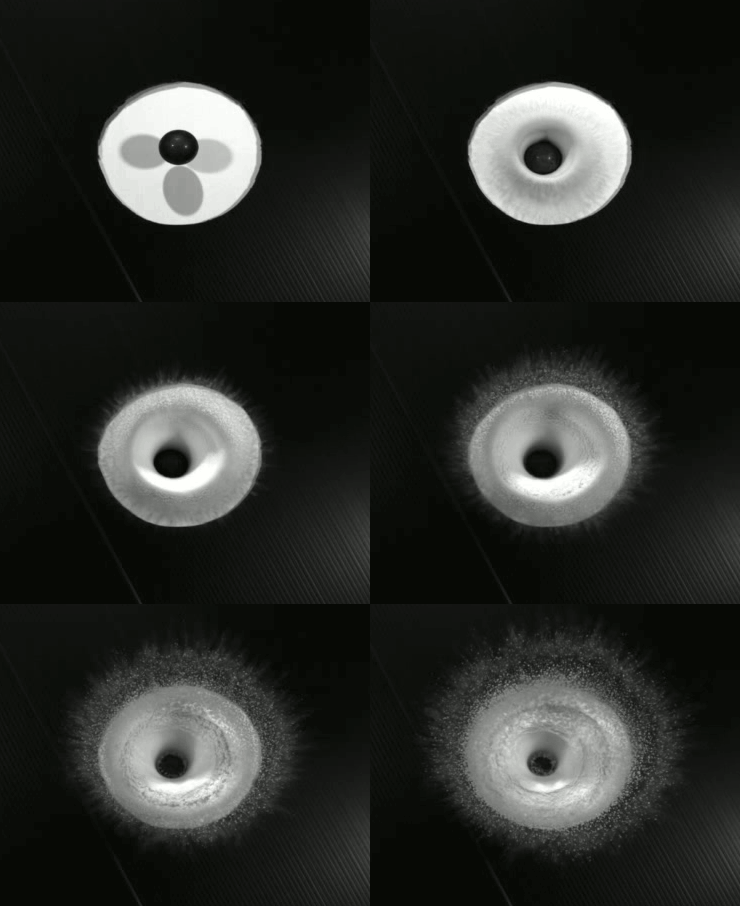
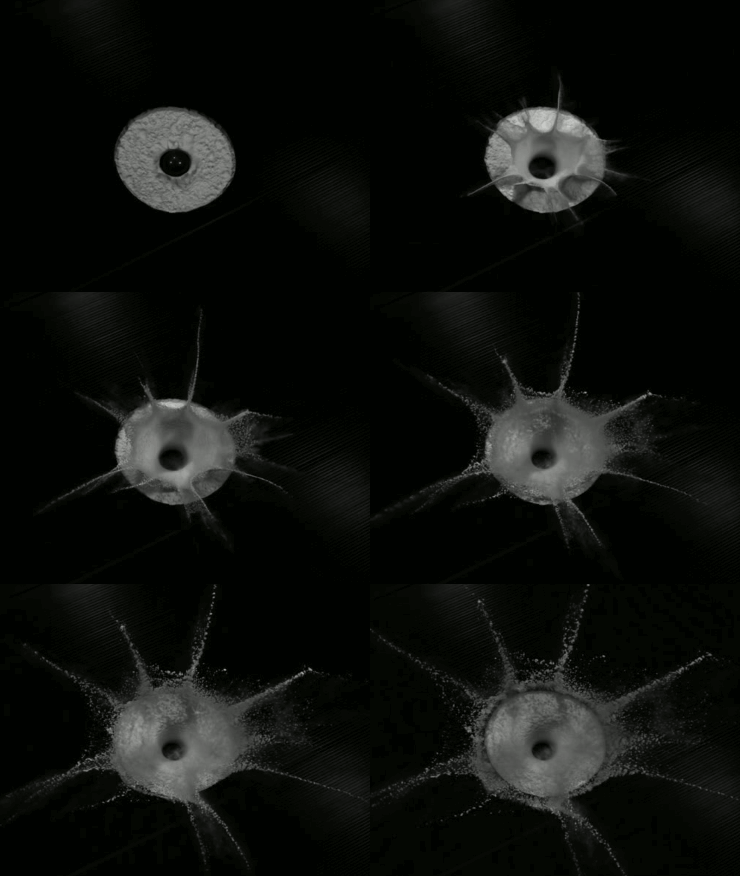
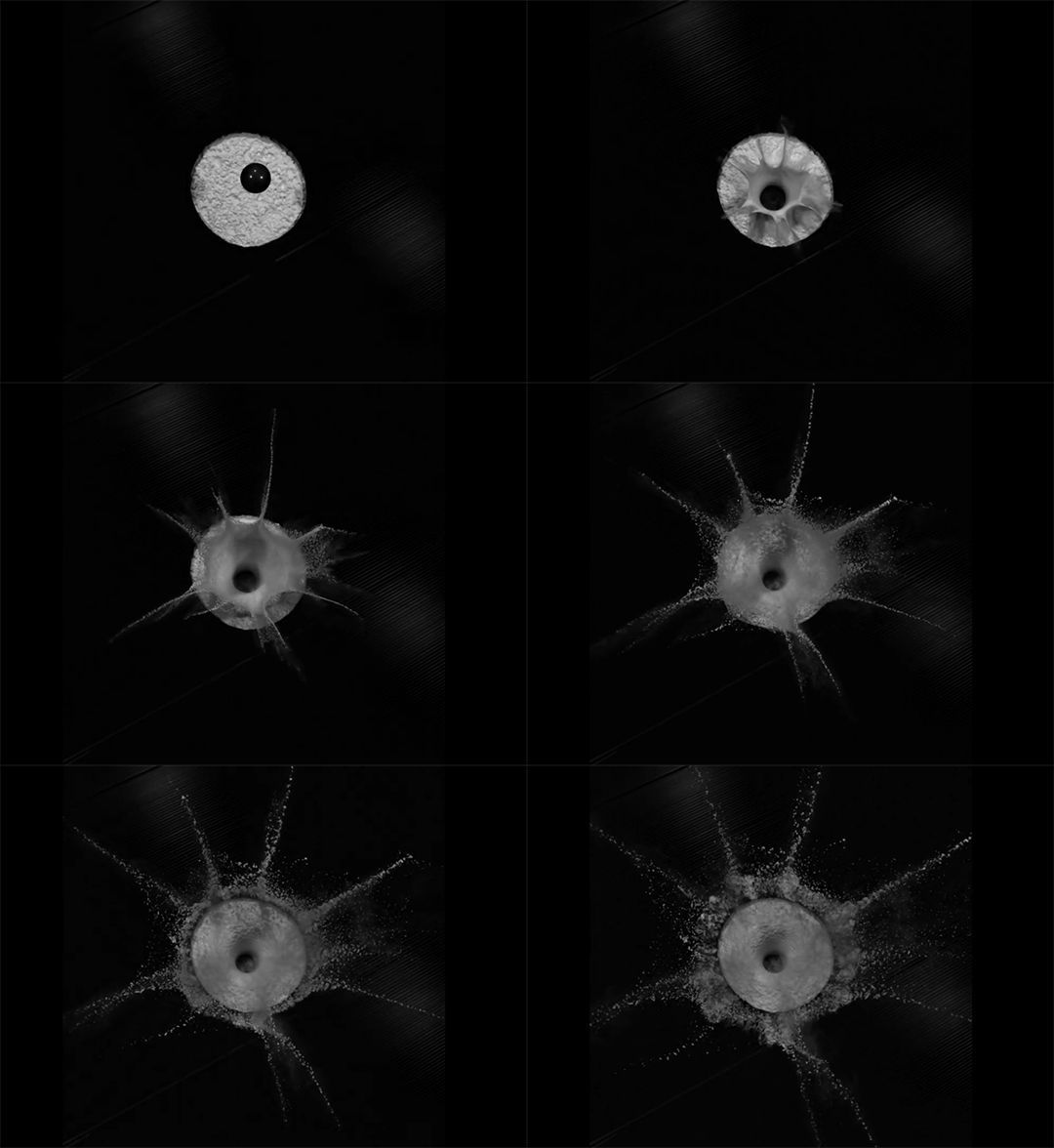
    On bodies around the solar system, there are craters marking billions of years’ worth of impacts. Many of these craters have rays–distinctive lines radiating out from the point of impact. But if you drop an object onto a smooth granular surface (upper left), the ejecta form a uniform splash with no rays. The impactor must hit a roughened surface (upper right) in order to leave rays. 

    Through experiment and simulation, researchers found that the rays emanate from valleys in the surface that come in contact with the impactor. Moreover, the number of rays that form depends only on the size of the impactor and the undulations of the surface. That means that, by knowing the topography of a planetary body and counting the number of rays left behind, scientists can now estimate what the size of the object that struck was! (Image, video, and research credit: T. Sabuwala et al.)

  • Craters and Rays

    Craters and Rays

    The history of our solar system is written in impact craters, but these craters have been remarkably mysterious for years. Scientists knew that you could recreate many of their features by dropping solid objects into granular materials like sand, but this did not produce the distinctive rays that we see around many real craters (bottom image, Mars). It was only by watching videos of schoolchildren recreating these experiments that scientists discovered what they’d been doing wrong: they’d smoothed the sand’s surface first. 

    It turns out that when you smooth the sand before impact (top left), you get an even ejecta curtain with no rays. But when the surface is uneven, as it is in kids’ experiments or on actual planetary bodies, suddenly rays form (top right). The object’s impact creates a shock wave in the granular medium, which becomes a rarefaction (i.e., expansion) wave when it reaches the surface. This is what actually ejects material. The uneven surface focuses those rarefaction waves, creating the distinctive ejecta rays. (Image credit: T. Sabawala et al., source; NASA; research credit: T. Sabawala et al.; via Jennifer O.)

  • Inside a Splash

    Inside a Splash

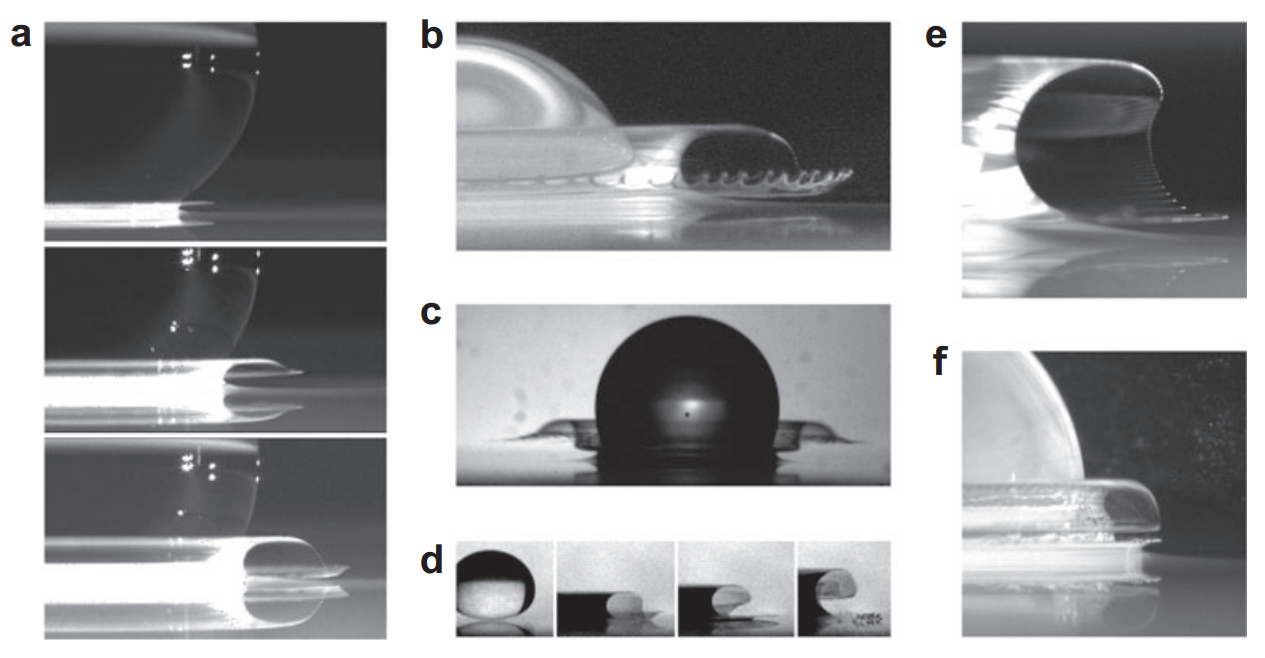
    When a droplet strikes a pool, a thin, fast-moving sheet of liquid expands outward from the region of contact. These ejecta sheets come in many forms depending on surface tension, viscosity, air pressure, and droplet momentum. When the ejecta sheet curls downward to touch the pool, it can spray microdroplets outward or trap a layer of air underneath the droplet. For more, see this video by S. Nagel et al., and the papers Thoroddsen (2002) and Thoroddsen et al. (2008).  (Photo credits: S. Thoroddsen et al.; GIF from this video by S. Thoroddsen et al.)