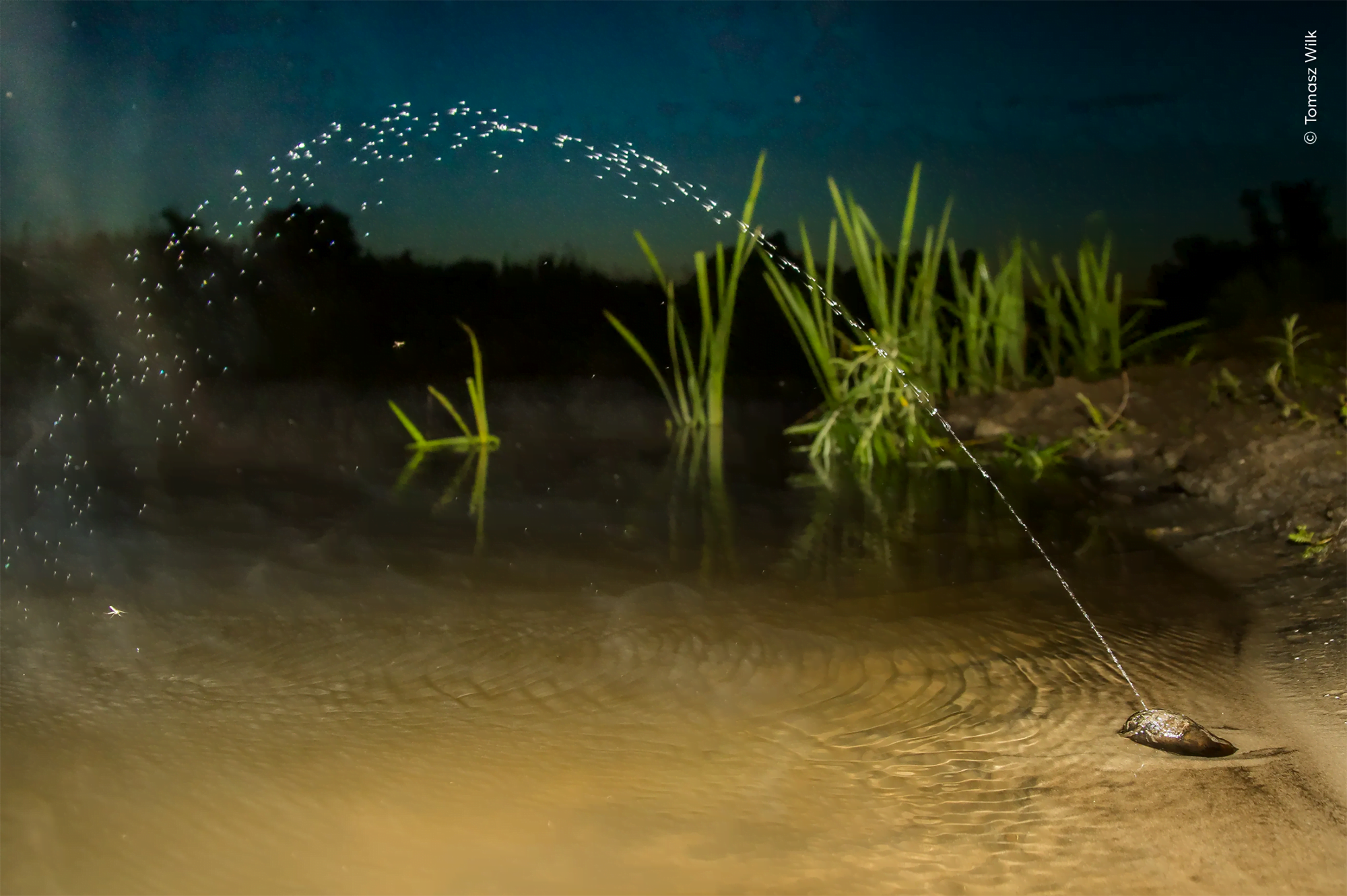
When Tomasz Wilk settled to camp one evening on the banks of a Polish river, he didn’t expect to find fountains in the shallows. Though reminiscent of an archer fish’s shot, this stream comes from a freshwater mussel. In spring, the mature female thick-shelled river mussels head to the shallows, where they edge a bit of their shell out of the water and release this fountain of water and larvae. Once dispersed, the larvae will attach (harmlessly) to the gills of fish until they grow into a juvenile mussel. (Image credit: T Wilk; via Wildlife POTY)
Tag: mussels

Anchoring Mussels


Mussels live in rough conditions, constantly pummeled by waves and turbulent currents. They hold themselves fast in the flow using dozens of byssel threads (commonly called a mussel’s beard) that anchor them to rocks and other mussels. The threads get built within the mussel’s foot, the tongue-like protrusion mussels use to drag themselves. The threads are similar to our ligaments: strong and stretchy. Each one is cemented securely using an adhesive that hardens in water. If engineers could replicate that adhesive, it would be fantastic for use in medicine. (Video and image credit: Deep Look)
Freshwater Mussels


Freshwater bivalves like these California floater mussels are critical species for the health of our waters. And although we don’t think of mussels as being very mobile, they’re actually quite active. As larvae, the mussels get released from their parent bivalve and attach to the fins or gills of a fish. While they develop, they cling to the fish, hitching a ride until they’re ready to strike out on their own. Considering the fluid forces typical on those areas of a fish, that means the larvae must have some impressive strength!
Once grown, the mussels anchor themselves using their tongue-like foot and begin their filter-feeding. They draw water in through a cilia-lined inlet, filter out algae, oxygen, and other nutrients, and expel clean water. This constant cycling, though largely invisible to the naked eye, is how bivalves keep their native waterways clean. (Image and video credit: Deep Look)

The Livers of Our Rivers
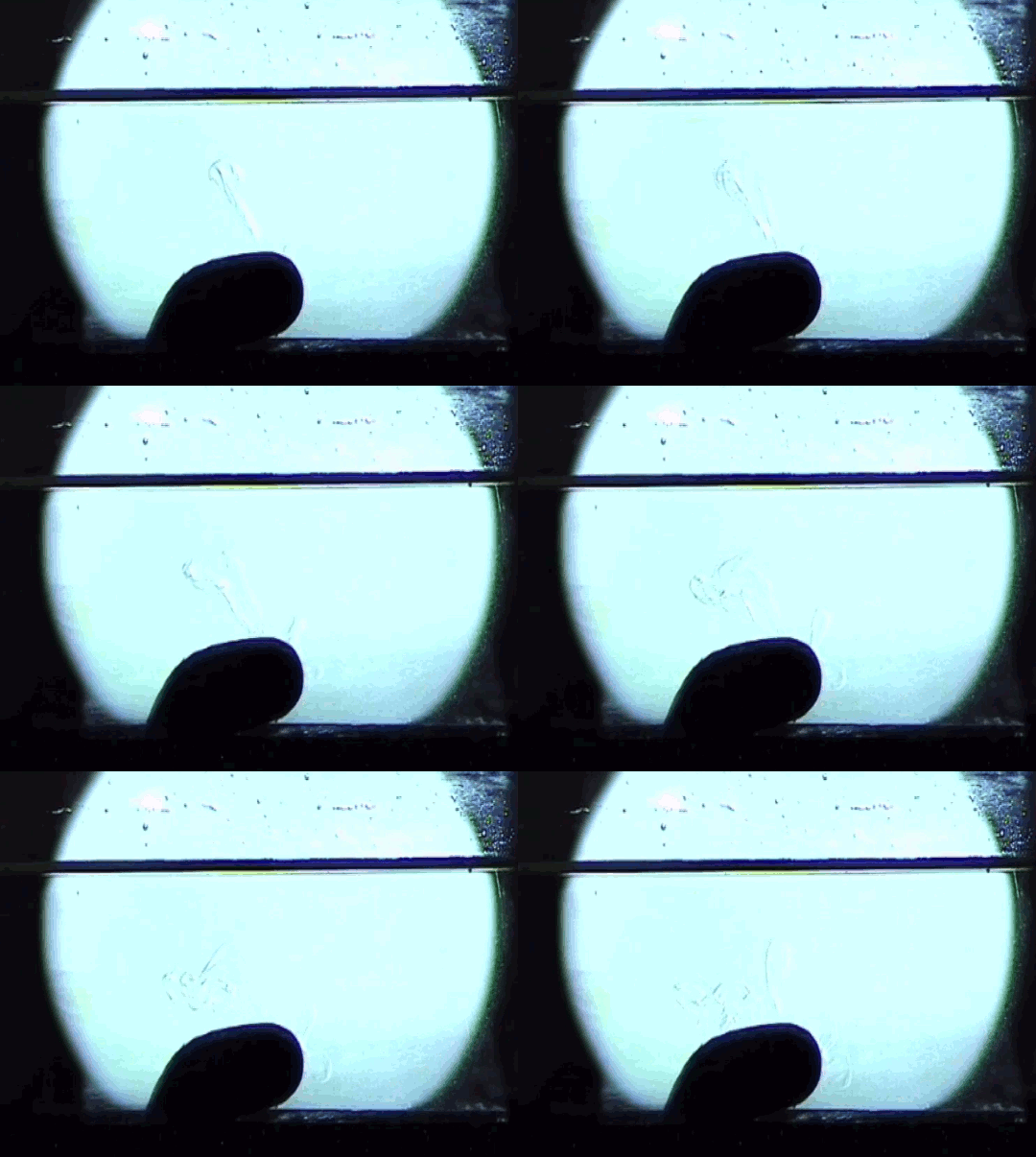
To the naked eye, mussels and other bivalves don’t appear to be doing much. But these filter feeders are hard at work. The mussel takes in water through its incurrent siphon (on the right side in this image), and tiny cilia move the water through its gills, which filter out plankton and other edibles. Wastewater flows out the exacurrent siphon, seen here as the plume coming out the top of the mussel.
Mussel species are important indicators of the health of both fresh and marine water bodies. Because they’re stationary and they are constantly processing the water, the health of these bivalves is indicative of the ecosystem’s overall health. (Image credit: S. Allen, source)
Mussels
In this video, schlieren imaging is used to make visible the flow field around a mussel. Mussels are filter-feeders, drawing nearby water in to obtain their food and expelling the unneeded fluid once they’ve gathered the plankton they eat. Normally this process is invisible to the naked eye, but schlieren imaging reveals changes in density (and thus refractive index) that make it possible to visualize the outflow from the mussel. The technique is also commonly used in supersonic flows to reveal shock waves. (Video credit: Stephen Allen)