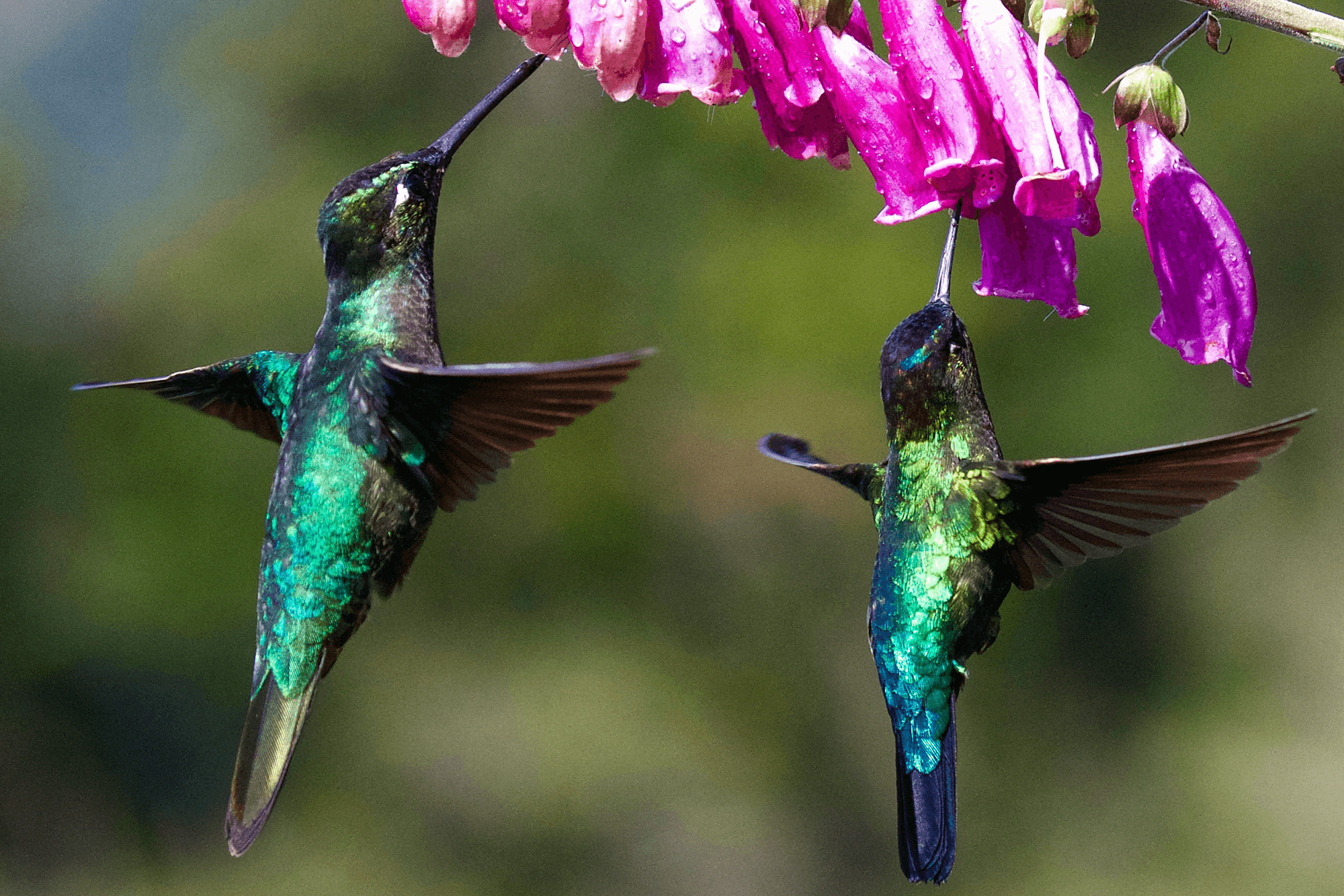
Hummingbirds and many insects hover when feeding, escaping predators, and mating. While scientists have decoded the mechanics of a hummingbird’s figure-8-like hovering wingstroke, it’s been harder to understand how the creatures control their hovering. Most of our attempts to control hovering require more computational power than hummingbirds and insects are thought to have. But this study describes a new control scheme: one that allows stable, real-time hovering with little computational cost. (Image credit: J. Wainscoat; research credit: A. Elgohary and S. Eisa; via APS)
Tag: active control

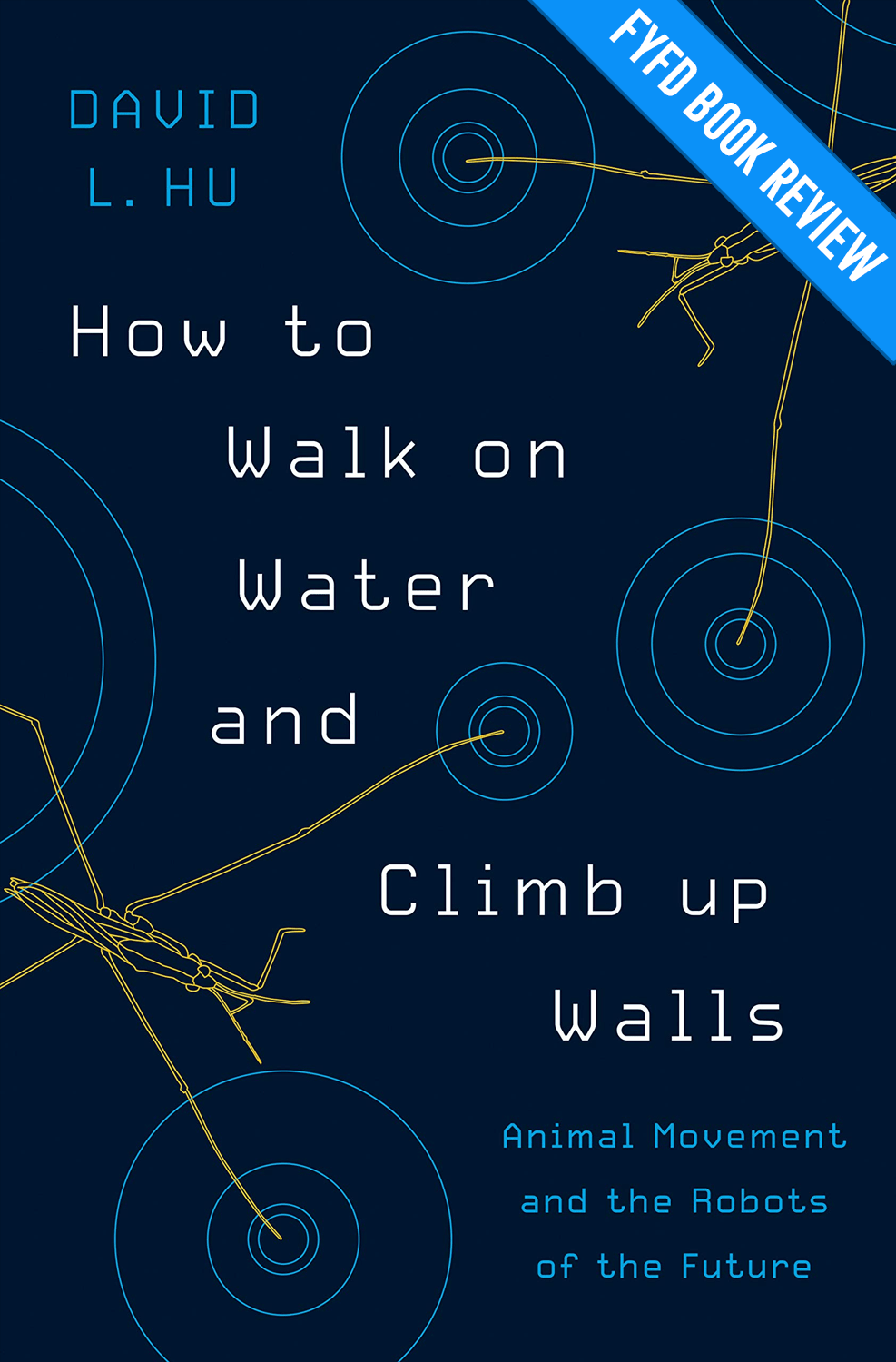
Review: “How to Walk on Water and Climb Up Walls”


“An eight-year-old girl kicked her feet back and forth on the seat of a Long Island Railroad train. I beckoned her to cover over and pointed to the top of my winter jacket, which I slowly unzipped. Inside, nestling against me for warmth, were ten snakes, their forked tongues waving back and forth. The child shrieked and ran back over to her mother, who was napping. ‘That man has a coat full of snakes,’ she shouted.”
So begins Chapter 2 of Dr. David Hu’s new book, How to Walk on Water and Climb Up Walls (*), a captivating and funny journey through animal locomotion and biorobotics. Don’t let that fool you, though; this book has plenty of fluid dynamics to it. Long-time FYFD readers will recognize some of the topics, such as the fluid-like behavior of fire ants, how eyelashes keep our eyes clean and moist, and why swimming behind an obstacle is so easy even a dead fish (like the one shown above) can do it.
There are plenty of exciting, new stories as well, like how sandfish – a type of lizard – can swim under sand and why a lamprey’s nervous system may lead to better robots. The explanation of how cockroaches are virtually unsquishable and able to squeeze themselves into crevices a quarter of their height absolutely floored me.
Hu’s book offers a front-row seat to research at the cutting edge of biology, engineering, and physics, with anecdotes, explanations, and applications that will stick with you long after you put the book down. If you’re looking for a holiday gift for yourself or another science-lover, check this one out for certain (*).
*Disclosures: I purchased my copy of this book using my own funds, and this review is not sponsored in any way. This post contains affiliate links – marked with (*); if you click on one of these links and purchase something, FYFD may receive a small commission at no additional cost to you.
(Image credits: book – Princeton University Press; fish – D. Beal et al.; ants – Vox/Georgia Tech; eyelashes – G. Diaz Fornaro; shark denticles – J. Oeffner and G. Lauder)

Drawing With Microfluidic Tweezers

One of the challenges of dealing with objects at the microscale is finding ways to manipulate them. This is what techniques like optical tweezers or magnetic traps are used for. The downside to these methods is that they often require complex experimental set-ups or place restrictions on the kinds of particles that can be manipulated. Recently, however, researchers have developed a new hydrodynamic alternative: the Stokes trap.
Using a six-channel microfluidic device like the the ones shown in A) and B) above, scientists can alter the flow in the device in such a way that they trap and manipulate two particles at the same time. The simultaneous inflow and outflow in the device creates streamlines like those shown in C) and D) above. The large white areas where the streamlines converge and diverge are stagnation points–areas of little to no velocity. The scientists trap their particles at the stagnation points and then carefully shift the flow rates into and out of the device to move the stagnation points–with particles in tow–wherever they want them. In the animation, you can see part of a movie where they use the particles to write out a capital I (for University of Illinois). The researchers hope the technique will be used in the future for studying the physics of soft materials and biologically-relevant molecules like DNA. For more, check out the full paper or the group’s website. (Image credit and submission: C. Schroeder et al.)

Hummingbird Hovering
Hummingbirds have a unique way of flying among birds. By flapping in a figure-8 motion, they generate lift on both the upstroke and the downstroke, which enables them to fly forward, backward, and even hover for extended periods. Such mid-air acrobatics are necessary for a species that feeds on flower nectar. What is especially impressive about the birds, though, is how they hold up even in adverse conditions like wind or rain. By placing birds in a wind tunnel and filming with high-speed video, researchers can see how hummingbirds maintain their feeding position even in 20 mph (32 kph) winds. By fanning out their tail feathers like a rudder, they can control their body orientation despite turbulent gusts. Not even rain stops them. The birds will periodically shake themselves dry, much like a dog if a dog could manage to fly while shaking itself. (Video credit: Deep Look; submitted by entropy-perturbation)
Fine-Tuning Flight
We humans generally use fixed wings for flight, but in nature, flapping flight dominates. As an animal flaps, it extends or draws in its wings during key points of the cycle in order to change its aerodynamics. But this control can be more than just a matter of stretching their wings. Recent work on bats shows that they can fine-tune the stiffness of their wings’ membrane using tiny, hair-thin muscles. Each muscle is too slight to change a wing’s shape on its own, but by firing synchronously–tensing on the downstroke and relaxing on the upstroke–the bat can manipulate its membrane stiffness and thereby affect its wing shape. Moreover, the timing of the muscles’ action changes with flight speed, suggesting that the bats are actively controlling their aerodynamics during flight. (Video credit: Swartz-Breuer lab/Brown University; via Futurity; submitted by Boris M)

Stopping the Slosh
Sloshing is a problem with which anyone who has carried an overly full cup is familiar. Because of their freedom to flow and conform to any shape, fluids can shift their shape and center of mass drastically when transported. The issue can be especially pronounced in a partially-filled tank. The sloshing of water in a tank on a pick-up truck, for example, can be enough to rock the entire vehicle. One way to deal with sloshing is actively-controlled vibration damping – in other words, making small movements in response to the sloshing to keep the amplitude small. This is exactly the kind of compensation we do when carrying a mug of coffee without spilling. (Image credit: Bosch Rexroth; source)
Diving Peregrines
Few animals can compete with a peregrine falcon for pure speed. There is evidence that, when diving, the falcon can reach speeds upward of 200 mph (320 kph). That the birds can achieve this by pulling their wings back into a low-drag profile is impressive, but the control they exert to do so is even more astounding. The placement and acuity of a falcon’s eyes would require tilting its head roughly 40 degrees if diving straight down on its prey. Such asymmetry increases their drag by more than 50% and creates a torque that yaws the bird. Instead, as seen in the video above, the falcon keeps its head straight and flies in a spiral-like dive, allowing it to maintain sight contact with its target and maximizing its speed despite the extended dive. (Video credit: BBC; research credit: V. A. Tucker)
Can a Squid Fly?
Evidence is mounting that several kinds of squid will use jets of water to propel themselves into the air where they can actively fly some 50 times their body length.