Tag: swallowing

  • Sliding Foams

    Sliding Foams

    What happens when a foam interacts with a sliding surface? That’s the question at the heart of this study, which finds three major regimes of foam-surface interaction. On smooth surfaces (Image 1), foams will simply slide against the wall without sticking or deforming. When surface roughness is about as large as the foam’s wall thickness (Image 2), the foam will stick to individual asperities, then slip to the next rough spot as the wall moves. But when the surface roughness is large compared to the foam wall (Image 3), the foam will remain anchored to the surface and all the shear from the wall’s movement goes into deforming the bulk of the foam.

    Researchers thus found they could change foam’s behavior by changing the surface roughness. They also looked at the reverse situation: a surface with fixed roughness — like, say, a human tongue — and how tuning the size of foam bubbles might alter perception and ease of swallowing. That’s what we’re looking at in the last image, where a spoon slides a foam along a surface with roughness similar to the human tongue. (Image and research credit: M. Marchand et al.)

  • Swallowing Physics

    Swallowing Physics

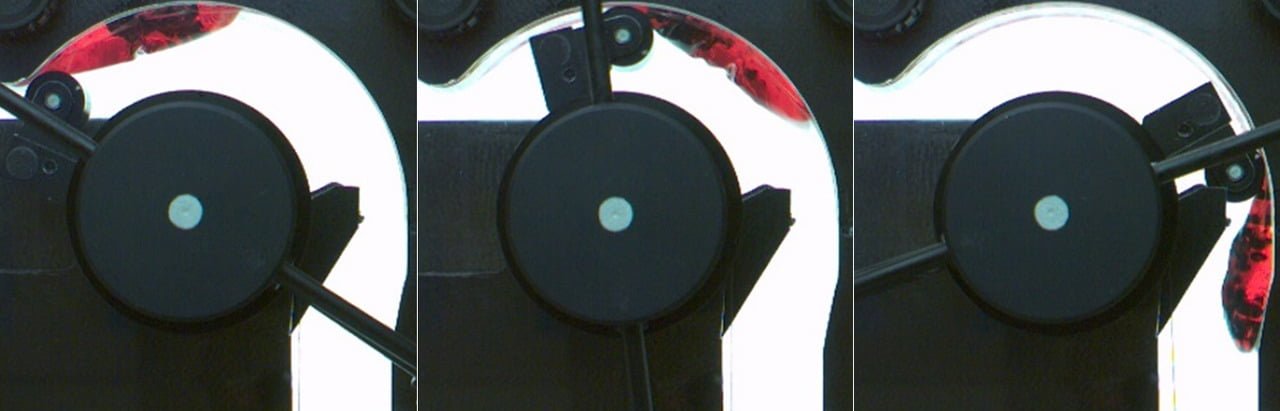
    Swallowing – whether of food, beverage, or medication – is an important process for humans, but it’s one many struggle with, especially as they age. To help study the physics behind swallowing, one research group has built an artificial mouth and throat model, shown in the bottom row of images. The model uses rollers to imitate the wave-like motion of swallowing. 

    In our mouths, chewed food typically combines with saliva to form a soft ball we can move from our tongue and down our throat with a series of reflex actions. How easily we swallow something depends on its flow properties, our saliva, shape, and more. 

    In their early studies of model swallowing, researchers have focused on what it takes to swallow pills (suspended in liquid). What they found is probably consistent with your own experience: smaller pills are easier to swallow than large ones, and elongated pills are easier to swallow than round ones of the same volume. That seems to be a function of elongated pills’ smaller cross-section when aligned with flow going down the throat. As the research continues, scientists hope to explore what can be done to make food easier to swallow for those who struggle with it. (Image credits: meal – D. Shevtsova; model – M. Marconati; via APS Physics; submitted by Kam-Yung Soh)