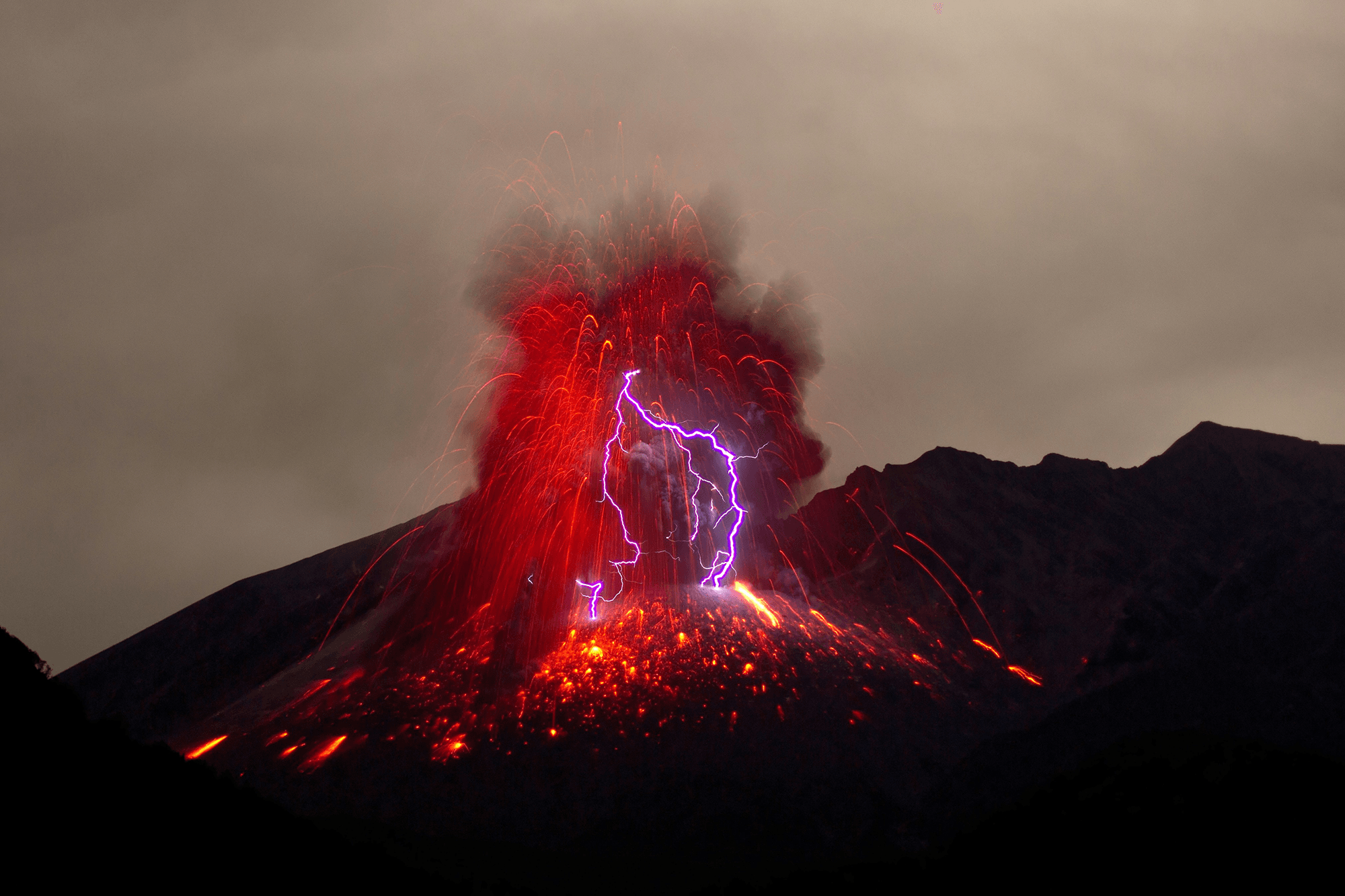
In volcanic eruptions, collisions between ash particles can sometimes build up enough electric charge for lightning to arc through the plume. Scientists have long debated how this happens–it’s not obvious that insulating materials like oxides would build up electric charges through contact, especially when dealing with substances of the same material. It’s not like rubbing a balloon against your hair, where each material–and its tendency to hold a charge–differs.

To test how charges build on identical materials, a team of scientists used acoustic levitation to repeatedly bounce a silica bead against an identically treated silica plate, observing their charge build-up. Then they would take one of the pieces–either the sphere or the plate–and treat it to strip away the film of molecules that naturally adsorb onto the surface over time. Then they bounced the treated and untreated surfaces off one another again.
The result was–pardon the pun–striking. Whichever surface had been treated to remove adsorbates charged more negatively the second time around. Looking more closely at what they were removing, the team found their surfaces were mostly adsorbing carbon molecules. And if they iteratively removed the carbon from both the sphere and plate, they could no longer charge the two through collision. It seems that the key to charging two oxides off one another is actually the difference between the incidental amounts of carbon on their surfaces! (Image credit: volcano – M. Szeglat, experiment – G. Grosjean et al.; research credit: G. Grosjean et al.; via Gizmodo)