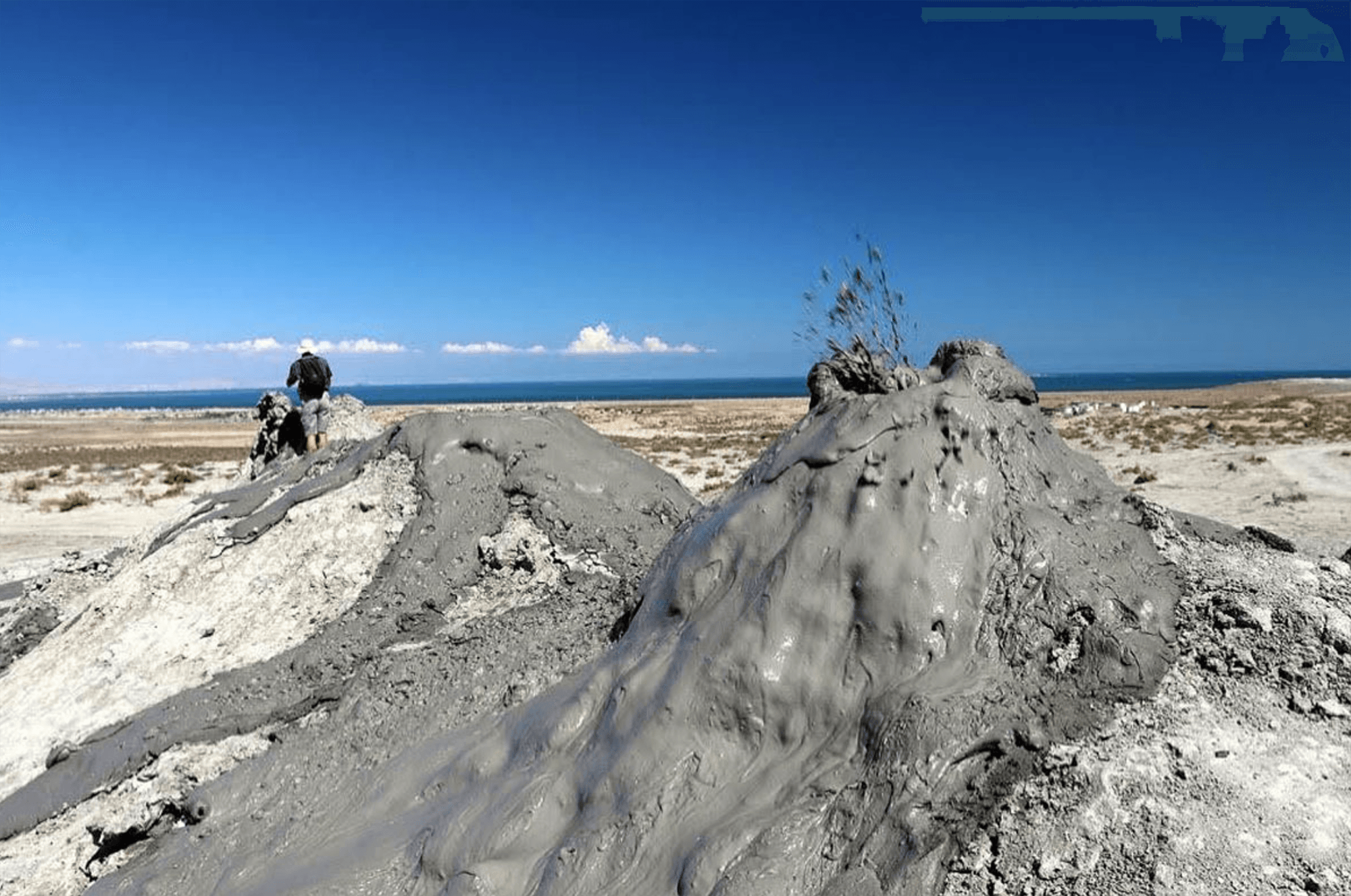
Mars features mounds that resemble our terrestrial mud volcanoes, suggesting that a similar form of mudflow occurs on Mars. But Mars’ thin atmosphere and frigid temperatures mean that water — a prime ingredient of any mud — is almost always in either solid or gaseous form on the planet. So researchers explored whether salty muds could flow under Martian conditions. They tested a variety of salts, at different concentrations, in a low-pressure chamber calibrated to Mars-like temperatures and pressures. The salts lowered water’s freezing point, allowing the muds to remain fluid. Even a relatively small amount of sodium chloride — 2.5% by weight — allowed muds to flow far. The team also found that the salt content affected the shape the flowing mud took, with flows ranging from narrow, ropey patterns to broad, even sheets. (Image credit: P. Brož/Wikimedia Commons; research credit: O. Krýza et al.; via Eos)
Tag: mud

Mud Pots


Mud pots, or mud volcanoes, form when volcanic gases escape underlying magma and rise through water and earth to form bubbling mud pits. I had the chance to watch some at Yellowstone National Park a few years ago and they are bizarrely fascinating. In this Physics Girl video, Dianna recounts her adventures in trying to locate some mud pots in southern California and explains the geology that enables them there. And if you haven’t seen it yet, check out her related video on the only known moving mud puddle! (Image and video credit: Physics Girl)
Exploring Martian Mud Flows


When looking at Mars and other parts of our solar system, planetary scientists are faced with a critical question: if what I’m looking at is similar to something on Earth, did it form the same way it does here? In other words, if something on Mars looks like a terrestrial lava flow, is it actually made of igneous rock or something else?
To tackle this question, a team of researchers explored mud flows in a pressure chamber under both Earth-like and Martian conditions. They found that mud flowed quite freely on Earth, but with Martian temperatures and pressures, the flows resembled lava flows like those found in Hawaii or the Galapagos Islands.
On Mars, mud begins boiling once it reaches the low pressure of the surface. This boiling cools it, causing the outer layer of the mud to freeze into an increasingly viscous crust, which changes how the mud flows. In this regard, it’s very similar to cooling lava, even though the heat loss mechanisms are different. (Video and research credit: P. Brož et al.; image credit: N. Sharp; see also P. Brož; submitted by Kam-Yung Soh)



.JPG)