Category: Book Review

  • Review: “How to Walk on Water and Climb Up Walls”

    Review: “How to Walk on Water and Climb Up Walls”

    “An eight-year-old girl kicked her feet back and forth on the seat of a Long Island Railroad train. I beckoned her to cover over and pointed to the top of my winter jacket, which I slowly unzipped. Inside, nestling against me for warmth, were ten snakes, their forked tongues waving back and forth. The child shrieked and ran back over to her mother, who was napping. ‘That man has a coat full of snakes,’ she shouted.”

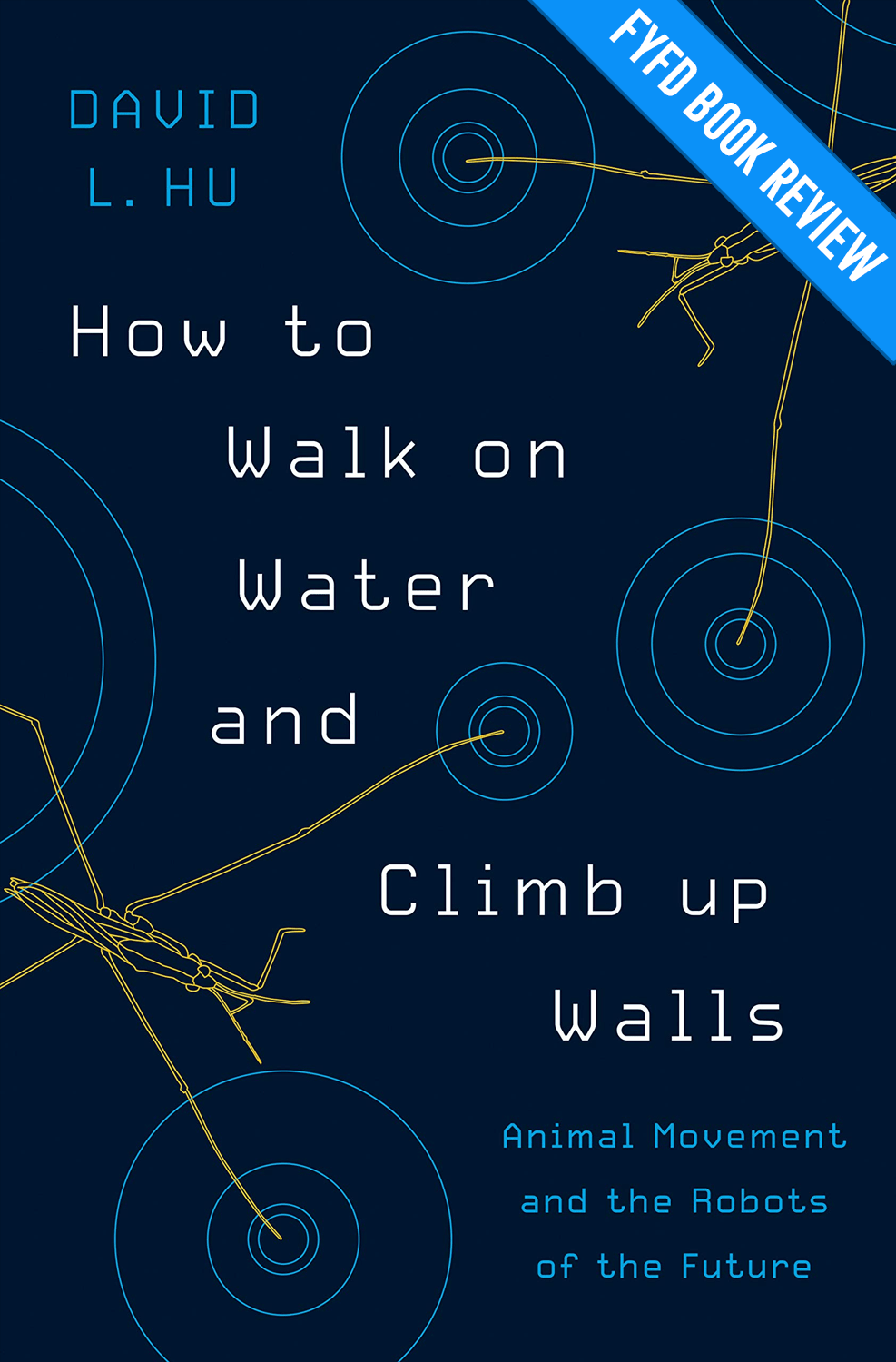
    So begins Chapter 2 of Dr. David Hu’s new book, How to Walk on Water and Climb Up Walls (*), a captivating and funny journey through animal locomotion and biorobotics. Don’t let that fool you, though; this book has plenty of fluid dynamics to it. Long-time FYFD readers will recognize some of the topics, such as the fluid-like behavior of fire ants, how eyelashes keep our eyes clean and moist, and why swimming behind an obstacle is so easy even a dead fish (like the one shown above) can do it.

    There are plenty of exciting, new stories as well, like how sandfish – a type of lizard – can swim under sand and why a lamprey’s nervous system may lead to better robots. The explanation of how cockroaches are virtually unsquishable and able to squeeze themselves into crevices a quarter of their height absolutely floored me. 

    Hu’s book offers a front-row seat to research at the cutting edge of biology, engineering, and physics, with anecdotes, explanations, and applications that will stick with you long after you put the book down. If you’re looking for a holiday gift for yourself or another science-lover, check this one out for certain (*).

    *Disclosures: I purchased my copy of this book using my own funds, and this review is not sponsored in any way. This post contains affiliate links – marked with (*); if you click on one of these links and purchase something, FYFD may receive a small commission at no additional cost to you.

    (Image credits: book – Princeton University Press; fish – D. Beal et al.; ants – Vox/Georgia Tech; eyelashes –  G. Diaz Fornaro; shark denticles – J. Oeffner and G. Lauder)

  • Review: “ABCs From Space”

    Review: “ABCs From Space”

    For me, one of the most fun aspects of studying science is seeking out examples of it in the world around us. Adam Voiland – who writes for NASA Earth Observatory, one of FYFD’s favorite sources for excellent fluids in action – takes this a step further with his children’s book “ABCs From Space: A Discovered Alphabet”. Voiland has sought out satellite imagery from around the world to illustrate all twenty-six letters, creating a lovely book for budding scientists of all sorts.

    Each letter has its own full-page image with no added text, like the G and H shown above. Younger children will have fun identifying and tracing out each letter. The back of the book provides more detail for older kids and adults, including brief descriptions of where and what each image shows, a map of all image locations, and some FAQs about satellite imagery and the geology, meteorology, and earth science on display. There are enough specifics to satisfy casual interest, but I suspect that science-inclined adults will find the book a fun springboard for more in-depth discussions with curious kids.

    Fluid dynamics itself makes a solid showing in the book. Several letters are formed by vortices (like G above) and various types of clouds, including the ship track clouds (like H) that form when water condenses on aerosols released by ship exhaust. There are also meandering rivers, creeping glaciers, and erosion features among the letters.

    I’m often asked about resources for teaching kids about fluid dynamics, and Voiland’s book is a great option for introducing that subject, as well as many other fields of science. (Image credits: A. Voiland/Simon & Schuster)

    Disclosure: I received a review copy of this book but was not otherwise compensated by the author or publisher. All opinions are my own. Additionally, this post contains affiliate links. Purchases made using these links do not cost you anything extra but may provide FYFD with a commission. Thanks!

  • Review: “Life in Moving Fluids”

    Review: “Life in Moving Fluids”

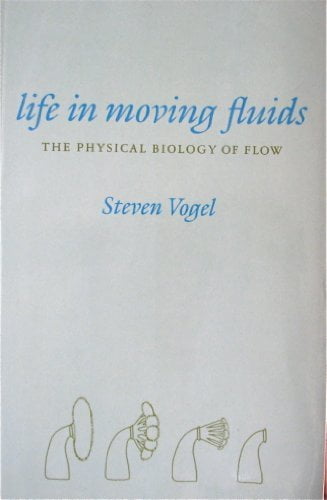
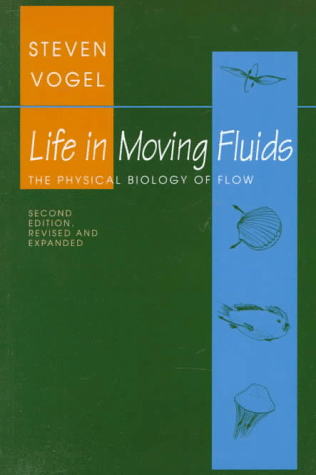
    If you liked the prairie dog post earlier this week and you’re interested in more examples of biological fluid dynamics, you may enjoy Steven Vogel’s “Life in Moving Fluids”. I’m often asked for suggestions of readable textbooks for those who want an introduction to fluid dynamics, and this book is a great option. It addresses a wide variety of basic fluids concepts without getting as bogged down mathematically as many of the engineering texts do. It is written as an introduction to fluid dynamics for working biologists, though, so it contains plenty of technical detail – including relevant equations, discussions of basic flow measurement techniques, and overviews of the early academic literature.

    It is also chock full of interesting biological applications of fluid dynamics with examples ranging from the growth patterns of barnacles to the shape-shifting drag capabilities of trees. Vogel keeps a light-hearted tone and dry humor throughout and doesn’t shy away from puns.

    I read a first edition of the book (copyright 1981). The second edition, from the mid ‘90s, has updated coverage of the research literature, but I dare say the the topic has exploded within the last 20 years, so your mileage may vary with regard to the literature review. However, age in no way impacts the quality of Vogel’s coverage of the basics of fluid dynamics, and I feel confident in recommending this as an introductory text for those who’d like to pursue fluids in more depth.  (Images: S. Vogel/Princeton U. Press; h/t to Chris R.)