Complicated shock wave patterns envelope vehicles traveling at supersonic and hypersonic speeds. A shock wave is essentially a very tiny region–only a few mean free path lengths wide–over which flow conditions, including density, pressure, velocity, and temperature, change drastically. The image above shows a model of the Space Shuttle at a re-entry-like, high angle of attack at around Mach 20 in one of NASA Langley’s historic helium tunnels. The eerie glow outlining the shock structures around the model is a result of electron-beam fluorescence. In this flow visualization technique, a beam of high-energy electrons is swept over the model, causing the gas molecules to fluoresce according to temperature. (Photo credit: NASA Langley)
Tag: hypersonic flight

Fluids Round-up – 25 May 2013
Sometimes I come across cool links and stories about fluid dynamics that don’t quite fit into a typical FYFD post, but I’d like to start sharing those semi-regularly with round-up posts. Here’s some fun stuff I’ve seen lately:
- We’ve talked before about penguins and fluid dynamics, but this IOP talk from Helen Czerski is a great take on how they use fluids to escape predators.
- Over at FlowViz, Richard has a great video demonstrating deep versus shallow water waves side-by-side.
- io9 shows off the vibrational modes of mercury as well as explaining why birds can be good at flying or swimming but not both.
- Giant paint explosions (specifically here) may be fun to watch but the dangers are not for squeamish viewers.
- Dylan G sent us this 512K real-time fluid particle simulation that’s a fun distraction.
- xckd’s Randall Munroe answers all kinds of physics questions at his What If? blog, but occasionally there are some fluids ones. Two of my favorites consider a hypersonic steak and what happens if the glass is literally half full.
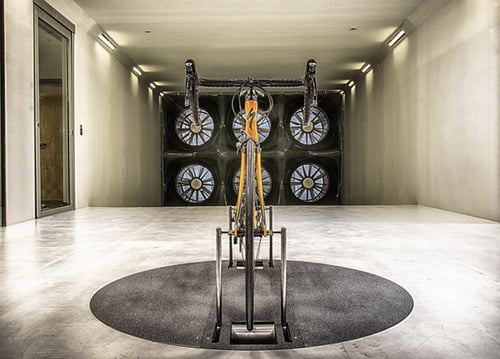
- Finally, for the cyclists and triathletes among you, the recent news that bicycle manufacturer Specialized has built its own wind tunnel has generated lots of discussion of aerodynamics in sport. Mark Cote (@MITAeroBike) and Chris Yu (@chrisyuinc) of Specialized’s aero R&D have been answering questions on Slowtwitch, Twitter, and in live chats.
And, yes, that last Specialized video chat includes an FYFD shout-out about 49 minutes in. 🙂
(Photo credit: Specialized)

How Scramjets Work
The scramjet–supersonic combustion ramjet–engine has been a holy grail of aerospace engineering for 50 years. It is an air-breathing engine with no moving parts capable of propelling crafts at hypersonic speeds beyond Mach 5. As indicated in the name, combustion in the scramjet occurs at supersonic speeds, where the heating due to air compression is sufficient to ignite fuel when injected into the engine. At present the record for the highest speed attained in scramjet flight is held by the NASA X-43A, which reached Mach 9.8 in 2004 after about 10 seconds of scramjet free-flight. The longest scramjet flight belongs to the Boeing X-51 Waverider with 140 seconds of burn time in a 2010 test flight. Few tests of these experimental hypersonic crafts have been completely successful; they represent the frontier of aerospace technology.

X-51A Scramjet Test Flight
The X-51A Waverider hypersonic aircraft had its second test flight earlier this week. Unfortunately, its supersonic combustion ramjet (scramjet) engine failed to transition from its start-up fuel to its primary fuel. According to the US Air Force Research Laboratory:
A US Air Force B-52H Stratofortress released the experimental vehicle from an altitude of approximately 50,000 feet. After release the X-51A was initially accelerated by a solid rocket booster to a speed just over Mach 5. The experimental aircraft’s air breathing scramjet engine lit on ethylene and attempted to transition to JP7 fuel operation when the vehicle experienced an inlet un-start. The hypersonic vehicle attempted to restart and oriented itself to optimize engine start conditions, but was unsuccessful. The vehicle continued in a controlled flight orientation until it flew into the ocean within the test range. #
Un-starting is the term used when supersonic flow is lost in an engine or wind tunnel. If the pressure or temperature in the engine deviates too far from the ideal conditions, the upstream mass flow through the engine will be greater than the downstream mass flow and the engine will choke (video). A shock wave forms and travels upstream, leaving subsonic flow in its wake. Loss of supersonic flow inside the engine would likely also result in losing ignition of the fuel/air mixture, resulting in flameout. #
If you haven’t guessed already, engineers like to make up words.
Air Force Gears Up For Hypersonic Missile Test
Air Force Gears Up For Hypersonic Missile Test
The U.S. Air Force has announced another test of the X-51 Waverider coming up on March 22nd. This will be the latest in only a handful of tests of a new supersonic combustion ramjet engine, also known as a scramjet. The test should involve flying at Mach 6 for about four minutes. Hopefully we’ll have see some exciting results from that test flight in a week or so.