Month: April 2026

  • Making a Star-Shaped Droplet

    Making a Star-Shaped Droplet

    We usually think of surface tension turning droplets into spheres in order to minimize their area. But spheres aren’t the only shape surface tension can enforce. Here, researchers suspend tiny droplets of oil in a soapy fluid. At the right temperature, these droplets form a crystalline surface while the fluid within remains liquid. As in the fully liquid droplet, surface tension tries to minimize the shell’s surface energy, enabling it to take on many different shapes.
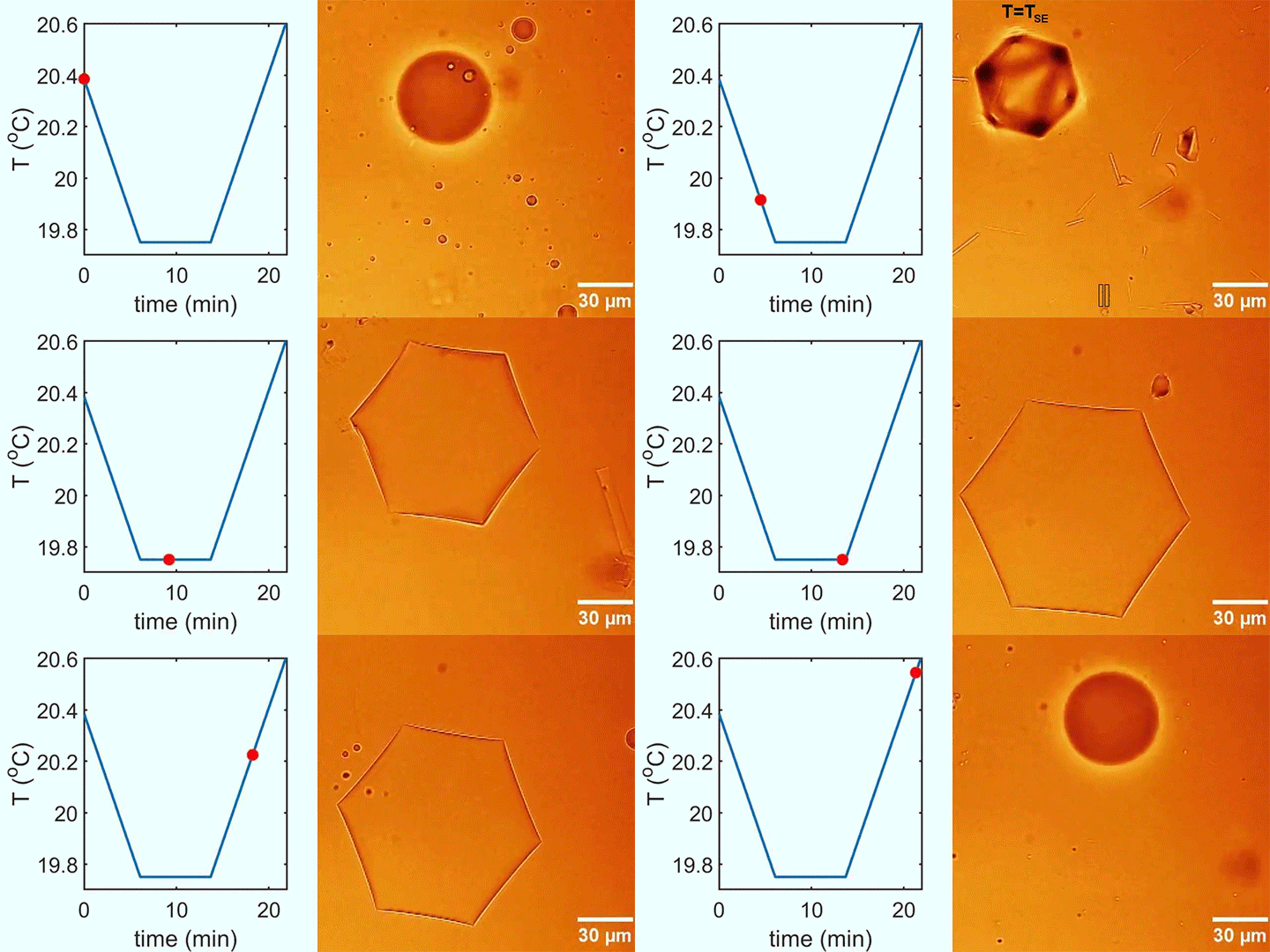
    Video showing the droplet's transition from hexagon to star and back. The shape changes occur as the liquid's temperature changes, thereby affecting its surface tension.
    The droplet’s transition from hexagon to star and back. The shape changes occur as the liquid’s temperature changes, thereby affecting its surface tension.

    In this study, researchers demonstrate that the shell-enclosed droplets can even change, reversibly, from a hexagon to a six-pointed star and back. The transformation is shown above, in an experiment that gradually changes the droplet’s temperature–and, thus, its surface tension.

    Although shape changes similar to these have been described before, this experiment was the first where the shell’s defects–the vertices of the hexagon–don’t shift during the transformation. (Video, image, and research credit: C. Quilliet et al.; via APS)

    Fediverse Reactions
  • Featured Video Play Icon

    Particles Separate When Flowing Downhill

    When particle-laden fluids like a mudslide flow downhill, even well-mixed particles can wind up separating. To explore how this works, researchers put glass spheres–of two different sizes but equal density–into silicone oil and let it flow down an incline. Their initially well-mixed oil soon turned red as the larger red particles overtook the smaller blue particles near the front. Looking at the flow from the side, the team observed a Brazil-nut-effect-like behavior where the larger particles move toward the top of the flow. That’s where the flow speed is fastest, and the particles are congregating there despite being denser than the oil carrying them! (Video and image credit: Y. Ba et al.)