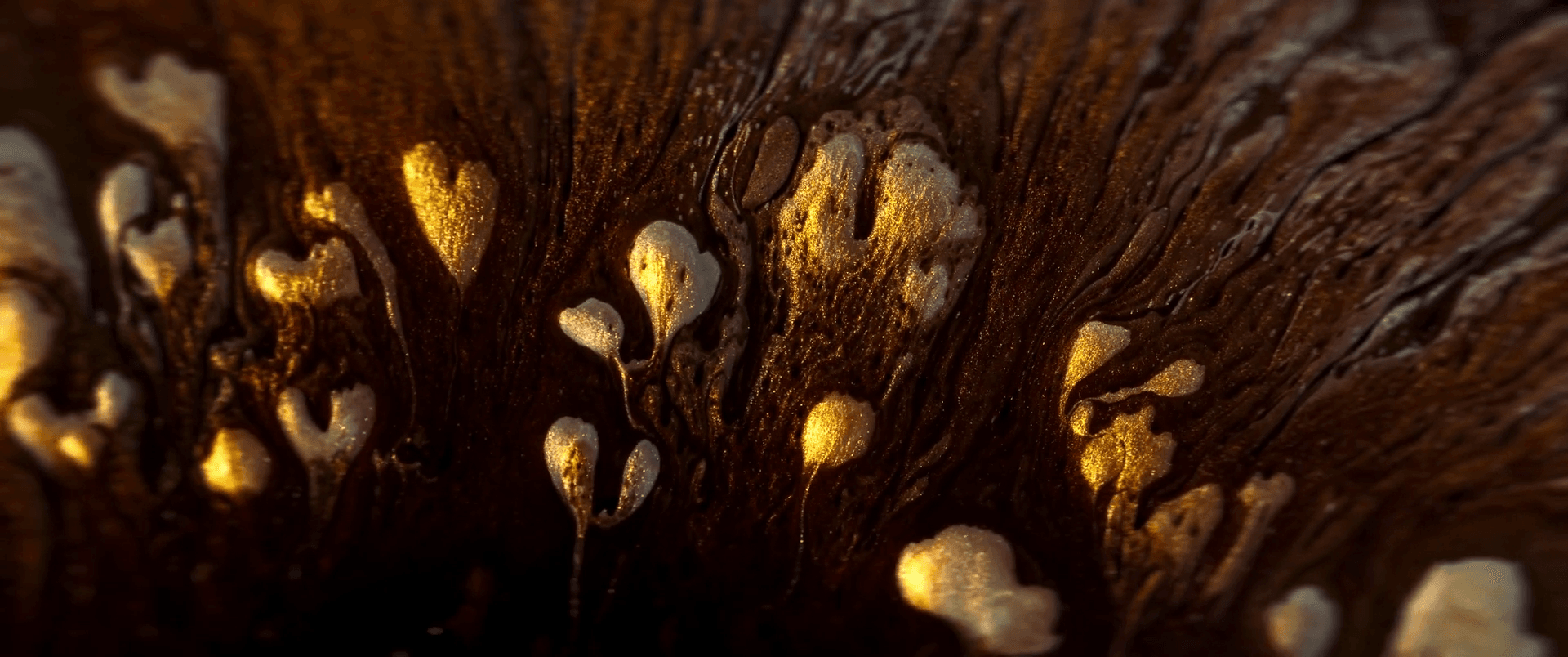
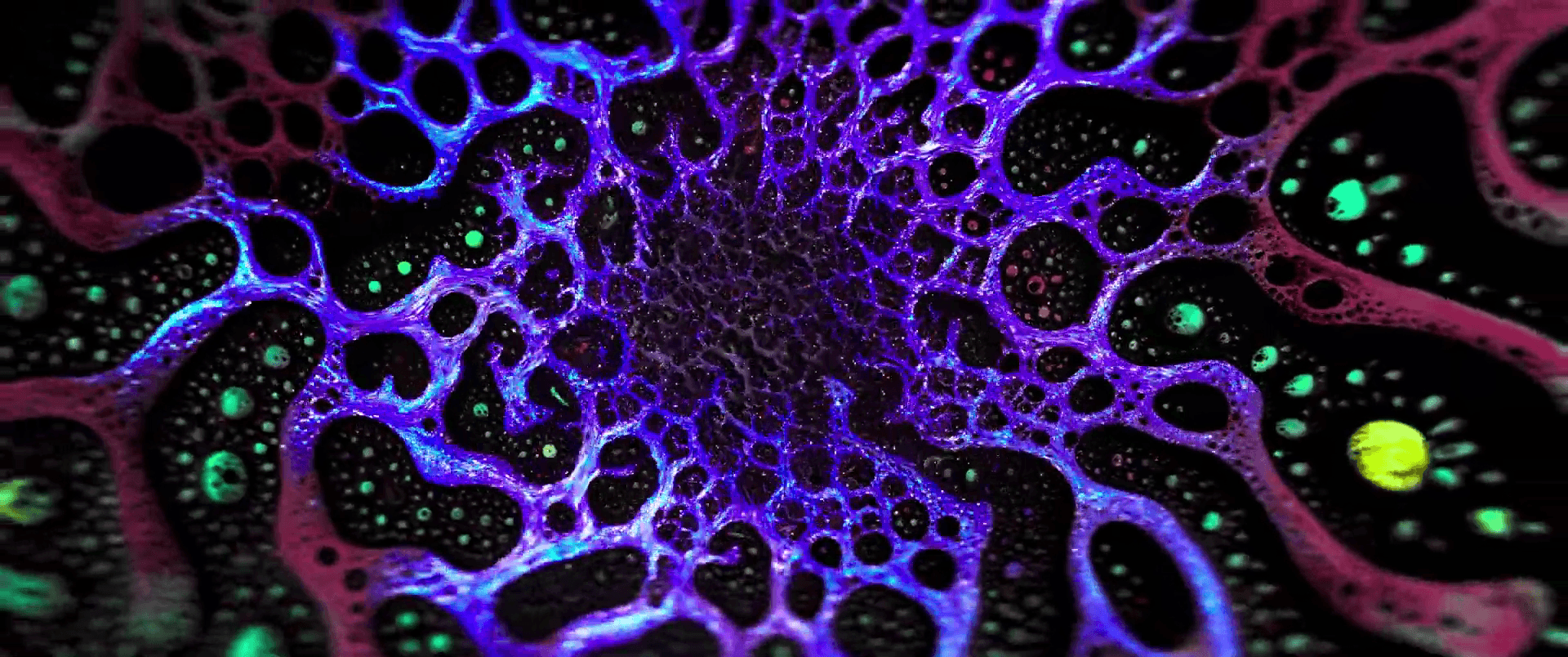
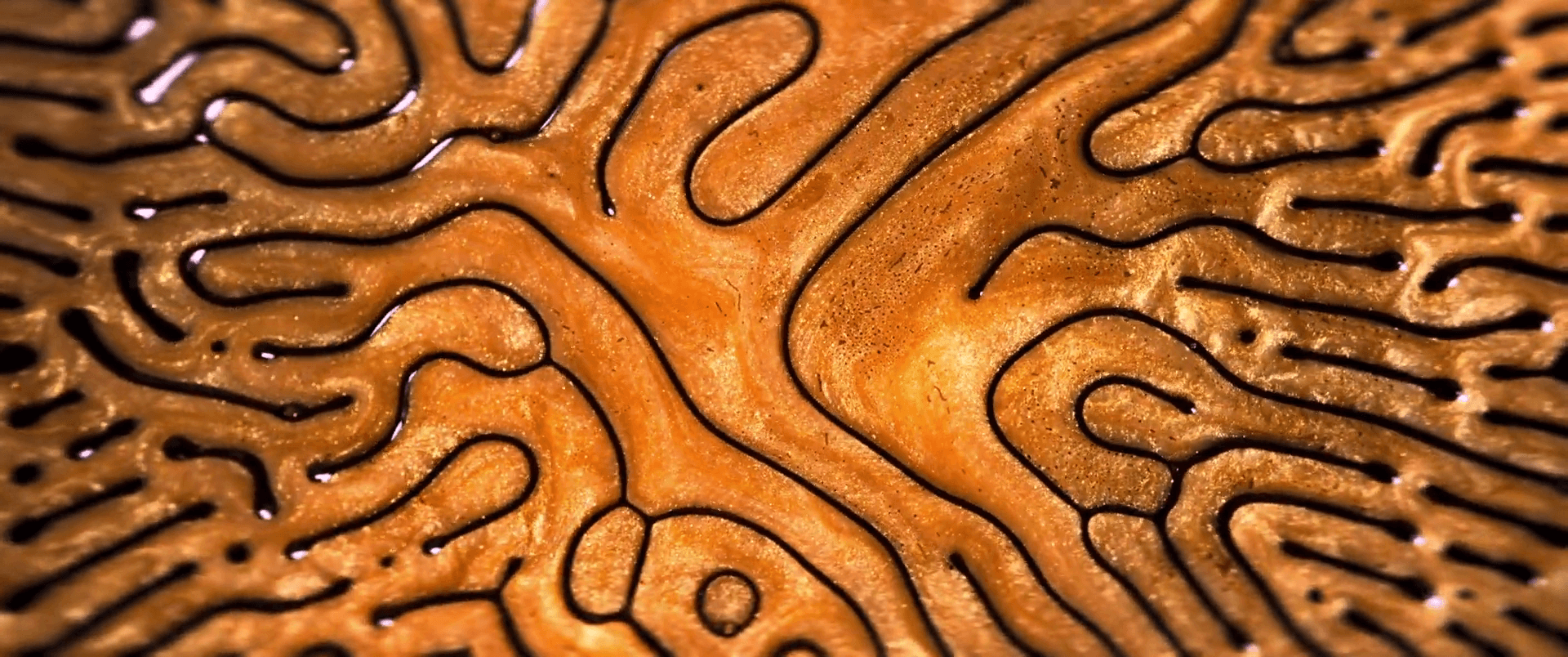
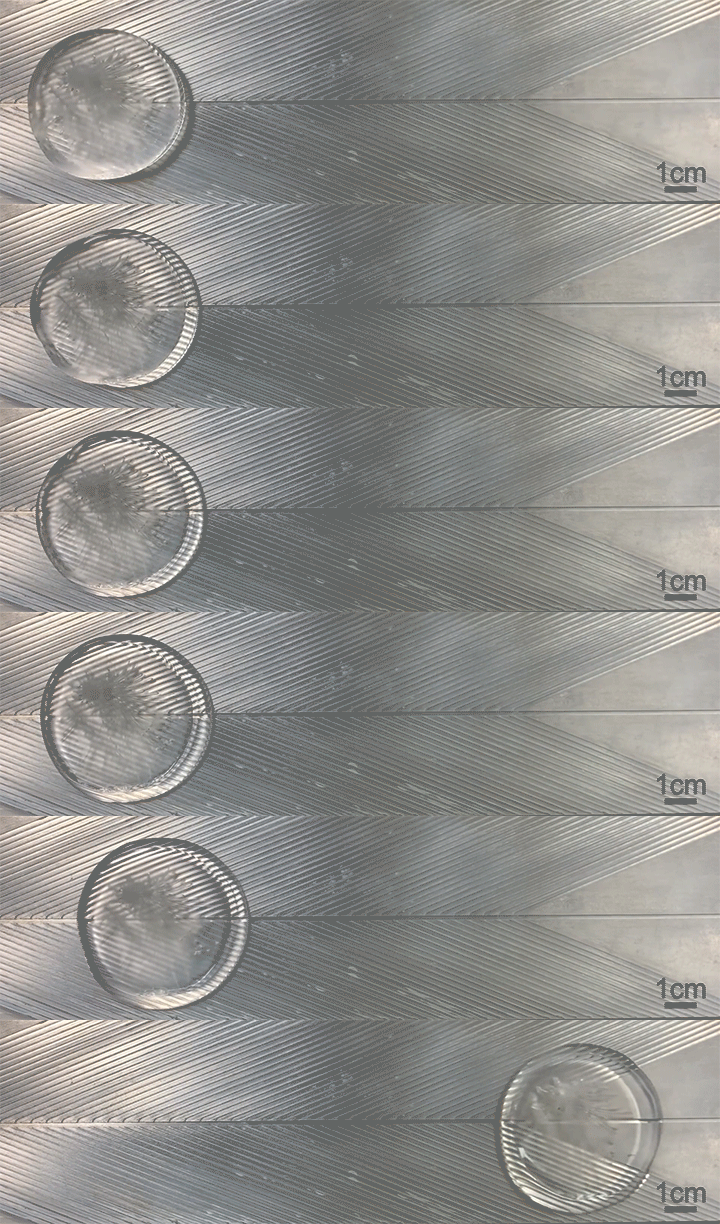
In “Re:Birth,” videographer Vadim Sherbakov explores the fascinating patterns of ferrofluids, which suspend tiny ferrous particles in another liquid, often oil. When this magnetic liquid is mixed with ink or paint, its black lines take on a labyrinthine appearance. The result is rather psychedelic, especially with Sherbakov’s bold colors. (Video and image credit: V. Sherbakov)
Month: October 2025

Ice Discs Surf on Herringbones
Inspired by the roaming rocks of Death Valley, researchers went looking for ways to make ice discs self-propel. Leidenfrost droplets can self-propel on herringbone-etched surfaces, so the team used them here, as well. On hydrophilic herringbones, they found that meltwater from the ice disc would fill the channels and drag the ice along with it.
But on hydrophobic herringbone surfaces, the ice disc instead attached to the crest of the ridges and stayed in place–until enough of the ice melted. Then the disc would detach and slingshot (as shown above) along the herringbones. This self-propulsion, they discovered, came from the asymmetry of the meltwater; because different parts of the puddle had different curvature, it changed the amount of force surface tension exerted on the ice. Thus, when freed, the ice disc tried to re-center itself on the puddle.
The team is especially interested in how effects like this could make ice remove itself from a surface. After all, it requires much less energy to partially melt some ice than it does to completely melt it. (Image and research credit: J. Tapochik et al.; via Ars Technica)

Albuquerque: Balloonist Paradise
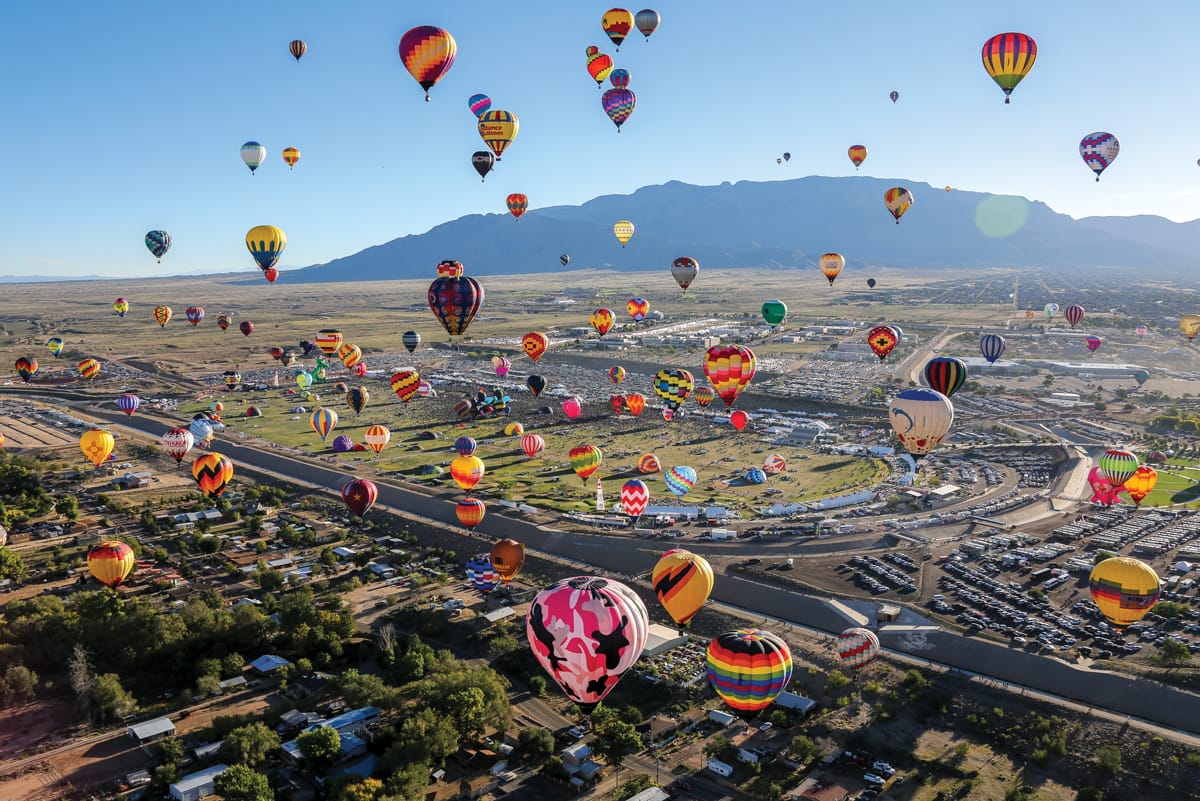
Albuquerque, New Mexico’s unique weather characteristics make it a popular destination for hot-air balloonists. While balloonists can control their altitude by warming or venting the air in their balloon, their horizontal travel comes at the mercy of the wind. (Just ask the erstwhile Wizard of Oz.) What makes Albuquerque special is a combination of topography, dry air, and altitude. Together, these features create the “Albuquerque box,” a circulation that gives south-flowing drainage winds below north-flowing prevailing winds.
The key to the box’s flow is a temperature inversion, where cooler, denser air is trapped near the surface and lighter, warmer air sits above. This typically occurs after a night of clear skies when much of the ground layer’s warm gets radiated away to space — something that’s easily done in high, dry altitudes.
Temperature inversions like this don’t last very long, though; by late morning, the sun’s warmth will dismantle the Albuquerque box. Still, it is a frequent enough occurrence, especially in the stable atmospheric conditions common in the autumn, that the city hosts an International Balloon Fiesta every October. (Image credit: B. Bos; via Physics Today)