What happens to liquid crystals in a flow? In this video, researchers look at liquid crystals flowing through the narrow gap of a microfluidic device. Initially, all the crystals are oriented the same way, as if they are logs rolling down a river. But as the flow rate increases, narrow lines appear in the flow, followed by disordered regions, and, eventually, a new configuration: vertical bands streaking the left-to-right flow. The colors, in this case, indicate the orientation of the liquid crystals. As the researchers show, the crystals collectively twist to form the spontaneous bands. (Video and image credit: D. Jia and I. Bischofberger)
Month: April 2025

Simulating a Sneeze
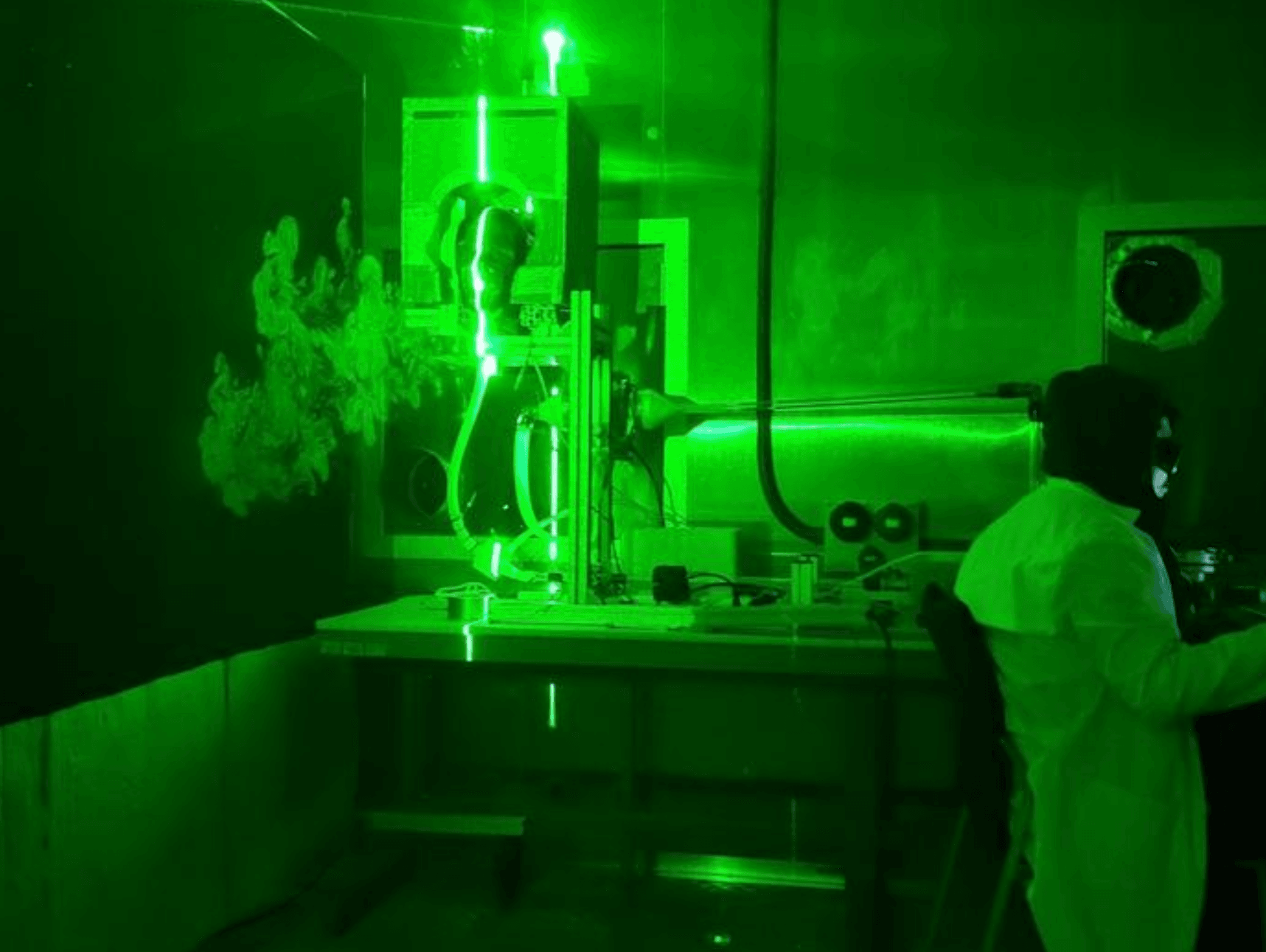
Sneezing and coughing can spread pathogens both through large droplets and through tiny, airborne aerosols. Understanding how the nasal cavity shapes the aerosol cloud a sneeze produces is critical to understanding and predicting how viruses could spread. Toward that end, researchers built a “sneeze simulator” based on the upper respiratory system’s geometry. With their simulator, the team mimicked violent exhalations both with the nostrils open and closed — to see how that changed the shape of the aerosol cloud produced.
The researchers found that closed nostrils produced a cloud that moved away along a 18 degree downward tilt, whereas an open-nostril cloud followed a 30-degree downward slope. That means having the nostrils open reduces the horizontal spread of a cloud while increasing its vertical spread. Depending on the background flow that will affect which parts of a cloud get spread to people nearby. (Image and research credit: N. Catalán et al.; via Physics World)