Year: 2019

  • Reader Question: Waves Breaking

    Reader Question: Waves Breaking

    As a follow-up to the recent waves post, reader robotslenderman asks:

    What does it look like when the wave breaks? And why do waves sometimes push us back? Why are we able to ride them?

    I wasn’t able to find an equivalent breaking wave version of that dyed wave – side note: readers with flumes, please feel free to make one and share it! – but here’s an undyed breaking wave for our reference.

    Waves break, or get that white, frothy look, when they reach shallower water. In the previous post, the waves we saw were effectively deep-water waves, so they didn’t change in height as they rolled across the tank. Here there’s an incline to simulate a beach, which causes the water to slow down and steepen. That forms the characteristic curl of a plunging breaker, seen here.

    At the beach, a wave runs out of water to pass through and all the energy that wave was carrying has to go somewhere. Some is lost as heat, some turns into the sound of that classic crashing wave, and a lot of it gets dissipated as turbulence that pushes us, sand, shells, and anything else its way.

    As for why we can ride waves, there’s some special physics at play when it comes to surfing. To catch a wave, a surfer has to paddle hard to get up to the wave’s speed just as it reaches them. Too slow and the wave will just pass them by, leaving them bobbing more or less in place. (Image credit: T. Shand, source)

  • Cavitation Collapse

    Cavitation Collapse

    The collapse of a bubble underwater doesn’t seem like a very important matter, but when it happens near a solid surface, like part of a ship, it can be incredibly destructive. This video, featuring numerical simulations of the bubble’s collapse, shows why. 

    When near a surface, the bubble’s collapse is asymmetric, and this asymmetry creates a powerful jet that pushes through the bubble and impacts the opposite side. That impact generates a shock wave that travels out toward the wall. As the bubble hits its minimum volume, a second shock front is generated. Both shock waves travel toward the wall and reflect off it, generating high pressure all along the surface. (Image and video credit: S. Beig and E. Johnson)

  • How Waves Travel

    How Waves Travel

    When playing in the surf, it’s easy to imagine that the incoming waves are a wall of water crashing into the shore. And, in a way they are, but probably less so than you imagine. Waves travel through a medium, whether it’s solid or fluid, but for the most part, they’re not translating the medium itself. You can see that in the animation above by watching the dye beneath the surface. The passing waves don’t cause much mixing in the dye, and though their passage distorts the underlying water, we see that everything returns more or less to its starting position once the wave has passed. (Image credit: S. Morris, source)

  • Featured Video Play Icon

    “Vorticity 2”

    There’s no better way to appreciate our atmosphere than through timelapse, and photographer Mike Olbinski is a master at capturing the beauty and power of nature at work through this medium. In “Vorticity 2″, he highlights two full seasons of storm chasing in an incredible seven-and-a-half minutes. Prepare yourself for dramatic cloudscapes, torrential rains, and even twin tornadoes. This one deserves a watch on the biggest screen you have available. (Image and video credit: M. Olbinski; via Colossal)

  • Breaking Up

    Breaking Up

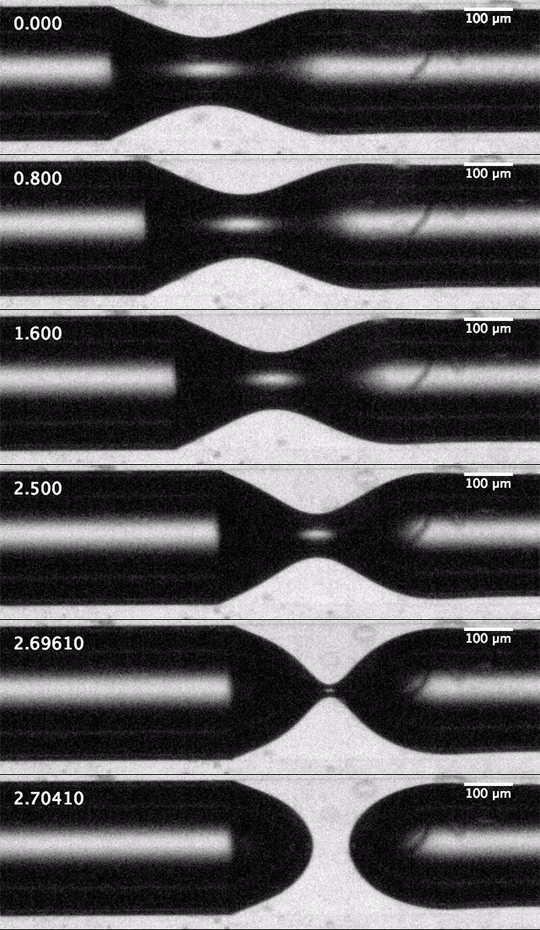
    The dripping of a faucet and the break-up of a jet into droplets is universal. That means that the forces – the inertia of the fluid, the capillary forces governed by surface tension, and the viscous dissipation – balance in such a way that the initial conditions of the jet – its size, speed, etc. – don’t matter to the process of break-up. 

    We’d expect that the inverse situation – the breakup of a gas into bubbles in a liquid – would be similarly universal, but it’s not. When unconfined bubbles pinch off, the way they do so is heavily influenced by initial conditions. But that changes, according to a new study, if you confine the gas to a liquid-filled tube before pinch-off. Confinement forces a different balance between viscous and capillary effects, one which effectively erases the initial conditions of the flow and restores universality to the pinch-off process. (Image and research credit: A. Pahlavan et al.; via phys.org)

  • Featured Video Play Icon

    Feathered Fighter Jets

    Peregrine falcons are built for speed. They’ve been clocked at more than 380 kilometers per hour when diving. This video from Deep Look examines some of the features that make these birds of prey so fast, from the shape of their eyes to the tubercles in their nostrils that help them breathe during high-pressure dives. 

    Part of the falcon’s speed comes from its signature stoop, where it pulls in its wings to form a tight, streamlined shape. This reduces drag forces on the falcon, letting gravity pull it toward a high terminal velocity. But even with its wings extended, the falcon exudes speed and agility. Its wings form a sharp leading edge to cut through the air, with stiff, overlapping feathers that slice the flow. Compare this to the feathers of an owl, which specializes in silence rather than speed for catching its prey. (Video and image credit: Deep Look)

  • Grayscale Aurora

    Grayscale Aurora

    This swirling grayscale image shows a spring aurora over the Hudson Bay, as seen by the Suomi NPP satellite. As energetic particles from the sun zip past Earth, they interact with our magnetosphere, which tends to channel particles toward the poles. At these higher latitudes, some of the particles get trapped along Earth’s magnetic field lines and crash into the upper atmosphere where they excite oxygen and nitrogen molecules. It’s this molecular bombardment that creates the distinctive colors of the aurora. (Image credit: J. Stevens; via NASA Earth Observatory)

  • Splashes on Hairy Surfaces

    Splashes on Hairy Surfaces

    The question of whether a droplet will splash is a complicated one, even for smooth surfaces, but researchers are also interested in what happens to hairy surfaces when droplets strike. By varying the droplet viscosity and speed, along with the spacing of the hairs, researchers sketched out the variety of impacts one can get. 

    What happens during impact depends largely on how the kinetic energy of the droplet compares to the dissipation caused by interaction with the hairs. When the two balance, the droplet gets captured, like in the upper right image. If the hairy dissipation wins, you get a drop that stays mostly on the surface of the hairs. And if the kinetic energy outweighs the dissipation, you end up with a star-shaped splash that spreads between the hairs. (Image and research credit: A. Nasto et al.)

  • Hiding From Waves

    Hiding From Waves

    Ocean waves can be dangerous for boats, particularly when operating near off-shore platforms. But a new study, inspired by electromagnetic waveguides, demonstrates a lab-scale water waveguide capable of damping out a range of waves experienced by any ship inside its protected area. The water waveguide sits below the surface, changing the water depth and therefore the propagation of surface waves. 

    When properly positioned, the waveguide nearly eliminates wave motion in a protected channel. You can see this in the right image, where waves are clearly present in the foreground but the toy boat hardly moves. Contrast this with the image on the left, where the boat bobs and rocks under the same wave conditions without the waveguide. The researchers hope their waveguide concept can help protect ships in wharves and harbors soon. (Image and research credit: S. Zou et al.; via APS Physics; submitted by Kam-Yung Soh)

  • Featured Video Play Icon

    Seeing with Sound

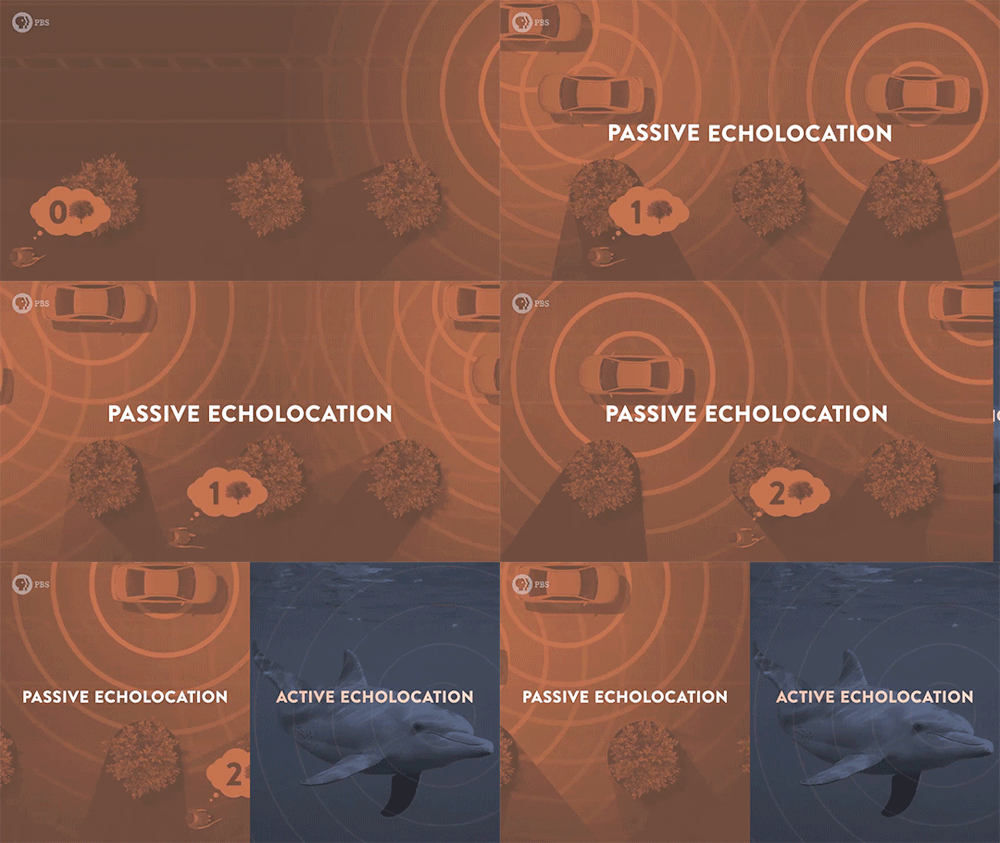
    Sound carries rich information about the environment through which it’s traveled. And while many sighted people never take the time to notice this, using sound to build a mental picture of the surrounding world is something many blind people do constantly, either by studying how sounds produced by others change (passive echolocation) or by using their own sounds to pinpoint what’s around them (active echolocation). 

    In the latest It’s Okay to Be Smart video, you have a chance to learn some of the basics of active echolocation and how you can train your brain to recognize and process this extra environmental information. 

    Personally, I am not very good at this. I can hear edges but it turns out I’m very bad at figuring out where they are. That said, having spent time recently in a few anechoic chambers – where sound reflection is almost completely damped out – I’ve come to realize that even as a sighted person, I rely on sound a lot more than I think I do! (Video and image credit: It’s Okay to Be Smart)