From spilling coffee to driving through puddles, our daily lives are full of examples of liquids fragmenting into drops. A recently published study describes how this break-up occurs and predicts what the distribution of droplet sizes will be for a given fluid. Viscoelasticity is the property that governs this droplet size distribution. Viscoelasticity describes two aspects of a fluid–its viscosity, which acts like internal friction, resisting motion–and its elasticity, the fluid’s ability to return to its original shape after stretching. Most fluids have a little bit of each of these properties, which makes them somewhat sticky, both in the sense of not-flowing-easily and in the sense of sticking-to-itself. These same properties cause viscoelastic fluids to wind up with a broader droplet size distribution, ultimately creating both more small droplets and more large droplets than a Newtonian liquid like water. (Video credit: MIT News; research credit: B. Keshavarz et al.; submitted by mrvmt)
Month: December 2016

Mixing Fresh and Salty
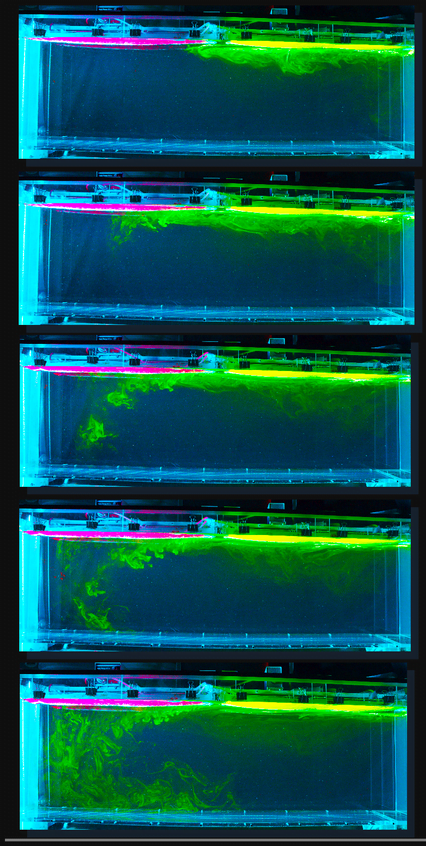
Earth’s oceans are a complex and dynamic environment, but fortunately, we can simulate some of their physics on a smaller scale in the laboratory. The time series of images above show how fresh and salty waters mix. On the right side of the image is fresh water with its top layer dyed green. On the left is salty water dyed pink. Initially, the fresh water spreads horizontally toward the salty region in a smooth and laminar fashion. As the fresh water picks up salt, it gets denser and starts sinking, ultimately forming a turbulent plume that will push all the way back across the tank. For more images, check out the full poster. (Image credit: P. Passaggia et al.)