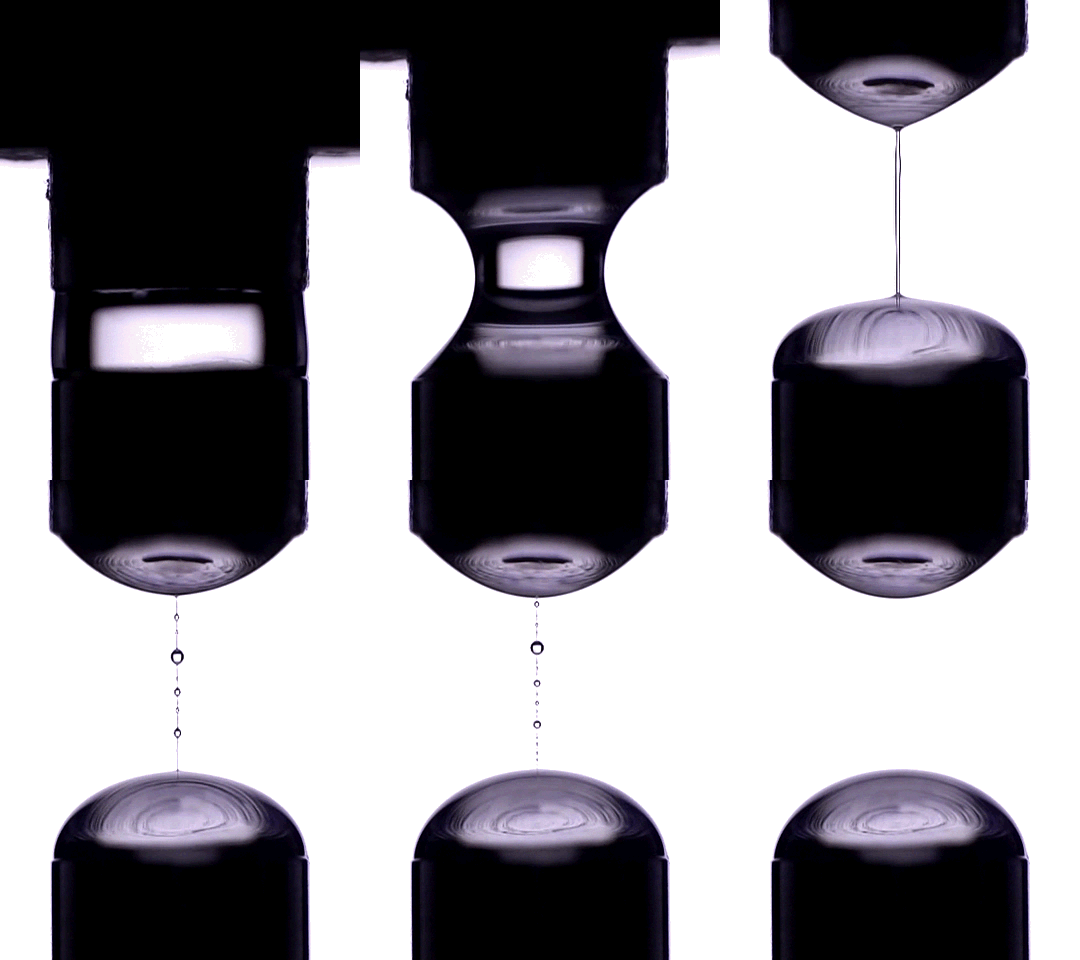
Tag: extensional flow

  • Beads on a String

    Beads on a String

    Adding just a small amount of polymers to a liquid can drastically change its behavior. The polymers make the liquid viscoelastic, meaning that, under deformation, the liquid shows behaviors that are both viscous (like all fluids) and elastic (i.e. able to resume its original shape, like a rubber band). These properties are particularly identifiable under extensional loading, like in the animation above. Under these loads, the polymers in the fluid stretch and rearrange, creating an internal compressive stress that acts opposite the imposed tensile stress. It’s this balance of forces, along with ever-present surface tension that creates the beads-on-a-string effect seen above. (Image credit: B. Keshavarz)

    ETA: As usual, Tumblr gave me issues with an animated GIF. It should be fixed now. Sorry!

  • Featured Video Play Icon

    Fano Flow

    Adding polymers to fluids can lead to strangely counter-intuitive behavior. Here two examples of bizarre extensional flow, sometimes called Fano flow, are shown. First, in the “tubeless siphon” fluid is drawn into a syringe from the level of the free fluid surface.  When the syringe is raised above the free surface of the fluid, the polymer-laden fluid continues to flow upward and into the syringe.  A similar effect is shown in the “open channel siphon” where, once initiated, the flow up and over the side of a beaker continues after the free surface of the fluid has fallen below the level of the beaker’s spout. In both of these cases, the cross-linking and entanglement of polymers within the fluid makes it capable of exerting normal stress when extensionally strained (e.g. stretching a rubber band). In other words, when the syringe is drawn out of the pool, the stretching of the fluid causes the polymers to exert a force that counteracts the weight of the fluid column, enabling the flow to continue upward despite gravity.