Month: July 2024

  • Paris 2024: Bouncing and Spinning

    Paris 2024: Bouncing and Spinning

    Spin, or the lack thereof, plays a major role in many sports — including tennis, golf, football, baseball, volleyball, and table tennis — because it affects whether flow stays attached around a ball, as well as how much lift or side force a ball gets. A ball’s spin doesn’t stay constant, however. During flight, a ball’s spin decays at a rate proportional to its initial spin and velocity. Researchers have found that a ball’s moment of inertia, flow regime, and surface roughness all affect that decay, but which factor is the most significant varies by ball and by sport.

    Whether a ball bounces while spinning also matters. For compliant balls on a non-compliant surface — think tennis balls on a court — a bounce can actually change how much a ball spins. During impact, a tennis ball can: slide, decreasing its tangential velocity while increasing its topspin; roll, where the ball’s tangential velocity matches the tangential velocity of the surface; or over-spin, where the ball spins faster than it rolls. For a given impact angle and velocity, researchers found that stiffer and/or lighter balls were more likely to over-spin. Within tennis’s allowable range of ball stiffness and mass, manufacturers could create tennis balls that over-spin far more than conventional ones, creating another opportunity for deceptive tactics in the sport. (Image credit: J. Calabrese; research credit: T. Allen et al.)

    Related topics: How flow separates from a surface, and why turbulence is sometimes preferable

    Find all of our Olympics coverage — past and ongoing — here and every sports post here.

  • Paris 2024: Triathlon Swimming

    Paris 2024: Triathlon Swimming

    Unlike the swimming competition, Olympic triathletes complete their swim legs in open waters. There are no lane dividers and no rules against drafting off a fellow athlete. Curious to see how draft positioning could affect swimmers, researchers experimented with swimmer-shaped models in a water channel and a numerical simulation. They found that the most advantageous position is directly behind a lead swimmer, where the follower could enjoy a 40% reduction in drag. Another good position is near the leader’s hip, where waves off the leader provide a 30% reduction in drag.

    The worst place to swim, interestingly, is immediately side-by-side. With both swimmers neck-in-neck, drag is maximized, and each swimmer feels more drag than they would swimming by themselves! (Image credit: J. Romero; research credit: B. Bolan et al.)

    Related topics: Drafting in each triathlon stage and drafting effects in nordic skiing

    Join us all this week and next for more Olympics-themed stories.

  • Paris 2024: Swimsuit Tech

    Paris 2024: Swimsuit Tech

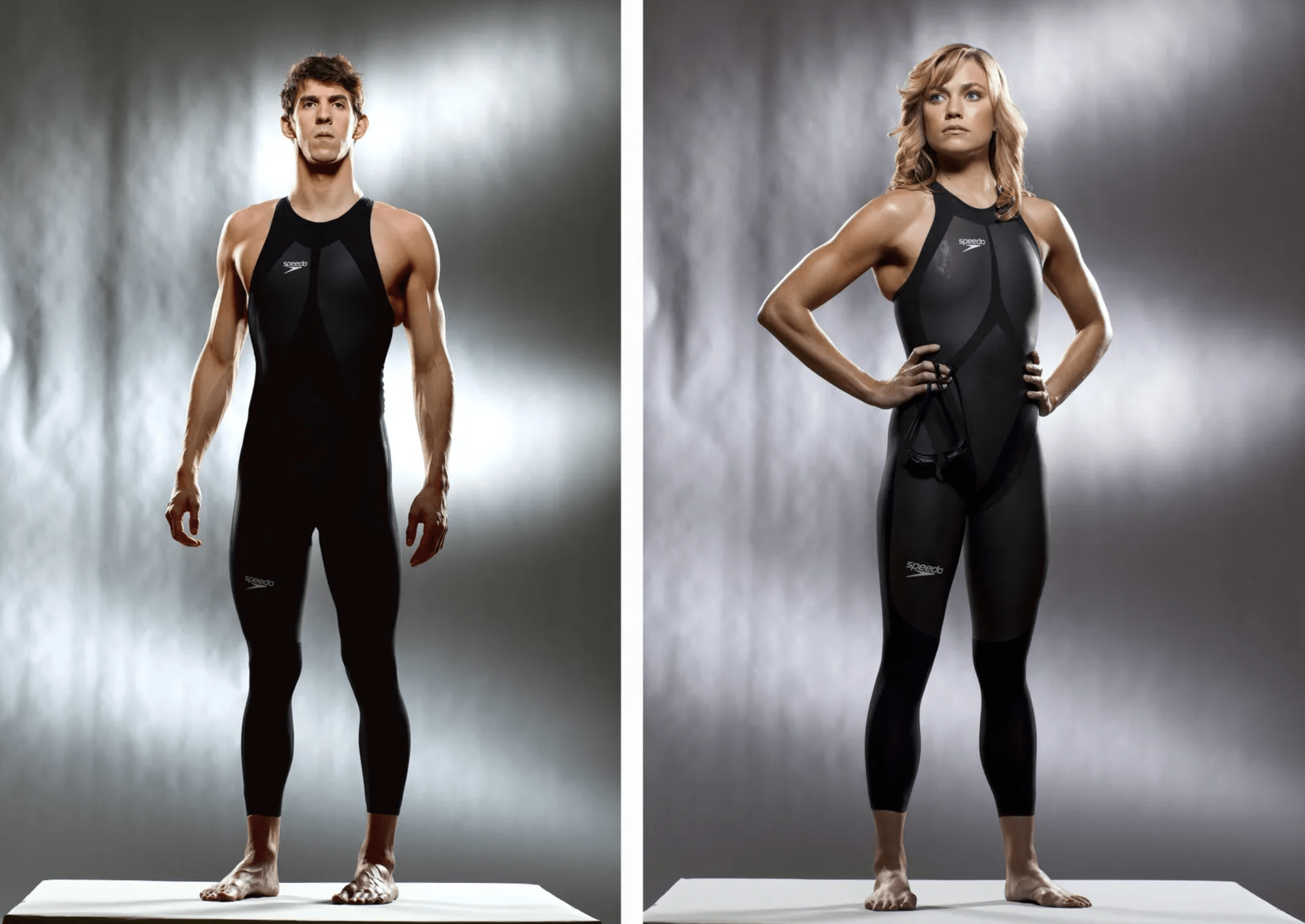
    The aughts were an exciting time to watch competitive swimming. Records were falling left and right, especially in 2008 and 2009. The first wave of improvements came around 2000, with the introduction of full-body swimwear. According to one analysis, men’s freestyle swimming performances improved by about 1% with that change. The next big leap came in 2008 when companies introduced polyurethane panels into the suits (most famously the LZR Razer suits pictured above) causing an additional 1.5-3.5% performance improvement. The panels were stiff, reducing the swimmer’s cross-sectional area and thereby reducing drag. Their effect was greatest in sprint events; long-distance swimmers saw fewer improvements, possibly because turning in the stiffer suits was tiring.

    The biggest leap came in 2009 with all polyurethane full-body swimsuits, which streamlined swimmers and gave them skin friction improvements that let them slip through the water more easily. Freestyle swimmers with those suits were showing a full 5.5% performance improvement on top of the 2000-era full-body suits.

    With so many records falling in 2008 and 2009 — largely to swimmers wearing the expensive new suits that some teams could not afford — swimming’s federation chose to ban the new technology, causing an immediate drop in performances to pre-polyurethane levels. Although sprint performances will likely improve little by little each year, no one is likely to break the sprint records of 2008-2009 in the next decade — not unless the federation establishes a “new rules” record the way officials did with the javelin after a major rule change. (Image credit: Getty Images; research credit: L. Foster et al.)

    Today kicks off our fluids-themed Olympics coverage. Stay tuned for more sports this week and next week. If that’s not enough sports physics for you, check out what we wrote in previous years.

  • Featured Video Play Icon

    Hand-Making Artist-Grade Pastels

    I’m constantly fascinated by the intersections of art and fluid mechanics. In this video, we get an inside look at a French atelier making artist-grade pastels using centuries-old methods. And although the final product doesn’t appear to have much to do with fluids — compared to, say, paint — the process behind each pastel involves a lot of fluid mechanics: mixing, pressing, drying, and rolling. It’s a neat look at how a niche product gets made. (Video and image credit: Business Insider)

    P.S. – Next week we’ll kick off our Paris Olympics coverage, but if you’d like a head start on the celebration, you can find our coverage of previous Olympics here. – Nicole

  • Hole Punch Clouds

    Hole Punch Clouds

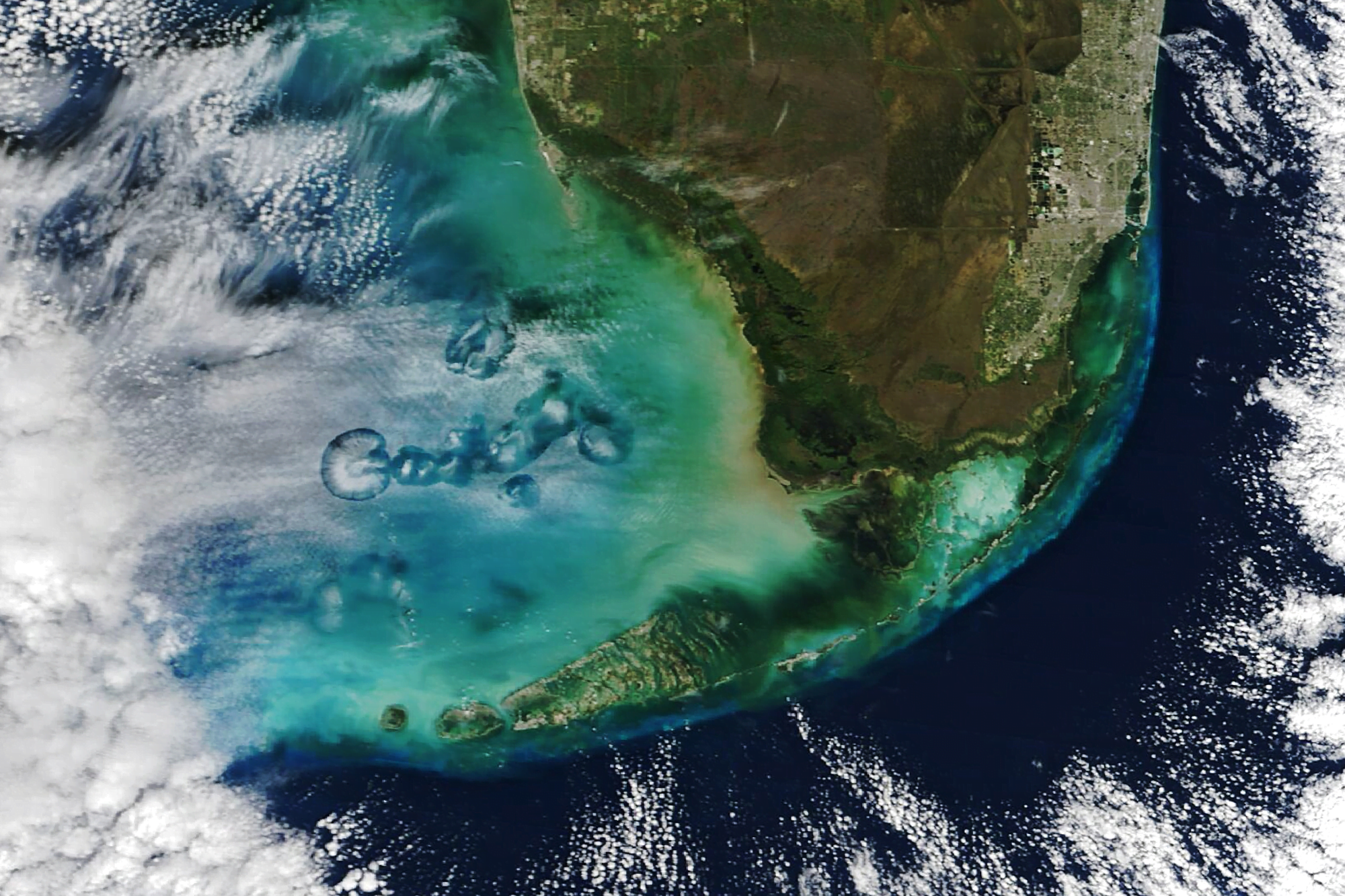
    At times altocumulus cloud cover is pierced by circular or elongated holes, filled only with the wispiest of virga. These odd holes are known by many names: cavum, fallstreak holes, and hole punch clouds. Long-running debates about these clouds’ origins were put to rest some 14 years ago, after scientists showed they were triggered by airplanes passing through layers of supercooled droplets.

    When supercooled, water droplets hang in the air without freezing, even though they are colder than the freezing point. This typically happens when the water is too pure to provide the specks of dust or biomass needed to form the nucleus of an ice crystal. But when an airplane passes through, the air accelerated over its wings gets even colder, dropping the temperature another 20 degrees Celsius. That is cold enough that, even without a nucleus, water drops will freeze. More and more ice crystals will form, until they grow heavy enough to fall, leaving behind a clear hole or wisps of falling precipitation.

    In the satellite image above, flights moving in and out of Miami International Airport have left a variety of holes in the cloud cover each of them large enough to see from space! (Image credit: M. Garrison; research credit: A. Heymsfield et al. 2010 and A. Heymsfield et al. 2011; via NASA Earth Observatory)

  • Junggar Basin Aglow

    Junggar Basin Aglow

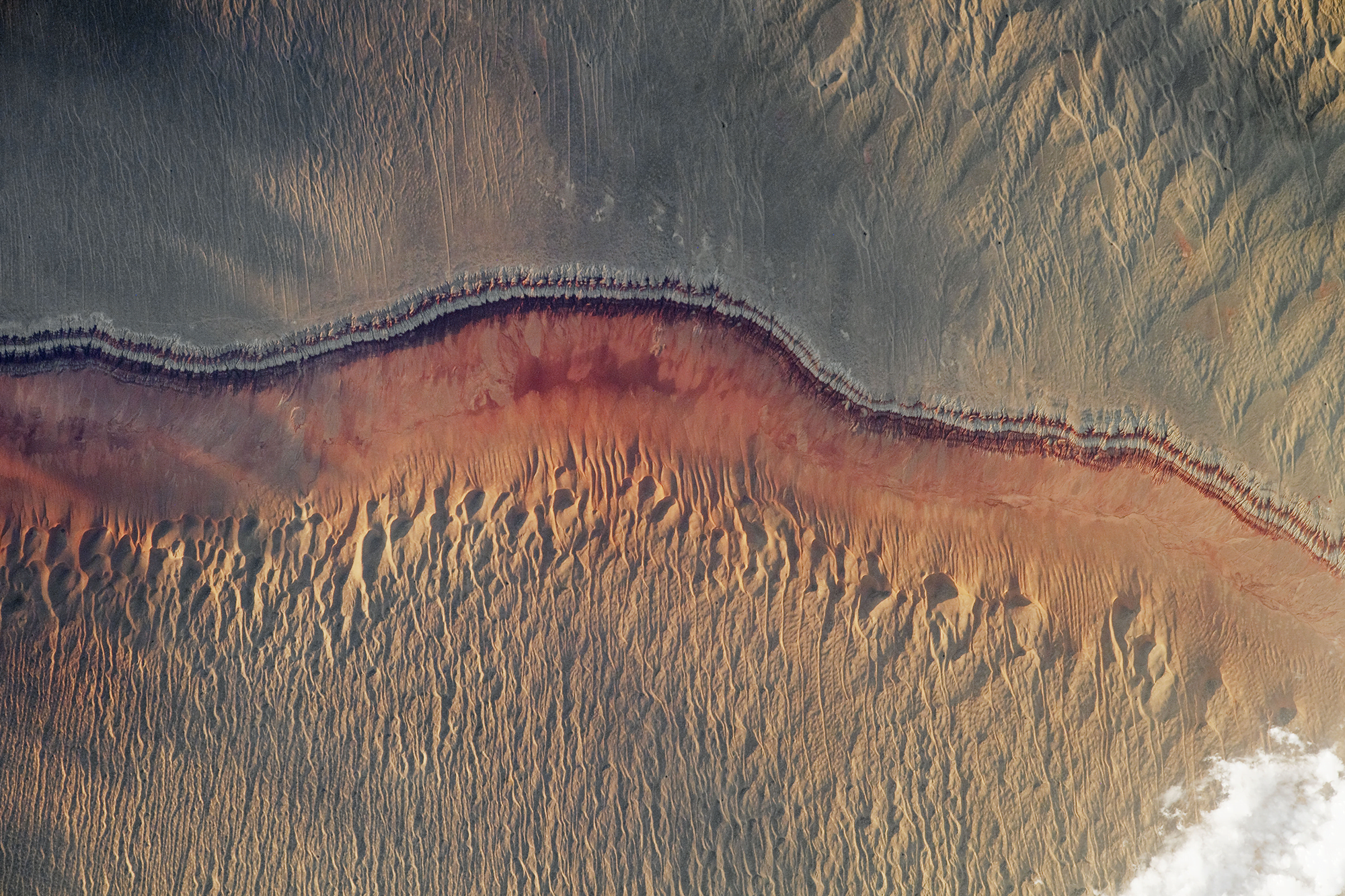
    The low sun angle in this astronaut photo of Junggar Basin shows off the wind- and water-carved landscape. Located in northwestern China, this region is covered in dune fields, appearing along the top and bottom of the image. The uplifted area in the top half of the image is separated by sedimentary layers that lie above the reddish stripe in the center of the photo. Look closely in this middle area, and you’ll find the meandering banks of an ephemeral stream. Then the landscape transitions back into sandy wind-shaped dunes. (Image credit: NASA; via NASA Earth Observatory)

  • “Stomp-Rocket”: A New Type of Eruption

    “Stomp-Rocket”: A New Type of Eruption

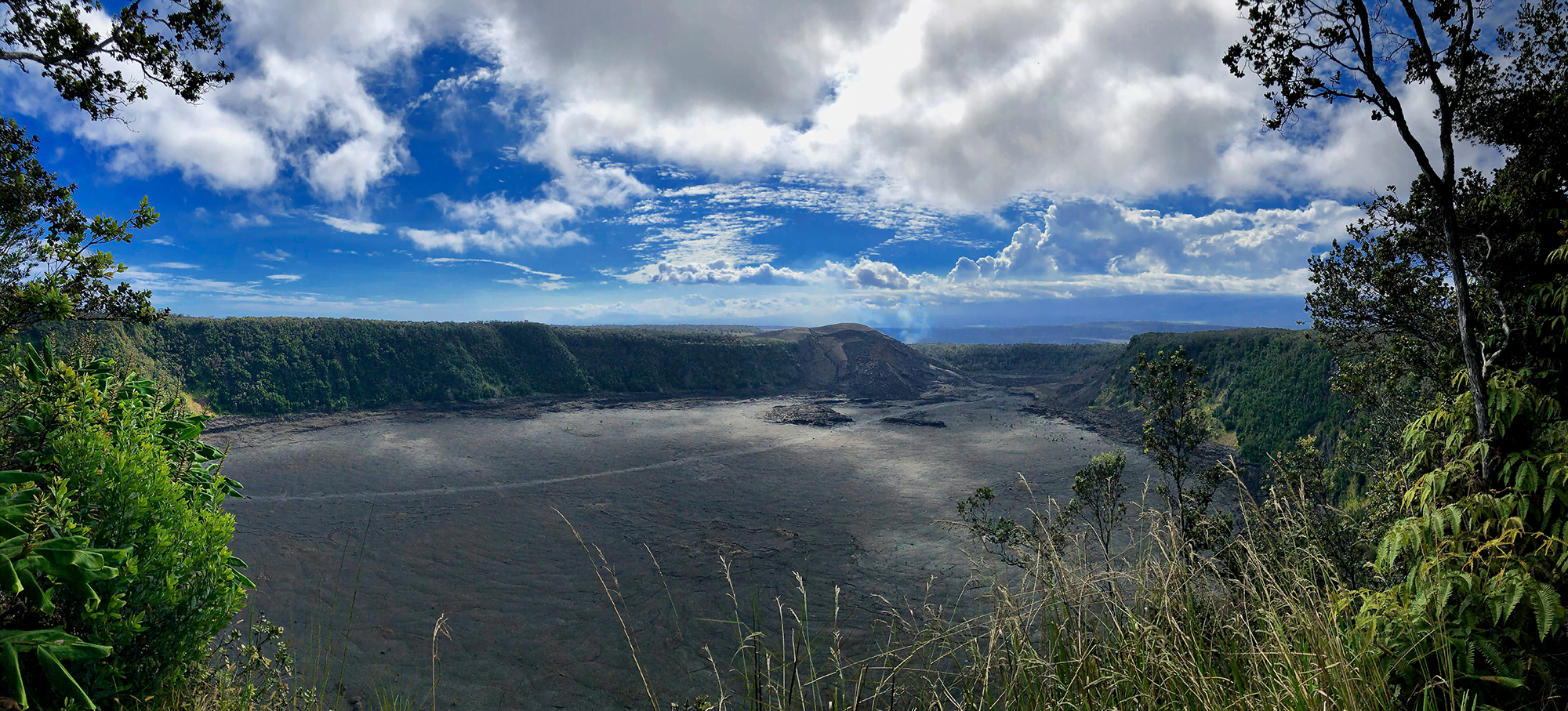
    When Kilauea‘s caldera collapsed in 2018, it came with a sequence of 12 closely-timed eruptions that did not match either of the typical volcanic eruption types. Usually, eruptions are either magmatic — caused by rising magma — or phreatic — caused by groundwater flash-boiling into steam. The data from Kilauea matched neither type.

    Instead, scientists proposed a new model for eruption, based around a mechanism similar to the stomp-rockets that kids use. They suggested that, before the eruption, Kilauea’s magma reservoir contained a mixture of magma and a pocket of gas. When part of the magma reservoir collapsed, the falling rock compressed the gases in the chamber — much the way a child’s foot compresses the air reservoir of a stomp rocket — building up enough gas pressure to explosively launch debris and hot gas up to the surface.

    The team found that computer simulations of this new eruption model matched well with observations and measurements taken at Kilauea in 2018. Kilauea is one of the most closely monitored volcanoes in the world; although the team suspects this mechanism occurs during caldera collapse of other volcanoes, it’s unlikely they could have pieced together such a convincing case for an eruption anywhere else. (Image credit: O. Holm; research credit: J. Crozier et al.; via Physics World)

  • Solar Filament Eruption

    Solar Filament Eruption

    From Earth, we rarely glimpse the violent flows of our home star. Here, a filament erupts from the photosphere creating a coronal mass ejection, captured in ultraviolet wavelengths by the Solar Dynamics Observatory. This particular eruption took place in 2012, and, while it was not aimed at the Earth, it did create auroras here a few days later. Eruptions like these occur as complex interactions between the sun’s hot, ionized plasma and its magnetic fields. Magnetohydrodynamics like these are particularly tough to understand because they combine magnetic physics, chemistry, and flow. (Image credit: NASA/GSFC/SDO; via APOD)

  • Featured Video Play Icon

    “The Art of Flying”

    Like schools of fish, starlings gather in massive undulating crowds. Known as murmurations, these gatherings are a type of collective motion. Scientists often try to mimic these groups through simulations and lab experiments where individuals in a swarm obey simple rules that depend only on observing their neighbors. It requires very little, it turns out, to form swarms that move in this beautiful manner! (Video and image credit: J. van IJken; via Colossal)

  • Venusian Lava Flows

    Venusian Lava Flows

    Venus is often known as Earth’s twin, given its similar size and proximity. But, thanks to its runaway greenhouse effect, Venus is a hellish landscape buried beneath a hot atmosphere of carbon dioxide and sulfuric acid. Unlike Earth, Venus is not tectonically active, though it does have active volcanoes. A recent study re-examined synthetic aperture radar data from the Magellan spacecraft mission in the early 1990s and found that the data contained evidence of fresh lava flows.

    The team found two areas near volcanoes where the surface backscatter changed significantly between orbital observations. After examining many possible explanations for the changes, the team concluded that the differences were most likely due to new lava. They even performed the same analysis for a volcanic field here on Earth between known lava flows and observed the same behavior. Combined with another recent study that found evidence of volcanic activity in Magellan data, signs are pointing toward Venus being about as volcanically active as our own planet, even if the mechanisms driving the volcanism differ. (Image credit: NASA/JPL-Caltech; research credit: D. Sulcanese et al.; via Gizmodo)