Many seabirds catch their prey through plunge diving, where they fly to a particular height, then fold their wings, and dive into the ocean. In busy waters, bubbles from all this diving can help obscure the birds from hapless fish. Some birds even use bubbles to escape from their own predators; some penguin species, for example, release trapped air from beneath their feathers as they surface, creating a flurry of bubbles that reduce the drag they have to overcome as they make their exit from the water. The fast exit and bubbly wake help them escape prowling seals. (Image credit: H. Spiers; via BWPA)
Month: June 2024

Universal Wingbeats
Eagles, butterflies, and whales don’t appear to have much in common, but a new study shows that they — along with over 400 other flying and swimming animals of all sizes — flap with a frequency determined by a simple equation. Their beat frequency is proportional to the square root of their mass divided by their wing area. As you can see in the graph below, this scaling collapses pretty much all of the data onto a single line:

Illustration of the predicted relationship between size and wing frequency (black line) shown alongside various insects, birds, bats, penguins, and whales. The swimming animals also fall on the line, once adjustments are made for the difference in density between air and water. It’s surprising to find such a consistent relationship among animals of such vastly different sizes and types. The next big question for researchers will be unpicking exactly why and how animals evolved to use such a consistent pattern between their size and their wing(/fin) frequency. (Image credit: top – E. Ward, graph – J. Jensen et al.; research credit: J. Jensen et al.; via Physics World)

Star-Birthing Shock Waves
Although the space between stars is empty by terrestrial standards, it’s not devoid of matter. There’s a scattering of cold gas and dust, pocked by areas known as prestellar cores with densities of a few thousand particles per cubic centimeter. This is just enough matter to help gravity eventually win its tug of war with the forces that would drive molecules apart.
When shock waves pass through these regions — whether thrown off a dying star or a newly birthed one — they compress the material, kickstarting the process of stellar formation. Passing shock waves can also shake loose molecules stuck to the dust, providing key tracer elements that astronomers can use to visualize shock waves and the areas they affect. To learn more, see this article over at Physics Today. (Image credit: NASA/ESA/CSA/STSCI/K. Pontoppidan/A. Pagan; see also Physics Today)

Warming Temperatures Increase Turbulence
After multiple high-profile injuries caused by atmospheric turbulence, you might be wondering whether airplane rides are getting rougher. Unfortunately, the answer is yes, at least for clear-air (i.e., non-storm-related) turbulence in the North Atlantic region. It seems that climate change, as predicted, is increasing the bumpiness of our atmosphere. There are a couple of mechanisms at play here.
The first is that warming temperatures fuel thunderstorms. When ground-level temperatures and water temperatures are warmer, that provides more warm, moist air rising up and feeding atmospheric convection. Especially in the summertime, that translates into stronger, more frequent thunderstorms; even with flights avoiding the storms themselves, there’s greater turbulence surrounding them.
The second mechanism relates to wind, specifically in the mid-latitudes. In general, a temperature difference between two regions causes stronger winds. (Think about the windy conditions that accompany an incoming cold front.) At the mid-latitudes, the difference between cold polar regions and warmer equatorial ones creates a strong wind, known as the jet stream. Now, as temperature gradients increase at cruising altitudes, the jet stream gets stronger, which means bigger changes in wind speed with altitude. And its those wind speed differences at different heights that drive turbulence.
So, yes, we’re likely to see more turbulent flights now and in the future. But, fortunately, there’s a simple way to avoid injuries from that bumpiness: buckle up! If you keep your seat belt fastened while you’re seated, you can avoid getting tossed around by unexpected G-forces. (Image credit: G. Ruballo; see also Gizmodo)

Dripping Viscoelastics
An ultrasoft viscoelastic fluid drips in this research poster from the Gallery of Soft Matter. Complex materials like this one have stretchy, elastic behaviors typical of a solid along with the flowing, viscous properties of a fluid. Here, gravity overcomes the material’s elasticity, leaving it to sag and flow. As that happens, the fluid must slide past air, and the density difference between the two fluids creates the small distortions seen on the liquid sheet. This is an example of a Rayleigh-Taylor instability. (Image credit: J. Hwang et al.)

Vortex Rings at Dawn
Vortex rings blown from Mount Etna’s vents drift through the dawn light in this beautiful image from Dario Giannobile. Little is required to create vortex rings — they are a puff of fluid shaped by an orifice — but they are relatively unusual to see around volcanoes. Etna is an exception; it happens to have one or more vents that frequently form rings. Their shape and the venting pattern of the volcano must be unusually well-suited to ring formation. (Image credit: D. Giannobile; via APOD)

Rocky Exoplanet With an Atmosphere
In the past few decades, the number of exoplanets we’ve found has ballooned to over 5,000, but most of these worlds are gas giants closer to Jupiter than our rocky Earth. But a recent study has turned up evidence of a rocky exoplanet that, like Earth, has an atmosphere made up of more than hydrogen.
By combining observations from the JWST with those from other telescopes, the team found that 55 Cancri e — an exoplanet nearly 9 times more massive than Earth in a system about 41 light years from us — probably has an atmosphere made up of carbon dioxide or carbon monoxide. 55 Cancri e is still a planet extremely unlike our own, though; it’s tidally locked to its star so that one side always faces the star, and its equilibrium temperature is an estimated 2000 Kelvin. That’s actually a lower temperature than expected, indicating that an atmosphere is helping distribute heat around the planet. Based on the JWST measurements, the researchers suggest that the planet’s volatile atmosphere could be supported by outgassing from a magma ocean. (Image credit: NASA/ESA/CSA/R. Crawford; research credit: R. Hu et al.; via Gizmodo)

Building In a Stingless Hive


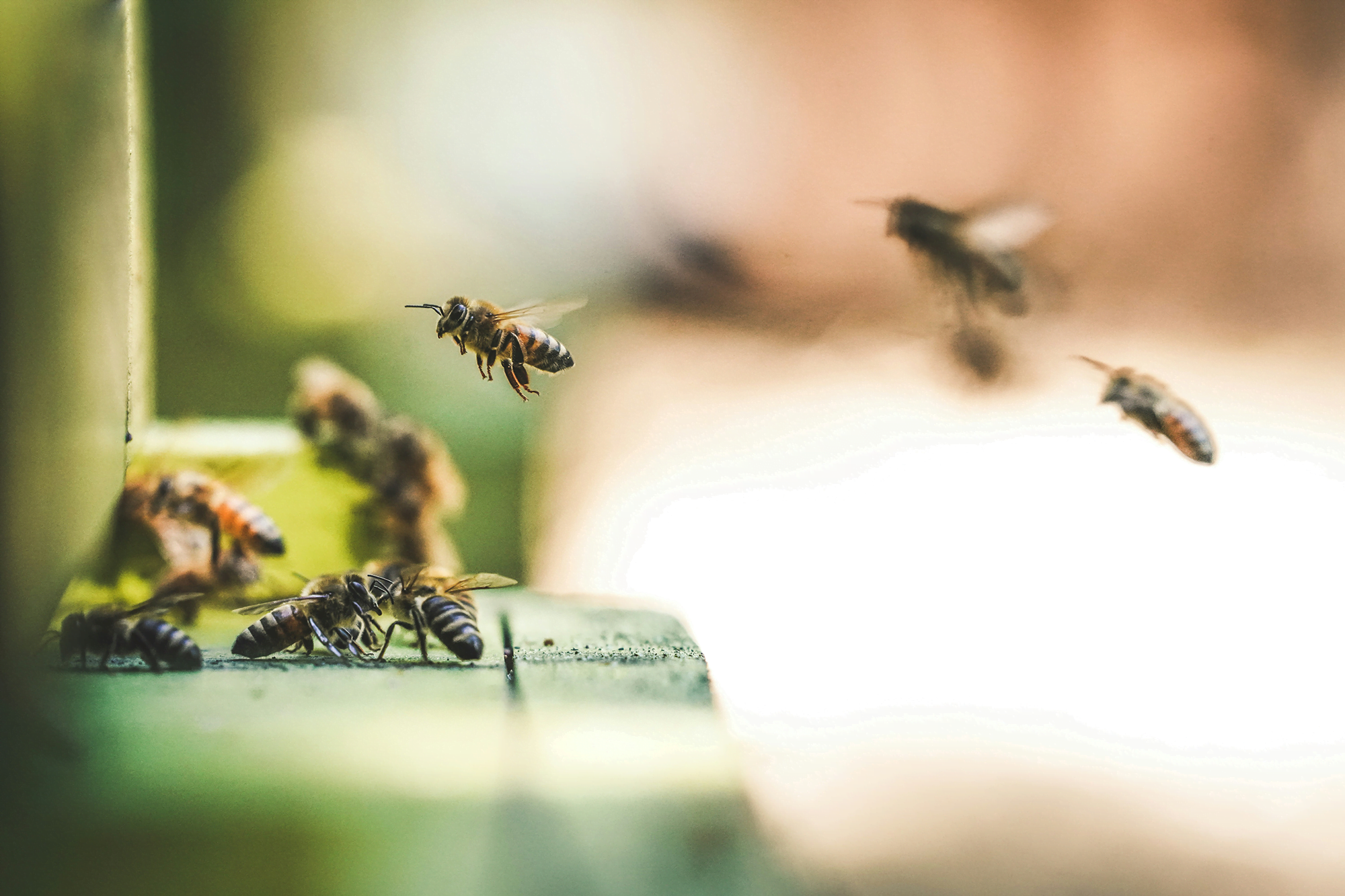
Honeybees, with their stingers, get lots of attention, but the Americas have plenty of stinger-less honeymakers, too. These stingless bees are native to Mexico, where beekeepers cultivate them for pollination. Without stingers and venom, the bees use their building prowess to keep out unwanted visitors. Much of the hive — from the entrance’s nightly gate to the pods where young are stored — is built from cerumen, a substance the bees create by mixing wax with resins they collect from nearby trees. Just as they do with pollen, worker bees collect drops of resin and store them on their hind legs before flying back to the hive. The viscous fluid sticks well, until a swipe of a leg shears it enough to lower its viscosity and slide it off. (Video and image credit: Deep Look)

Melting Permafrost Stains Alaskan Rivers Orange
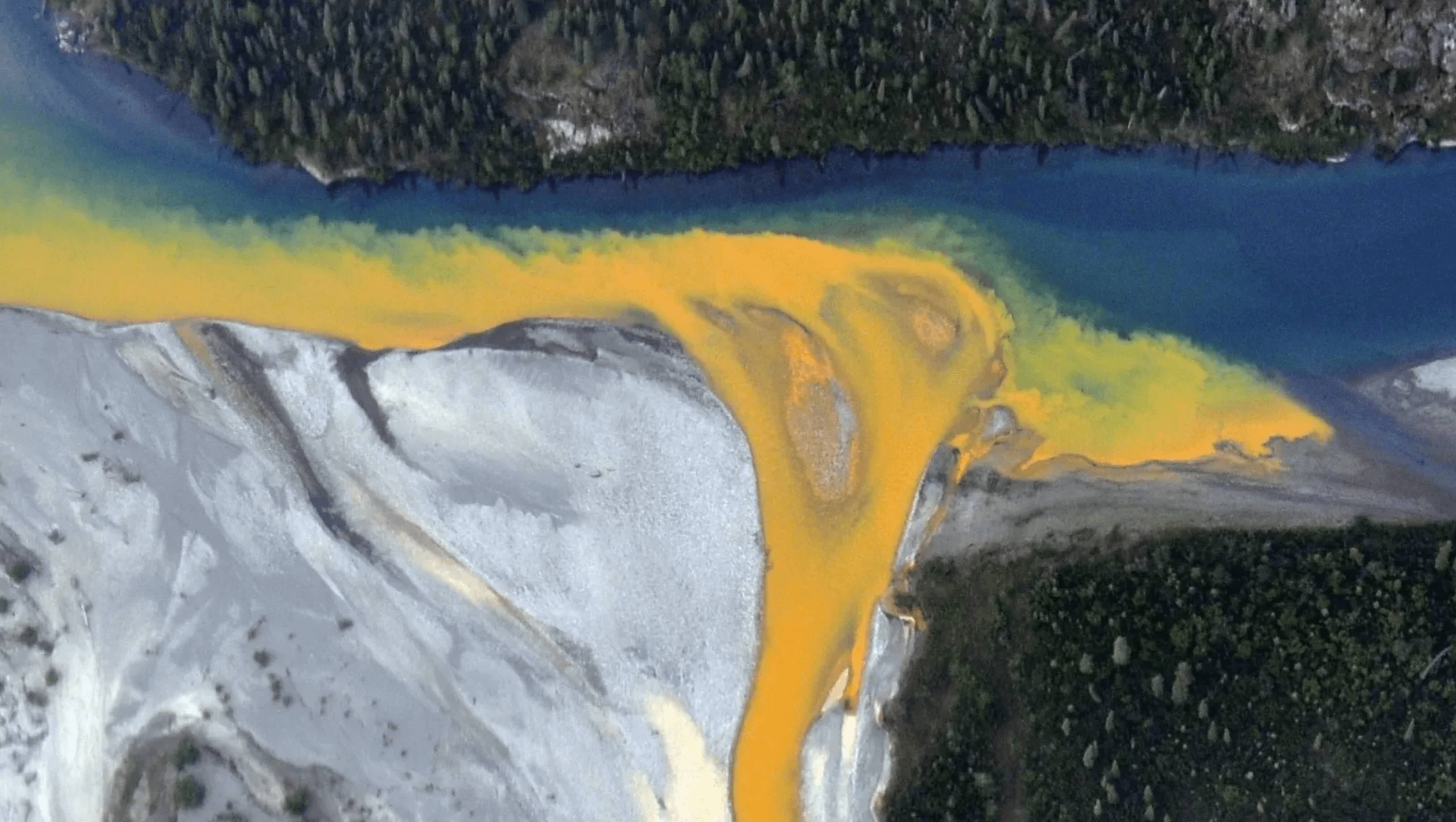
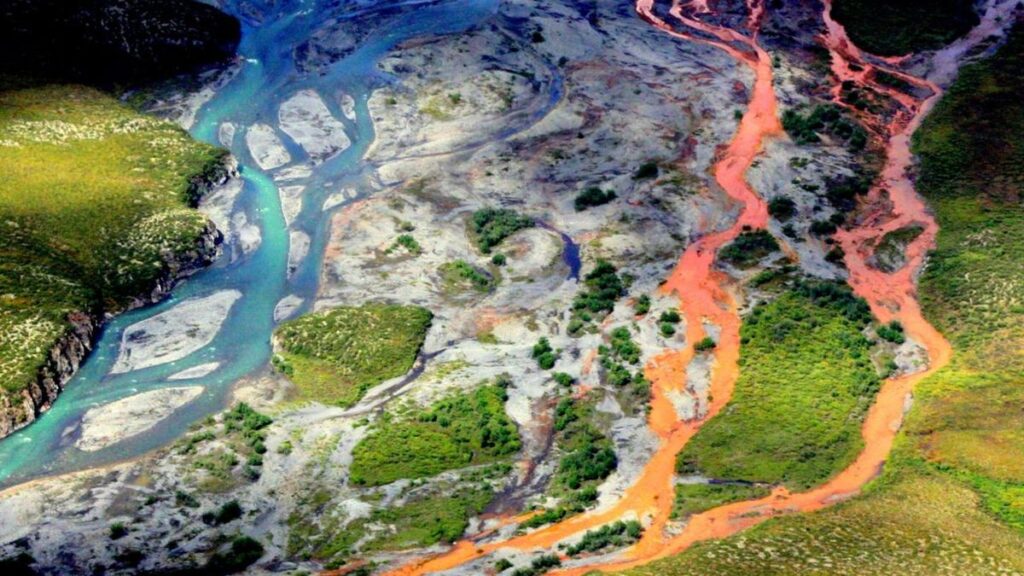
The swiftly melting permafrost of the Arctic is releasing toxic metals like zinc, cadmium, and iron into Alaskan waterways. The contaminant levels are so high that it’s staining many rivers orange — a feature that can be seen from space. A new study identified at least 75 affected rivers in the Brooks mountain range.
In addition to staining the rivers, these metals make the water acidic, with some waterways reaching a pH as low as 2.3, similar to the acidity of vinegar. The combination is deadly to aquatic life in the rivers, and the acidity, unfortunately, will accelerate the dissolution of rocks that can release even more metals into the water. (Image credit: K. Hill/National Park Service; research credit: J. O’Donnell et al.; via LiveScience; submitted by Emily R.)

A contaminated portion of the Kutuk River runs orange alongside an uncontaminated portion of the same waterway. Helping Fish Bypass Hydro Power Dams


Many dams in the U.S. were built at a time when their ecological impact was not a major concern. But, thanks to ongoing efforts to study affected species and upgrade infrastructure, many dams now balance human energy needs with the needs of non-humans, like migratory fish populations. In this video, Grady from Practical Engineering takes us behind-the-scenes at McNary Dam in the Pacific Northwest, where special plans and equipment help adult fish swim upstream and juvenile fish pass downstream with as little impact as possible. It’s impressive just how widespread and thorough their infrastructure for letting fish and lampreys through is! There are even facilities to help naturalists track and study the populations passing through. (Video and image credit: Practical Engineering)