A calm, sunny day erupted into a thunderstorm off the coast of Scotland for photographer Brian Matthews. Turbulent clouds streak the sky, and a downpour on the left releases a stream of precipitation. Storms like these were once uncommon in the United Kingdom, but with increasingly hot weather due to climate change, more water vapor and more energy in the atmosphere create conditions for storms like these. (Image credit: B. Matthews; via Wildlife POTY)
Month: May 2024

How Venus Is Losing Its Water
Since Venus formed at the same time as Earth and is similar in size, scientists believe it once had the same amount of water our planet does. Today, hellish Venus has hardly any water, a fact scientists have struggled to explain completely. Most of its water was lost long ago, as incoming particles from the solar wind stripped water from the upper atmosphere; unlike Earth, Venus doesn’t enjoy the protection of a magnetic field.
But that mechanism doesn’t explain just how arid Venus is now. A new study instead suggests that Venus’s water loss is ongoing, driven by simple chemical reactions. The team found that molecules of HCO+ (an ion made from one hydrogen, one carbon, and one oxygen atom) could mix with any remaining water to form a positively-charged molecule. Due to that charge, the chemical easily attracts loose electrons. Once combined, however, the resulting molecule is too energetic and breaks apart; when it does so, it releases highly-energetic hydrogen, which escapes the atmosphere into space. Without that hydrogen, water molecules can’t reform. This process of dissociative recombination could explain why the rest of Venus’s water has disappeared.
Science missions that have flown to Venus so far haven’t been equipped to measure HCO+, and the authors recommend this as a priority for future missions to our neighbor. With that data, we could confirm or disprove this mechanism for Venusian water loss. (Image credit: NASA; research credit: M. Chaffin et al.; via Gizmodo)

A Comet’s Tail
A comet‘s tail changes from day-to-day depending on how much material the comet is losing and how strong the solar wind it’s facing is. This image sequence shows Comet 12P/Pons-Brooks over nine days in 2024 from March 6th (top) through March 14th (bottom). The variations in the comet’s appearance are striking; some days show nearly no tail while others have long plumes with swirls of turbulence. It’s a reminder that, even if they appear unchanging in the moment you see one, a comet is in constant flux. (Image credit: Shengyu Li & Shaining; via APOD)

Saving Screens with Shear-Thinning Fluids
These days glass screens travel with us everywhere, and they can take some big hits on the way. Manufacturers have made tougher glass, but they continue to look for ways to protect our screens. Recently, a study suggested that non-Newtonian fluids are well-suited to the task.
The team explored the physics of sandwiching a layer of fluid between a glass top layer and an LCD screen bottom layer, mimicking structures found in electronic devices. Through simulation, they searched for the fluid characteristics that would best minimize the forces felt by the solid layers during an impact. They found that shear-thinning fluids — fluids that, like paint or shampoo, get runnier when they’re deformed — provided the best protection. Having the impact energy go into reducing the local viscosity of the fluid stretches the length of time the impact affects the glass, which lowers the bending forces on it and helps avoid breakage. (Image credit: G. Rosenke; research credit: J. Richards et al.; via Physics World)

How We Got Atoms From Brownian Motion


In 1827, botanist Robert Brown observed an odd jittery motion of particles as he watched grains of pollen floating in water under his microscope. He saw the random motion also with inorganic — which is to say definitely Not Alive — particles as well. But it was Einstein nearly 80 years later who figured out how to connect this observable motion to atoms. Einstein realized Brown’s particles were being constantly jostled by atomic collisions, and, with a little work, we could use those moving particles to determine Avogadro’s number. Steve Mould walks you through the whole story in this video. (Video and image credit: S. Mould)

“Dew Point” Deposits Droplets
Artist Lily Clark loves to work in water. One of her recent sculptures, “Dew Point,” uses superhydrophobic ceramic to grow and manipulate water droplets over and over and over. Droplets coalesce in four corners until they grow large enough for gravity to pull them into a circular depression. Given their limited contact with the ceramic, the falling water droplets zip and slide on their way to a return slit in the center of the piece. You can see more of the action in the video below. Personally, I’m reminded of coins falling into a collection box! (Video credit: L. Turczan; artwork by: L. Clark; via Colossal)

“Running on Water”
In the early morning light, young photographer Max Wood captured this coot escaping a fight. With wings flapping, the bird runs across the water surface. Each slap and stroke of a foot provides a portion of the vertical force needed to stay atop the water; lift from its wings provides the rest. With enough speed, the bird will take off. Some birds, however, are born water-walkers; certain species of grebe don’t need to use their wings to run on water. (Image credit: M. Wood; via BWPA)

Our Sun’s Corona Unfurled
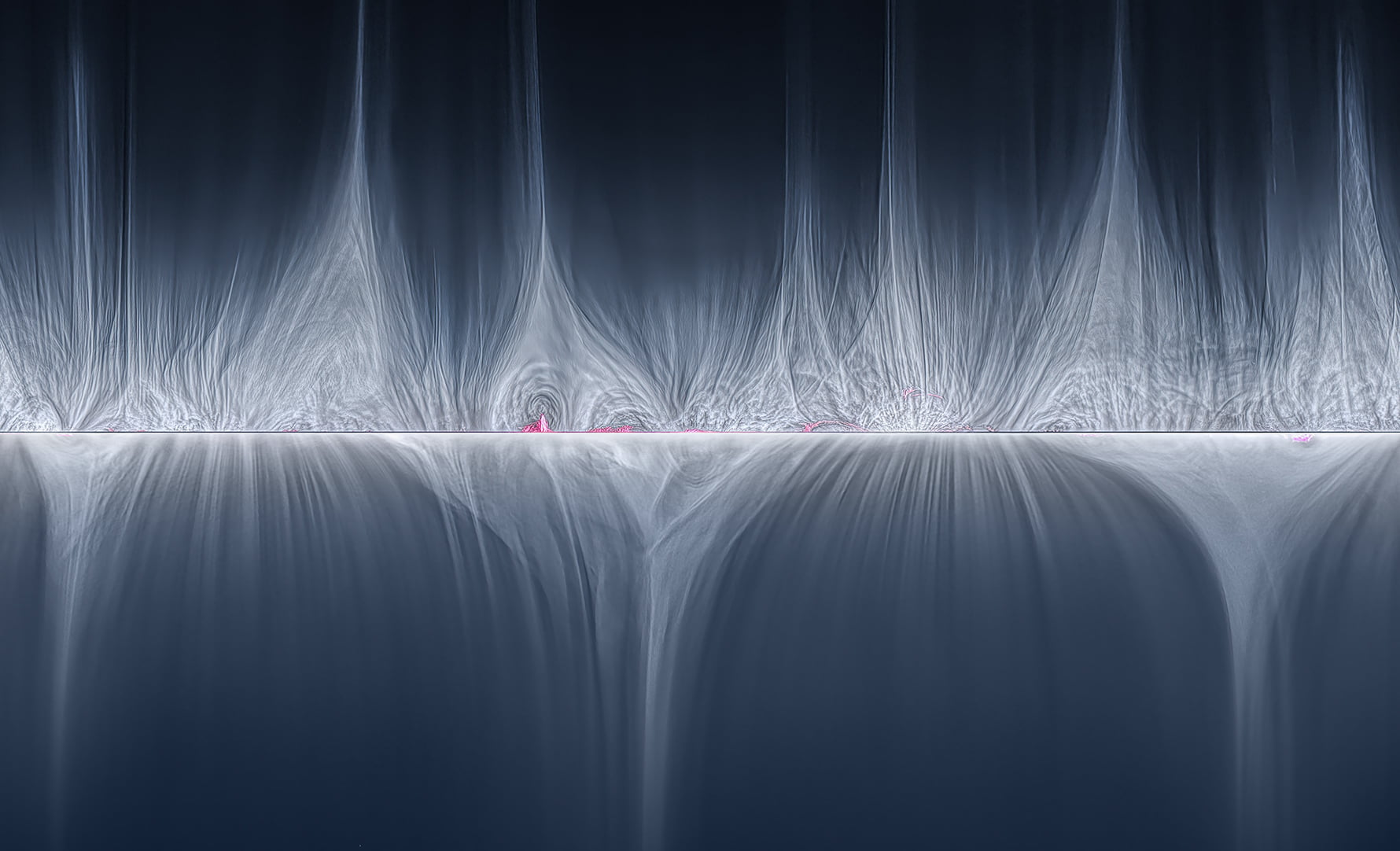
This clever image is actually two solar eclipses stacked atop one another. The bottom half of the image shows the sun‘s corona — its wispy, dramatic outer atmosphere — during the a 2017 total solar eclipse, and top half shows a 2023 total solar eclipse. In both, the corona has been unwrapped from around the sun’s circumference and project instead into a rectangle.
The 2017 eclipse took place near the minimum of the sun’s solar cycle and appears relatively tranquil. The 2023 eclipse, in contrast, came near solar cycle’s maximum and shows a far more chaotic and turbulent environment. Notice the bright pink solar prominences dotting the mid-line and the field of shadowy plasma loops above them. (Image credit: P. Ward; via APOD)

Microfluidics in Medicine
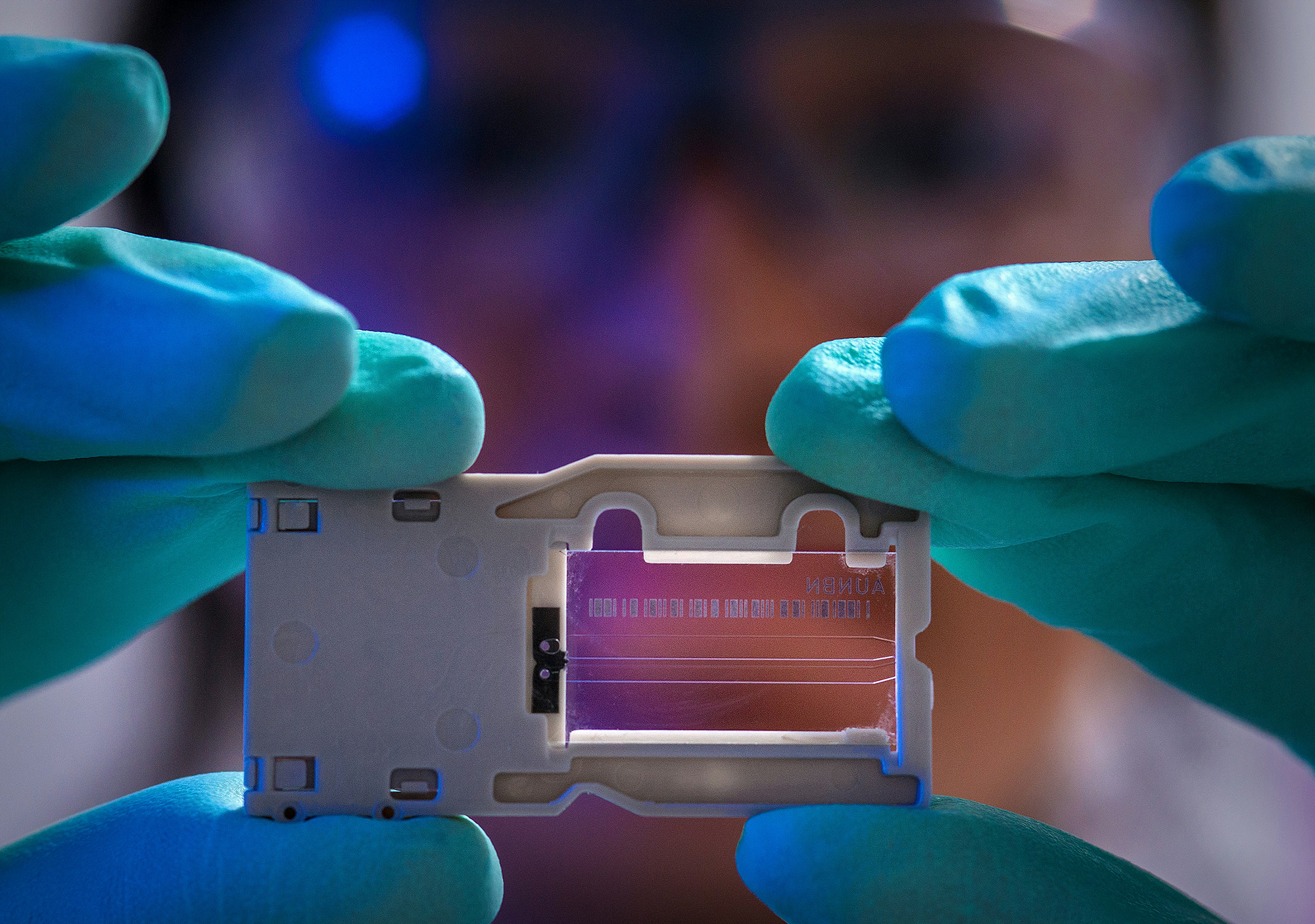
In the late 1990s and early 2000s, the Human Genome Project spent years decoding DNA from a handful of donors. The work was painstaking and slow, given DNA sequencing technology of the time. Today the same analysis goes much faster (and is much cheaper), thanks largely to microfluidic devices that automate steps that once had to be done by hand. Microfluidic devices have also made their way into medical diagnostics — pregnancy tests, at-home COVID tests, and blood glucose strips used by diabetics are common examples — as well as experimental biology. The Scientists has a nice review covering some of the many ways these devices have revolutionized the field. (Image credit: CDC; see also The Scientist; submitted by Marc A.)
Exciting a Flame in a Trough


A viewer sent Steve Mould his accidental discovery of this odd flame behavior. In these 3D-printed troughs, a flame lit in lighter fluid will rocket around the track repeatedly as it burns the local supply of gaseous lighter fluid. As Steve shows in his video, this system is an excitable medium and the trick works for a whole array of 3D-printed shapes. Check out the full video above. (Video and image credit: S. Mould)