If you stand on a bridge and watch the current flow past pylons below, you’ll see disturbances marking the wakes. Dragging a rod – or an oar – at a high enough speed through the water creates something similar: a wavy cavity in the fluid surface that surfs along behind the rod. The faster you pull the rod, the harder you’ll have to work, until that wake becomes so turbulent that it begins entraining air bubbles, like the tiny ones seen above. Once entrainment starts, the drag coefficient drops somewhat, presumably due to changes in the pressure distribution around the rod. The characteristics of air entrainment change with object size as well. Larger rods can entrain air through the cavity and not just in the wake. (Image and research credit: V. Ageorges et al.)
Month: July 2019

The Snowy Salt of the Dead Sea
At nearly 10 times saltier than the ocean, the Dead Sea is one of the saltiest places on Earth, and since 1979, scientists have observed it growing even saltier as snow-like salt precipitates to the bottom of the lake. Numerical simulations have now confirmed that this salt-fall is the result of double-diffusive salt fingers.
Here’s how the mechanism works: the upper layer of the lake is made up of warmer, saltier water covering deeper, colder waters. As the sun evaporates water near the surface, what’s left behind becomes saltier and heavier. Tiny pockets of this warm, salty water sink into colder regions and rapidly cool. The heat can move a lot more quickly than the salt, though, and since cold water cannot hold as much salt as warmer water, some of the salt precipitates out. That forms the falling crystals scientists observe sinking to the bottom of the lake. (Image and research credit: R. Ouillon et al., source; via Physics World; submitted by Kam-Yung Soh)

Superwalkers
Walking droplets – drops that bounce their way across a pool of the same liquid without coalescing – have fascinated researchers in recent years with their unusual behaviors, some of which mimic quantum phenomena. In a new experiment, researchers vibrate the pool at two frequencies simultaneously, which helps support much larger droplets, known as superwalkers. When the two driving frequencies are close to a harmonic match – like at 80 Hz and just under half that at 39.5 Hz – the droplets will walk, then come to a stop, and then begin walking again. (Image and research credit: R. Valani et al.; via APS Physics; submitted by Justin B and Kam-Yung Soh)

Dissolving Pills

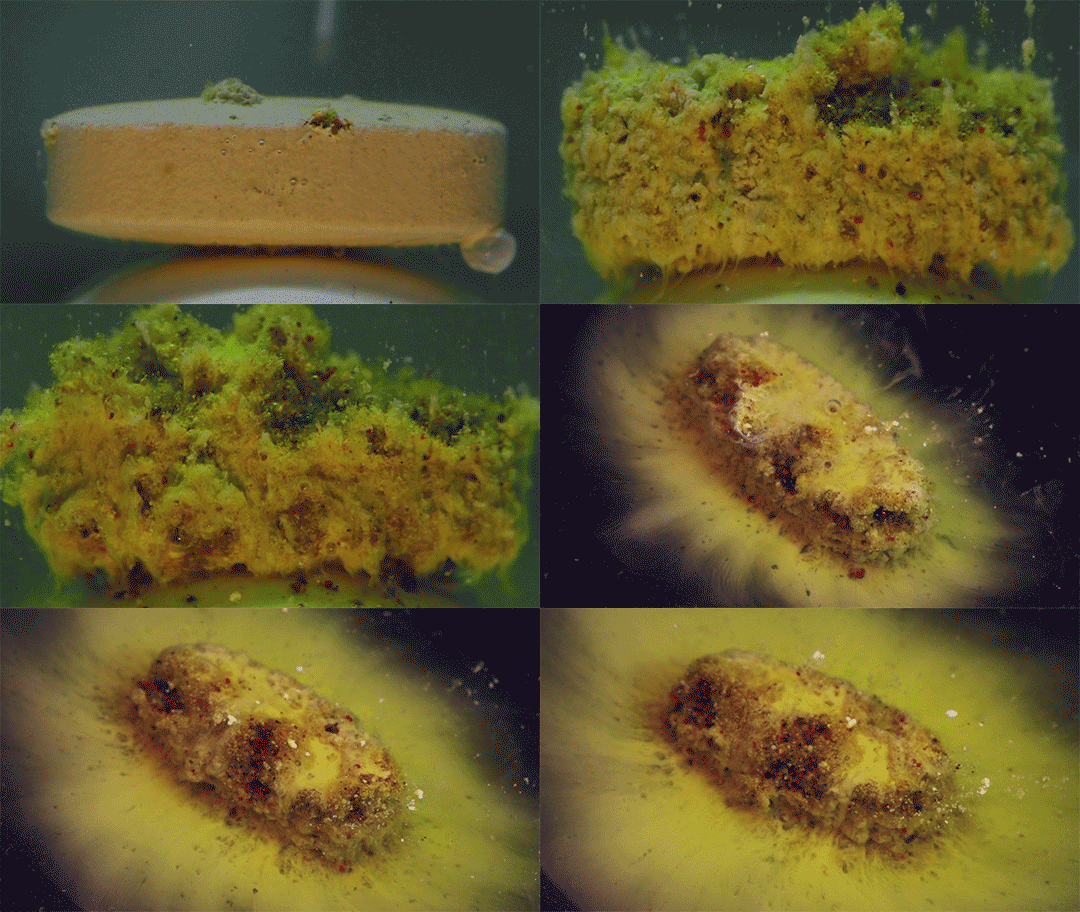


This short film from Macro Room shows how pills dissolve in timelapse. Dissolution is a complex process driven both by flow and chemical concentration. Any small motion in the water helps erode the surface, and as the chemicals dissolve, the subsequent variations in the concentration drive additional flow. This is why we often see a turning point in how quickly the pills come apart. The initial breakdown is slow, but once enough of the pill dissolves, it enhances the surrounding flow, which increases erosion. Notice how many of the pills – liquid-filled capsules, especially – have a point where fluid begins streaming away from them. Unlike the capsules, the solid pills seem to get an extra boost from bubbles that form and then pull away material. (Image and video credit: Macro Room; submitted by clogwog)

Jets from Lasers
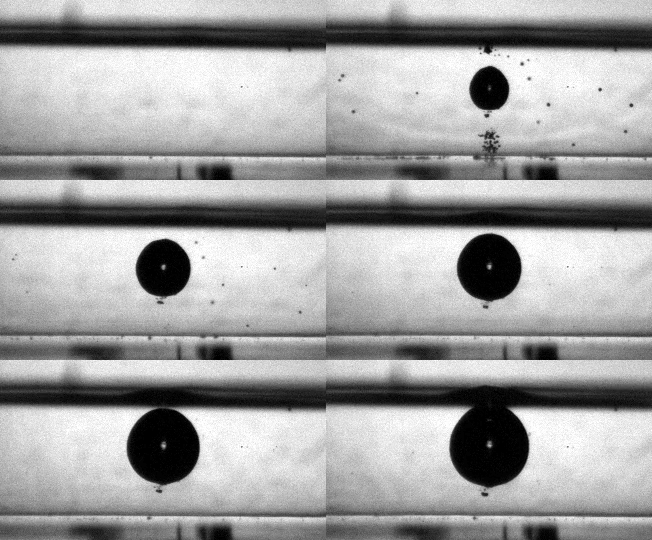
Laser-induced forward transfer (LIFT) is an industrial printing technique where a laser pulse aimed at a thin layer of ink creates a tiny jet that deposits the ink on a surface. In practice, the technique is plagued with reproducibility issues, in part because it’s difficult to produce only a single cavitation bubble when aiming a laser at the liquid layer. This is what we see above.
The laser pulse creates its initial bubble just above the middle of the liquid layer. Shock waves expand from that first bubble and quickly reflect off the liquid surface (top) and wall (bottom). When reflected, the shock waves become rarefaction waves, which reduce the pressure rather than increasing it. This helps trigger the clouds of tiny bubbles we see above and below the main bubble.
The effect is worst along the path of the laser pulse because that part of the liquid has been weakened by pre-heating, but impurities and dissolved gases in the liquid layer are also prone to bubble formation, as seen far from the bubble. The trouble with all these unintended bubbles is that they can easily rise to the surface, burst, and cause additional jets of ink that splatter where users don’t intend. (Image and research credit: M. Jalaal et al.; submitted by Maziyar J.)

Avoiding Droplet Contact
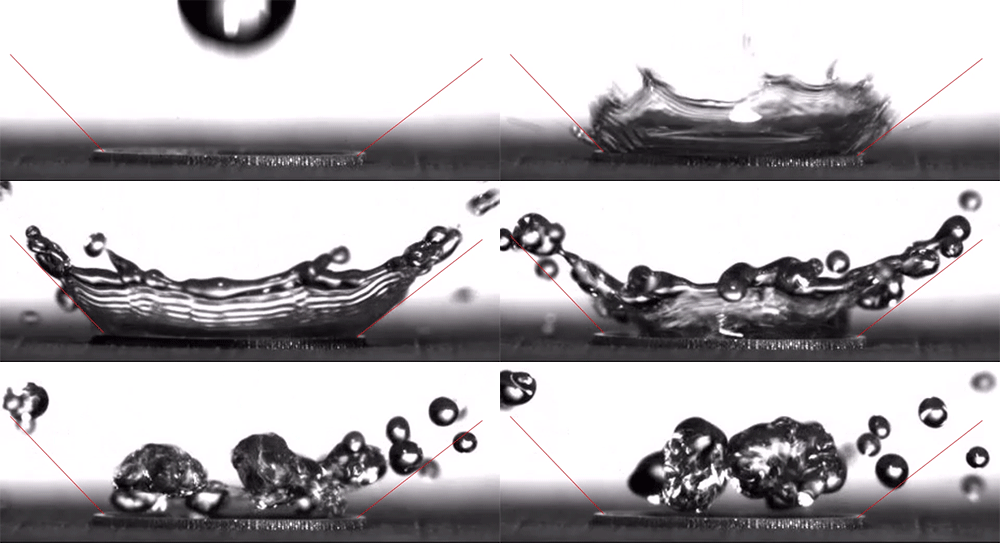
Cold rain splashing on airplane wings can freeze in instants. To prevent that, researchers look for ways to minimize the time and area of contact a drop has. Hydrophobic coatings and textures can do some of the work, but they are easily damaged and don’t always work well when it comes to freezing.
The new technique shown here uses ring-shaped “waterbowls” to help deflect drops. As the drop impacts and spreads, the walls of the ring texture force the lamella up and off the surface. This reduces both the time and area of contact and, under the right circumstances, cuts the heat transfer between the fluid and surface in half. The technique is useful for more than just preventing freezing, though; it would also be helpful for waterproofing breathable fabrics, where shedding moisture quickly without clogging pores is key to keeping the wearer dry. (Image and research credit: H. Girard et al.; via MIT News and Gizmodo)
Understanding Meteorite Geometry
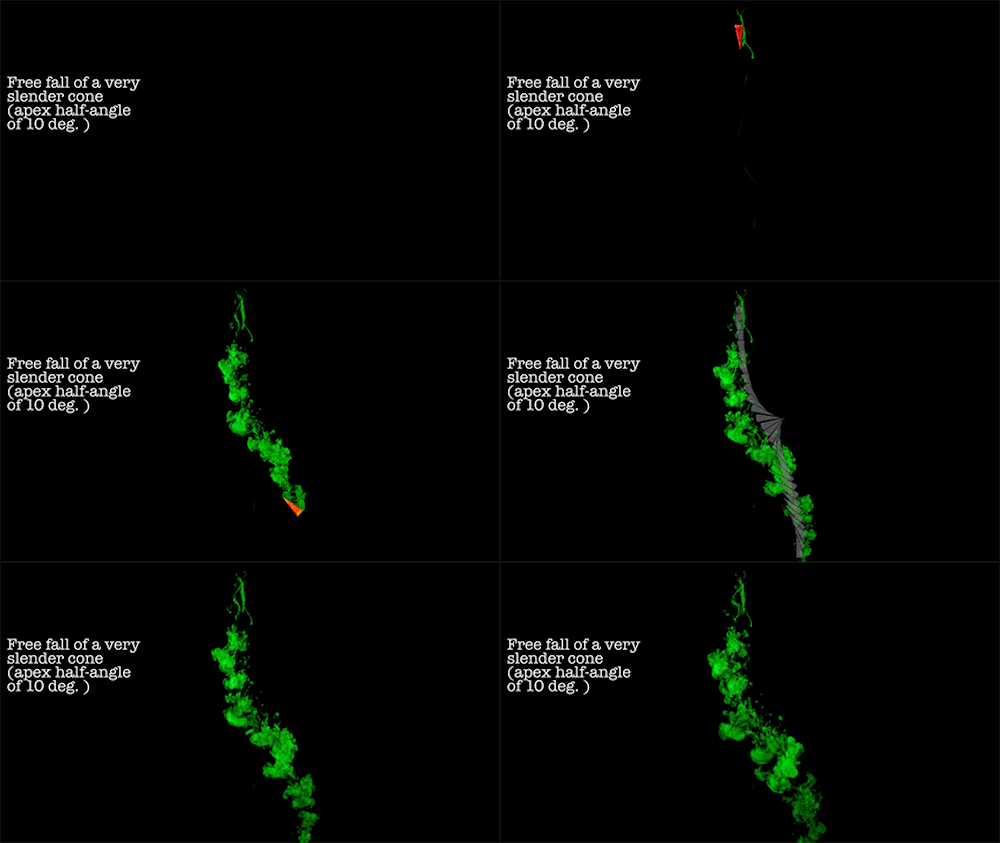
Back in February 2013, the skies over Russia were lit by the fall and explosion of a large meteor. The scavenger hunt for meteorite pieces that followed turned up lots of conically-shaped chunks of rock, consistent with other meteors. Why do so many meteorites end up in this shape? There are a couple factors influencing it.
The first is that erosion during flight tends to shape initially spherical meteor chunks into broad cones. And that shape, it turns out, is remarkably stable in flight. By dropping cones of various geometries, researchers can test how stable they are in flight: do they change orientation, flutter back and forth, or drop straight down? Slender cones (below) tend to invert and tumble. Very broad cones flutter back and forth as they fall. But for an intermediate cone angle – similar to the one found in meteorites – the cones stay perfectly oriented, so once the rock erodes into that cone, it will keep that shape. (Image and video credit: K. Amin et al.)

Phytoplankton Swirls
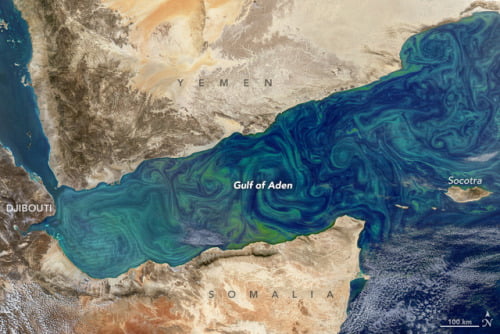
A winter bloom of phytoplankton appears as green and teal swirls in this false-color satellite image of the Gulf of Aden. Although phytoplankton can be an important food source for fish and other marine animals, in recent years we’ve observed more frequent toxic blooms. Currently, physical sampling of the phytoplankton is necessary to determine what type they are, but scientists are working to use multi-spectral imaging to identify different species remotely. As harmful as they can be, blooms like these help visualize the flow and mixing in different coastal regions. Here, for example, we can see distinctive turbulent eddies in the Gulf that are tens of kilometers across. (Image credit: N. Kuring/NASA; via NASA Earth Observatory)

Seeing the Song
We can’t always see the flows around us, but that doesn’t mean they’re not there. Audobon Photography Award winner Kathrin Swaboda waited for a cold morning to catch this spectacular photo of a red-winged blackbird’s song. In the morning chill, moisture from the bird’s breath condensed inside the vortex rings it emitted, giving us a glimpse of its sound. (Image credit: K. Swaboda; via Gizmodo; submitted by Joseph S and Stuart H)
Catching Fire
Citrus fruits like oranges house tiny pockets of oil in their peels. When squeezed, the oils jet out in tiny micro-jets that are about the width of a human hair. Despite their small size, the jets reach speeds of about 30 m/s and quickly break into a stream of droplets. When exposed to the flame of a lighter, like in the animation above, those microdroplets combust easily, creating a momentary fireball used to augment some cocktails. For more on how the citrus peel generates these jets, check out this previous post. (Image credit: Warped Perception, source; research credit: N. Smith et al.)