It’s time for another look at breaking fluid dynamics research with the latest FYFD/JFM video! This time around, we tackle some geophysical fluid dynamics, like listening to the sounds newborn tornadoes make below the range of human hearing; studying how melting ice affects burning oil spills; and how salt sinking from sea ice affects the ocean circulation. Check out the full video below for much more! If you’ve missed any of the previous videos in the series, you can check them out here. (Image and video credit: T. Crawford and N. Sharp)
Month: July 2018

Manipulating Droplets Remotely
Using acoustic levitation and an array of carefully-placed speakers, researchers can manipulate droplets without touching them. This lets scientists study the physics of droplet coalescence (top) without interference from solid surfaces, but it also provides opportunities for mixing two different substances in the final droplet.
On the bottom left, we see a droplet formed from the coalescence of a dyed droplet (visible as gray) and an undyed droplet. The swirling and mixing in the levitating droplet is fairly slow. By contrast, the droplet on the right is vibrated by manipulating the sound waves holding it aloft. This mixes the droplet quite efficiently, allowing it to reach a uniform state more than six times faster than the other droplet. (Image and research credit: A. Watanabe et al., source)

The Swimming of a Dead Fish
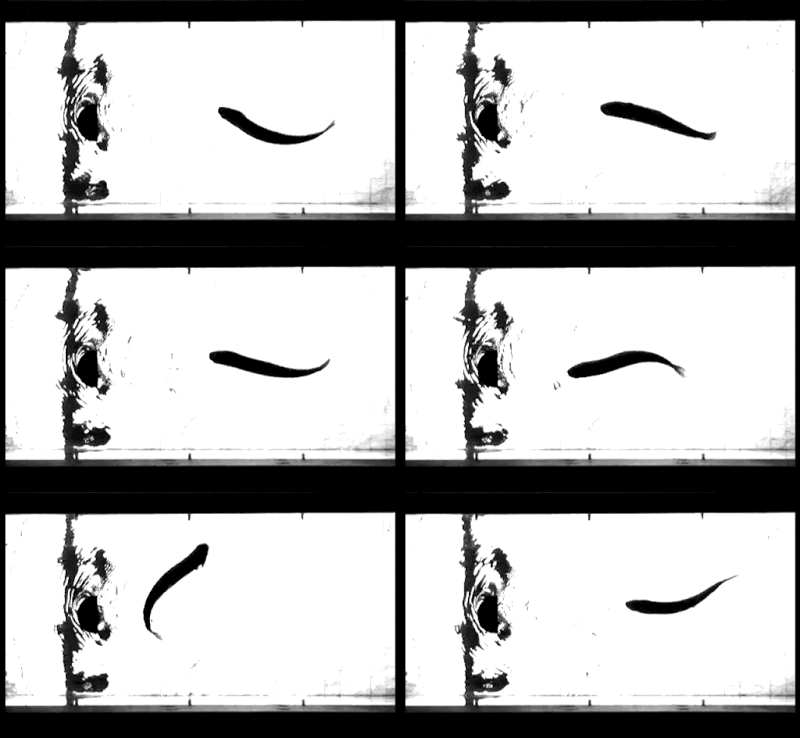
When I was a child, my father would take me trout fishing, and I spent hours marveling from the riverbank at the trouts’ ability to, seemingly effortlessly, hold their position in the fast-moving water. As it turns out, those trout really were swimming effortlessly, in a manner demonstrated above. The fish you see here swimming behind the obstacle is dead. There’s nothing powering it, except the energy its flexible body can extract from the flow around it.
The obstacle sheds a wake of alternating vortices into the flow, and when the fish is properly positioned in that wake, the vortices themselves flex the fish’s body such that its head and its tail point in different directions. Under just the right conditions, there’s actually a resonance between the vortices and the fish’s body that generates enough thrust to overcome the fish’s drag. This means the fish can actually swim upstream without expending any energy of its own! The researchers came across this entirely by accident, and one of the questions that remains is how the trout is able to sense its surroundings well enough to intentionally take advantage of the effect. (Image and research credit: D. Beal et al.; via PhysicsBuzz; submitted by Kam-Yung Soh)

Meteoroids
Meteoroids are debris from earlier eras in our solar system. They can be leftovers from planets that never formed or remains of ancient collisions. When these bits rock and metal enter our atmosphere, they become meteors. Since they travel at speeds of several kilometers per second, they create incredibly strong shock waves off their bow once they’re in the atmosphere. These shock waves are so strong that they rip the air molecules apart and create a hot plasma that can scorch the outside of the meteor. That plasma also glows, which is why meteors look like a streak of light from the ground. Any remains that make it to the ground are known as meteorites, and they have some pretty awesome features. Check out the full Brain Scoop episode below to learn some of the typical (and not so typical!) characteristics of meteorites. (Image and video credit: The Brain Scoop/Field Museum)

The Telstar 18
Every four years, Adidas creates a newly designed ball for the World Cup. This year’s version is the Telstar 18, which features six glued panels (no stitching!) with a slightly raised texture. That subtle roughness is an important feature for the ball’s aerodynamics. It helps ensure that flow around the ball will become turbulent at relatively low speeds. Some previous designs, notably the 2010 Jabulani, were so smooth that flow near the ball would not become turbulent until much higher speeds. In fact, one side of the ball might have laminar flow while the other was turbulent, causing the ball to wobble and misbehave. To learn more about World Cup aerodynamics and the importance of a little surface roughness to the ball’s behavior, check out the Physics Girl video below. (Image credit: Adidas; via APS News; video credit: Physics Girl)

The Fluid Dynamical Sewing Machine
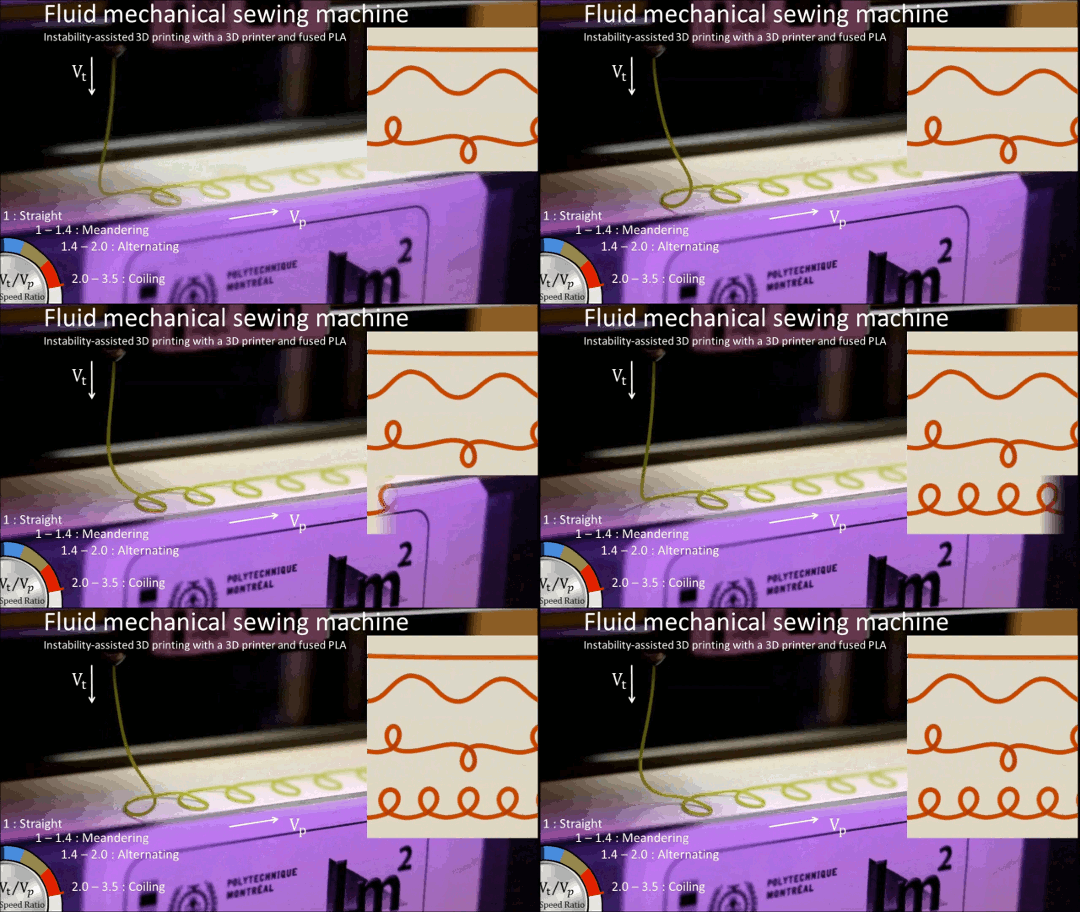
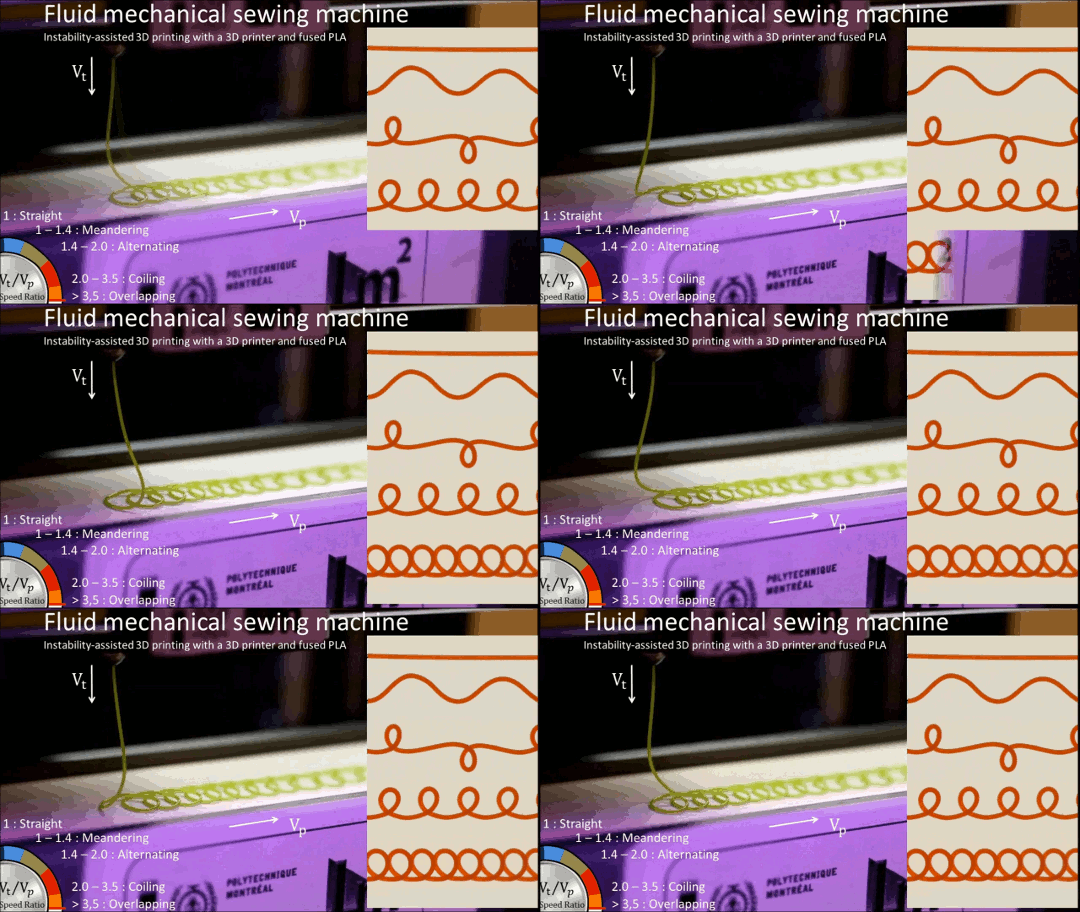
If you’ve drizzled viscous liquids like honey or syrup, you’ve no doubt witnessed their ability to coil. Combine that coiling with a moving platform and you form a system known as the fluid dynamical sewing machine, which creates different consistent patterns of loops and curves depending on the speed at which the liquid falls and the velocity of the moving platform. The predictability of these patterns makes them especially useful for 3D printing. Previously a group at MIT developed a glass printer that could use the instability, and here a group from Montreal demonstrates how they can build solid coils at various scales. Their video also explores what the structural properties of such coils are after they solidify. (Image, video, and research credit: R. Passieux et al.)

Spinning Droplet Galaxies
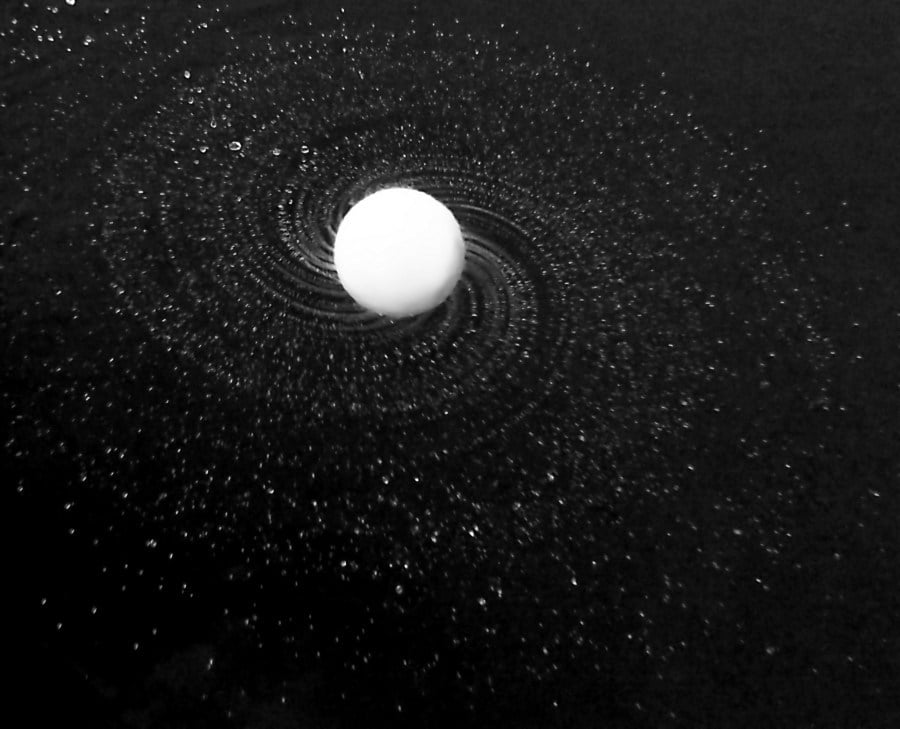
Water flung from a spinning tennis ball takes on a shape reminiscent of a spiral galaxy. As it detaches, water leaves the surface with both the tangential velocity of the spinning ball and a radial velocity due to the centrifugal force flinging it. The continued spin of the ball makes the thin ligaments of water still attached to it spiral and stretch. Eventually, surface tension can no longer hold the water together against the centrifugal forces, and the ligaments split into a spray of droplets. (Image credit: W. Derryberry and K. Tierney)

Flying Backwards
Spend a summer afternoon floating in a kayak and chances are you’ll see some impressive aerial acrobatics from dragonflies. One of the dragonfly’s superpowers is its ability to fly backwards, which helps it evade predators and take-off from almost any orientation. To do this, the dragonfly rotates its body so that it is nearly vertical, thereby changing the direction it generates lift. In engineering terms, this is “force-vectoring,” similar to the techniques used by helicopters and vertical-take-off jets.
Scientists found that backwards-flying dragonflies could generate forces two to three times their body weight, in part due to the strong leading-edge vortices (bottom image) formed on the forewings. They also found that the hind wings are timed so that their lift is enhanced by catching the trailing vortex of the first pair of wings. Engineers hope to use what they’re learning from insect flight to build more capable flying robots. (Image and research credit: A. Bode-Oke et al., source; via Science)

Craters and Rays
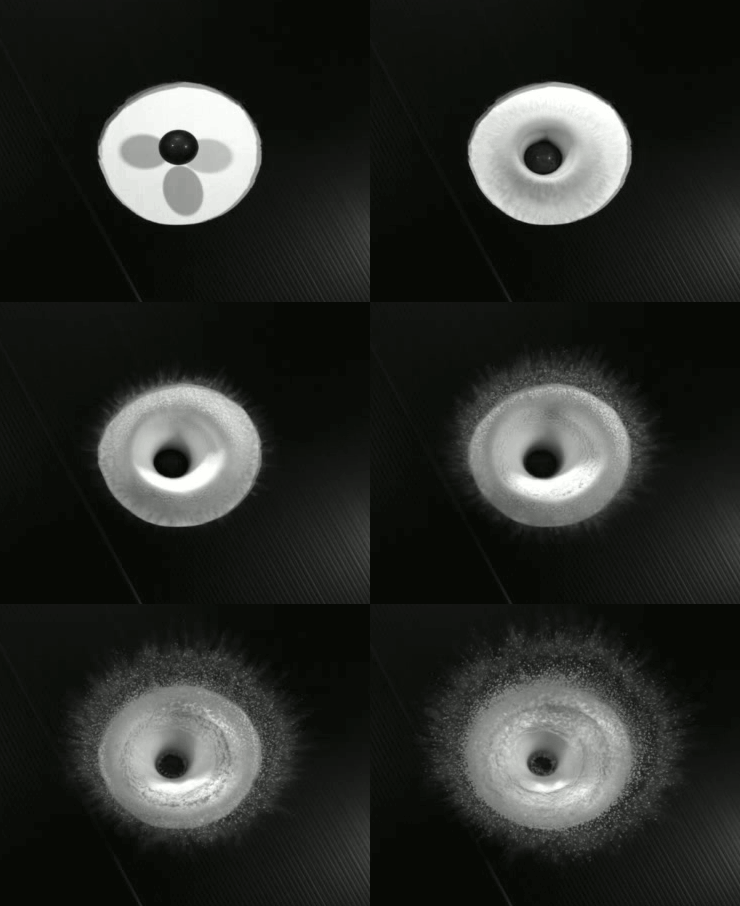
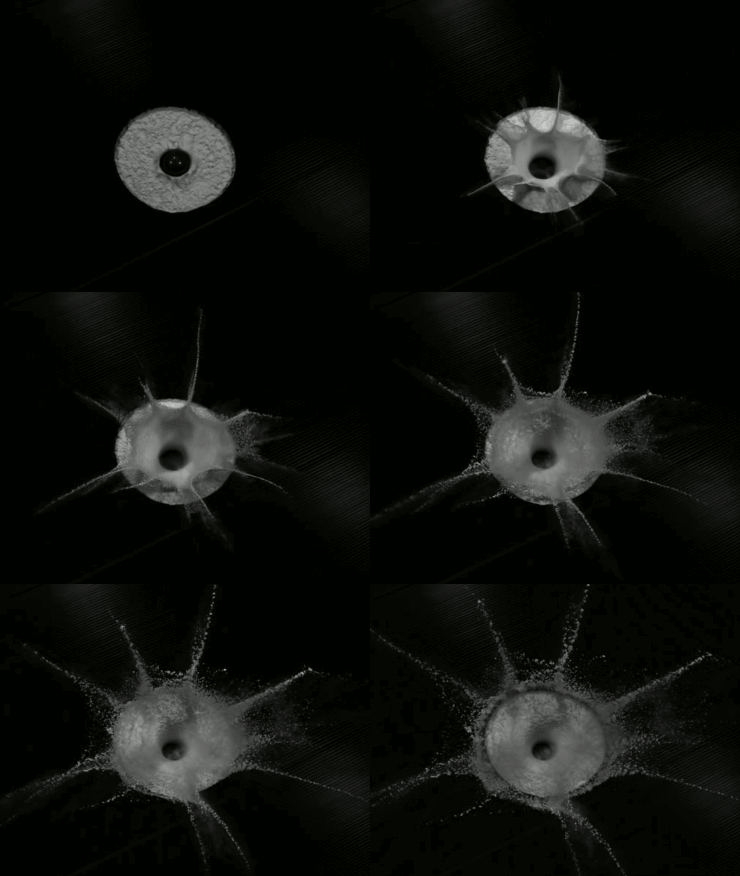
The history of our solar system is written in impact craters, but these craters have been remarkably mysterious for years. Scientists knew that you could recreate many of their features by dropping solid objects into granular materials like sand, but this did not produce the distinctive rays that we see around many real craters (bottom image, Mars). It was only by watching videos of schoolchildren recreating these experiments that scientists discovered what they’d been doing wrong: they’d smoothed the sand’s surface first.
It turns out that when you smooth the sand before impact (top left), you get an even ejecta curtain with no rays. But when the surface is uneven, as it is in kids’ experiments or on actual planetary bodies, suddenly rays form (top right). The object’s impact creates a shock wave in the granular medium, which becomes a rarefaction (i.e., expansion) wave when it reaches the surface. This is what actually ejects material. The uneven surface focuses those rarefaction waves, creating the distinctive ejecta rays. (Image credit: T. Sabawala et al., source; NASA; research credit: T. Sabawala et al.; via Jennifer O.)
Lava Balls
The continuing eruption of Kilauea is revealing phenomena rarely seen by those of us who are not volcanologists. One of the most surreal examples so far is colloquially known as a “lava boat,” seen above floating its way down a river of lava emanating from Fissure #8. The more technically accurate term is “accretionary lava ball,” but the colloquialism seems rather fitting, as long as this partially-solidified chunk of lava is still floating down the channel.
These lava balls form in a’a lava channels, which tend to be faster-moving and more turbulent. As chunks of lava solidify in the channel, they roll and gather more material, allowing them to get larger and larger. When broken open, the lava balls usually have a spiral interior as a result of this rolling formation. It’s essentially the lava equivalent of making a snowball. (Video credit: I. Marzo via M. Lincoln; via Ryan A.)